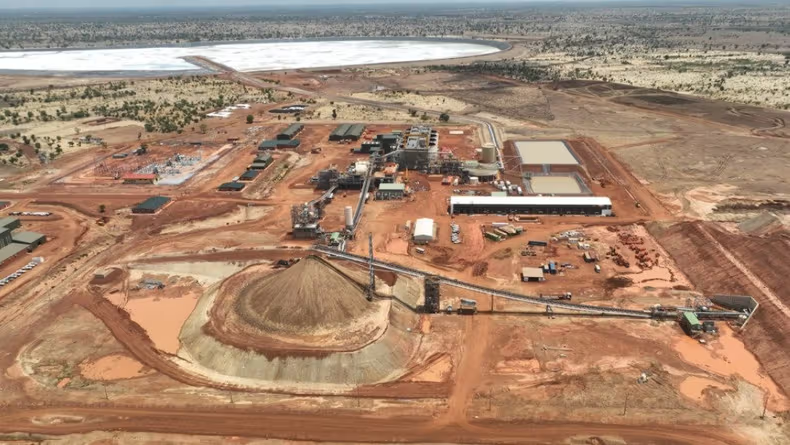
Kenya’s decision to open a competitive international tender for the development of the mineral-rich Mrima Hill in Kwale County marks a turning point in the country’s economic and strategic trajectory. Valued at approximately $62.4 billion, the site holds vast deposits of niobium and rare earth elements that are essential to modern industry, including clean energy systems, advanced electronics, and defense technologies. By inviting global investors to participate under a transparent and rules-based framework, Nairobi is not only seeking to unlock dormant geological wealth but also to reposition itself within a rapidly evolving global minerals economy where control over supply chains is becoming a defining feature of geopolitical power.
At the core of this initiative is a deliberate shift away from traditional extractive models toward a more structured and value-driven approach to resource development. The government’s insistence that bidders demonstrate both technical capability and financial strength, alongside concrete plans for local processing and sustainable operations, signals a policy recalibration aimed at ensuring that Kenya captures a larger share of the value chain. This approach reflects lessons drawn from decades of underperformance in the mining sector and aligns with a broader continental trend in which resource-rich countries are tightening regulatory frameworks to prioritize beneficiation, domestic participation, and long-term economic returns.
The economic implications of the Mrima Hill project are substantial and multidimensional. Beyond the immediate attraction of foreign direct investment, the development of the site has the potential to catalyze industrial expansion across several interconnected sectors. Mining operations would naturally anchor the initial phase, but the real transformative impact lies in downstream processing, where refining and separation of rare earth elements could give rise to new manufacturing capabilities. These capabilities could, in turn, support the growth of industries linked to electric mobility, renewable energy technologies, and high-value electronics, effectively integrating Kenya into global production networks that have historically been concentrated in a few countries.
This industrial expansion is likely to generate significant spillover effects across the domestic economy. Local suppliers and small and medium enterprises stand to benefit from increased demand for goods and services ranging from logistics and equipment maintenance to environmental management and construction. The emphasis on local content within the tender framework creates opportunities for Kenyan firms to participate more meaningfully in the value chain, while also fostering entrepreneurship, particularly among the youth. Employment creation is expected not only in direct mining activities but also across ancillary industries, contributing to broader socio-economic development and income diversification.
The geopolitical dimension of the Mrima Hill tender is equally significant, as it places Kenya at the intersection of a growing global contest for critical minerals. Interest from the United States and China underscores the strategic importance of rare earth elements, which are vital inputs in technologies that underpin both economic competitiveness and national security. China’s longstanding dominance in rare earth processing contrasts with Western efforts to secure alternative supply sources, creating a competitive environment in which Kenya can leverage its resource endowment to negotiate favorable terms. This dynamic enhances Nairobi’s bargaining power and provides an opportunity to secure not only capital but also technology transfer and industrial partnerships that support domestic capability building.
Regionally, the project has the potential to reinforce Kenya’s position as a key economic hub within East Africa. By developing processing capacity and strengthening export infrastructure, the country could serve as a gateway for mineral-based trade within the East African Community and the broader African Continental Free Trade Area. This would support efforts to deepen regional integration and expand intra-African trade, particularly in value-added products. In this context, Mrima Hill is not just a national asset but a strategic resource that could anchor regional industrialization and enhance Africa’s collective participation in global supply chains.
The initiative also aligns closely with Kenya’s long-term development frameworks, including Vision 2030 and broader industrialization priorities that emphasize manufacturing, infrastructure development, and value addition. By linking mineral extraction to industrial growth, the government is attempting to create a more diversified and resilient economic structure. The requirement for investors to incorporate sustainable practices further reflects an awareness of the need to balance economic ambitions with environmental stewardship, particularly given the ecological and cultural sensitivity of the Mrima Hill area.
At the same time, the project presents complex socio-economic and environmental challenges that will require careful management. The site’s status as both a protected forest and a culturally significant area for local communities introduces potential tensions around land use, conservation, and heritage preservation. Addressing these concerns through inclusive engagement, equitable benefit-sharing, and robust environmental safeguards will be critical to ensuring that development proceeds in a manner that is both socially acceptable and sustainable. Failure to do so could undermine investor confidence and delay project implementation, highlighting the importance of governance in large-scale resource projects.
Ultimately, the success of the Mrima Hill tender will depend on the government’s ability to translate policy ambition into practical outcomes. Transparent bidding processes, consistent regulatory enforcement, and effective oversight will be essential in attracting credible investors and ensuring that commitments to local value addition and sustainability are honored. If these conditions are met, the project could redefine Kenya’s role in the global economy, transforming it from a marginal player in the mining sector into a strategic hub for critical minerals and associated industries.
In a world where access to rare earth elements is increasingly tied to technological advancement and geopolitical influence, Kenya’s move to open Mrima Hill to global investors represents more than a commercial opportunity. It is a calculated step toward greater economic sovereignty, enhanced regional leadership, and a stronger voice in shaping the future of global supply chains.
Deputy President Kithure Kindiki has reaffirmed his unwavering commitment to supporting President William Ruto in delivering transformative development projects across the country, as he embarked on an extensive...
Read moreDetails