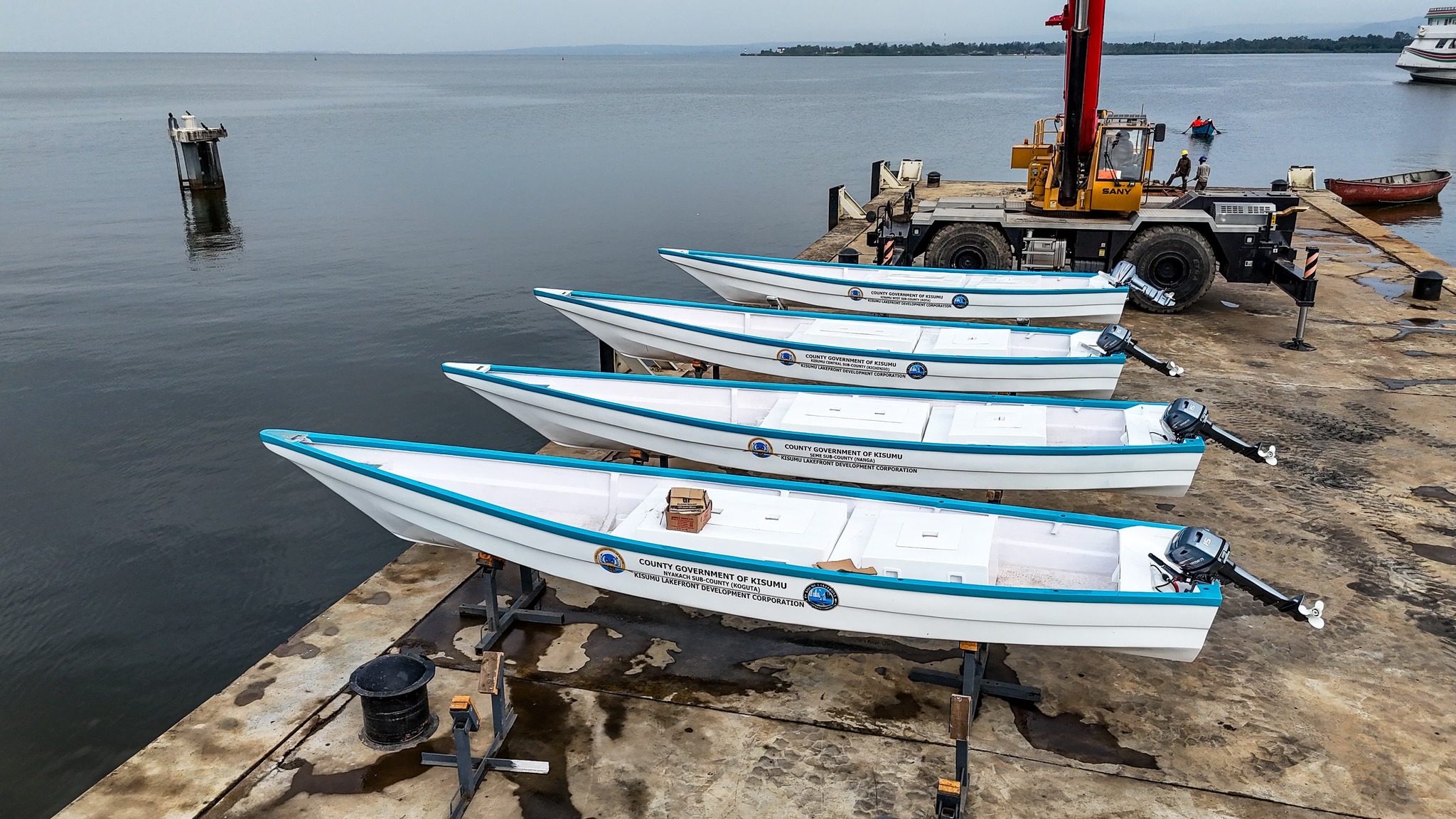
Kisumu County has received six modern fiberglass boats in a major step toward modernizing its fishing sector and enhancing safety on Lake Victoria. The vessels, built by Kenya Shipyards Limited (KSL), include five artisanal fishing boats and one patrol vessel. Governor Prof. Anyang’ Nyong’o officially announced their deployment, calling the initiative a vital intervention for improving livelihoods and strengthening the region’s blue economy.
The boats are part of a broader strategy by Kisumu County to phase out traditional softwood boats, which have long been associated with frequent accidents and loss of life on the lake. The use of fiber-reinforced vessels marks a significant shift toward safer, more durable, and climate-conscious alternatives. According to Governor Nyong’o, the new boats reflect the county’s commitment to ensuring that fisherfolk no longer have to risk their lives to earn a living.
Each fiberglass boat is fitted with 25 to 40 horsepower engines, life jackets, safety flares, and storage facilities including cooler boxes with a capacity of up to 500 kilograms. This technology is expected to reduce post-harvest fish losses, improve income for fishing communities, and raise the overall efficiency of lake transport. The upgraded boats will be distributed to five sub-counties: Kisumu Central, Seme, Kisumu West, Nyakach, and Kadibo.
The sixth vessel will serve as a patrol and surveillance unit under the Directorate of Fisheries. Its role will be to monitor lake activities, enforce safety standards, and curb illegal fishing practices. This is especially important in preserving Lake Victoria’s ecosystem and sustaining fish populations for future generations.
Governor Nyong’o praised the speed and quality of the boats delivered by Kenya Shipyards Limited, saying that Kisumu is now moving toward a new chapter defined by safer waters, empowered communities, and sustainable economic opportunities. He emphasized that this is not just a local project but a contribution to Kenya’s long-term blue economy development goals.
The delivery of the boats forms part of a larger maritime transformation agenda launched in February. The plan includes the construction of five modern fish landing sites at Kichinjio, Nanga, Rota, Koguta, and Nyamware beaches. These sites will improve safety, hygiene, and market access for fisherfolk by providing proper docking infrastructure, clean handling spaces, and cold storage support.
As part of the county’s blue economy roadmap, a fish processing plant is also planned for Kisumu. The facility will offer value addition services, storage, and processing solutions, allowing fishers to earn more while reducing waste. Once operational, the plant is expected to support local jobs, enhance food security, and unlock new export opportunities.
The benefits are not limited to the fishing sector. Kisumu is also developing a 46-kilometre lakefront promenade to connect major waterfront developments and create a vibrant corridor for tourism, commerce, and recreation. This integrated urban and economic planning approach is designed to attract investment and create a new identity for Kisumu as a regional hub for sustainable growth.
To coordinate these projects, the Kisumu Lakefront Development Corporation has been established. The agency is tasked with attracting investors, managing infrastructure development, and aligning public-private partnerships to ensure the success of the county’s blue economy initiatives.
Governor Nyong’o called on both local and international partners to support the county’s transformative vision, emphasizing that the time is right for Kisumu to emerge as a national leader in climate-smart economic development.
The short-term benefits of this initiative include safer fishing, improved fish quality, and higher earnings for fisherfolk. Over the long term, the project will help build resilience in the face of climate change, reduce pressure on forests by eliminating wooden boat production, and promote regional trade through better lake infrastructure.
Kenya’s focus on the blue economy is gaining traction, and Kisumu’s example shows how localized action can drive national development priorities. The lake region’s resources, if properly managed and supported by technology, could become central to Kenya’s strategy for inclusive, sustainable economic growth.
The deployment of the six boats is not only a milestone for Kisumu but a reflection of Kenya’s broader ambition to unlock the untapped potential of its freshwater assets. With consistent investment, good governance, and community involvement, Lake Victoria can become a cornerstone of the country’s economic transformation.
Deputy President Kithure Kindiki has reaffirmed his unwavering commitment to supporting President William Ruto in delivering transformative development projects across the country, as he embarked on an extensive...
Read moreDetails