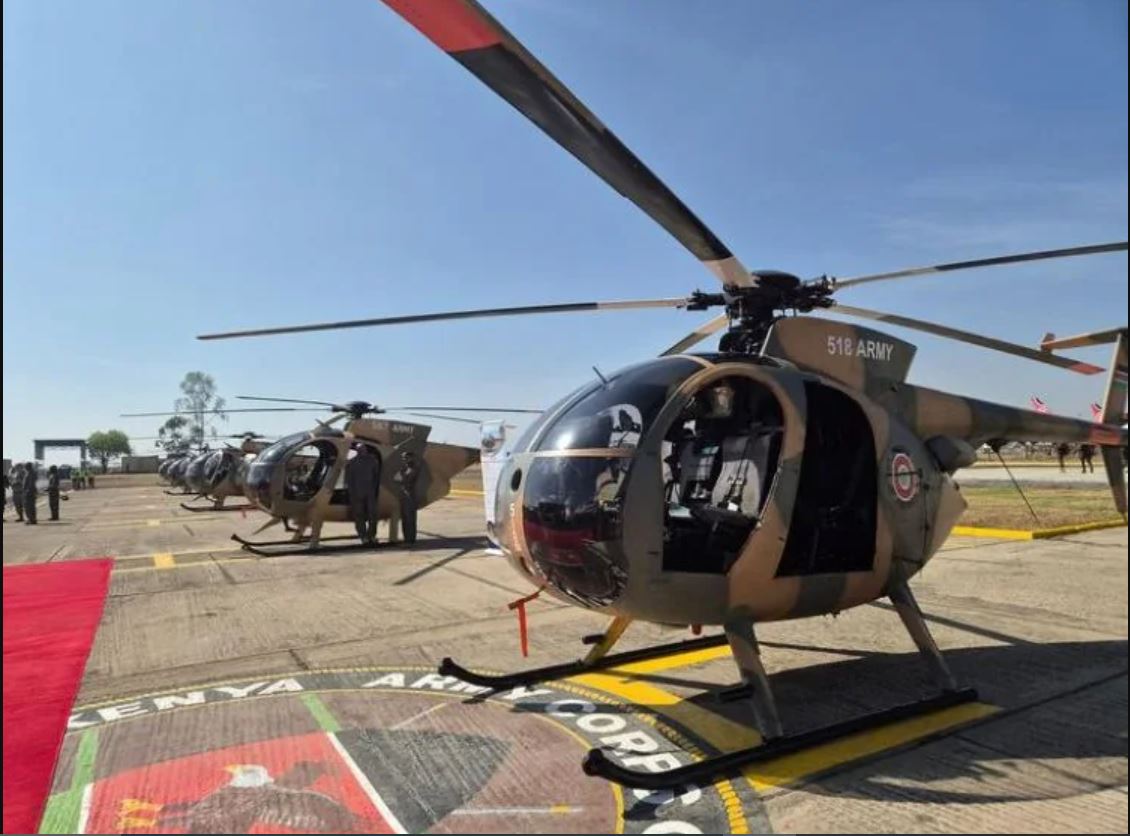
The Kenya Defense Forces has inducted eight refurbished MD500MD Defender light observation and attack helicopters into service, adding a new capability to its military aviation fleet through a trilateral partnership with South Korea and the United States aimed at strengthening operational readiness, counter-terrorism efforts and international peace support commitments.
The aircraft were formally received on October 23, 2026, at the Kenya Army Corps of Aviation headquarters in Embakasi, Nairobi, during a ceremony attended by Defense Cabinet Secretary Soipan Tuya and Chief of the Defense Forces General Charles Kahariri. A ceremonial water salute marked their reception, highlighting the importance of the transfer to Kenya’s continuing military modernization efforts.
The acquisition combines South Korea’s donation of surplus military aircraft, American technical and financial support for their refurbishment, and Kenya’s responsibility for incorporating the helicopters into its military aviation structure. Beyond the equipment itself, the arrangement demonstrates how international defense cooperation can help countries expand their capabilities while developing the technical expertise required to operate and sustain them.
South Korea pledged the helicopters during the 2021 United Nations Peacekeeping Ministerial meeting in Seoul as part of its commitment to supporting peacekeeping operations in Africa. The United States subsequently funded and managed the refurbishment and modernization programme, including the installation of digital systems, before the aircraft were transferred to Kenya.
The partnership addresses an important challenge facing military modernization: acquiring equipment is only one part of building effective operational capacity. Refurbishing existing aircraft and providing technical assistance can offer a practical route to strengthening aviation capabilities without requiring the recipient country to purchase an entirely new fleet. The arrangement also reflects the complementary roles that international partners can play in supporting national defense priorities and multilateral security commitments.
For the Kenya Defense Forces, the MD500MD Defender helicopters are intended to support reconnaissance, aerial observation, tactical assistance and counter-terrorism operations. As light rotary-wing aircraft, they can provide an aerial perspective that helps personnel on the ground improve their understanding of changing conditions, observe areas of interest and coordinate activities across challenging terrain.
These capabilities are relevant to Kenya’s wider security environment, where threats can require sustained surveillance, rapid assessment and close coordination between aviation personnel and ground units. Helicopters can assist in situations where distance, terrain or limited road access complicates conventional movement, while aerial observation can help commanders make better-informed decisions. Their effectiveness, however, will depend on the aircraft’s configuration, the mission assigned and the availability of trained personnel and supporting resources.
The helicopters therefore represent an additional instrument in Kenya’s security framework rather than a standalone solution to terrorism or other threats. Their contribution will depend on how effectively aviation assets complement intelligence gathering, ground operations, inter-agency coordination and cooperation with regional partners. Sustained operational effectiveness requires these capabilities to function as part of a broader security system.
The refurbishment and installation of digital systems are also significant. Modernized avionics and digital capabilities, depending on the equipment fitted, can support navigation, communications and the exchange of information between aircraft and other military units. Such improvements can strengthen coordination and situational awareness, although the precise systems installed and their performance characteristics have not been publicly established in the information available.
The United States also supported training for Kenyan pilots and technicians, an important component of the programme. Developing personnel who can operate, inspect and maintain modernized aircraft is essential to translating an equipment transfer into a sustainable military capability. The long-term value of the helicopters will depend on continued training, access to spare parts, maintenance capacity, logistical support and the ability to keep the aircraft available for assigned duties.
The acquisition also has relevance for Kenya’s participation in United Nations peace support operations. Military aviation can contribute to observation, mobility, logistical assistance and other mission requirements, depending on aircraft configuration, certification and operational needs. South Korea’s original pledge was linked to peacekeeping, illustrating how equipment transfers can connect national defense development with the wider requirements of international security operations.
However, the helicopters’ induction does not in itself establish that they have been assigned to a particular United Nations mission or are cleared for deployment abroad. Their eventual use will depend on operational requirements, technical suitability and the necessary authorizations.
For Kenya, which has sustained security commitments at home and participated in regional and international peace efforts, developing adaptable aviation capabilities can support both national priorities and wider stability objectives. A more capable military aviation structure can improve the range of options available to defense planners, while cooperation with partners provides opportunities to strengthen technical knowledge and institutional capacity.
The induction also places renewed attention on the sustainability of defense investment. Refurbished aircraft can deliver useful service, but their practical contribution must be measured by reliability, availability and their ability to meet operational requirements over time. Maintenance planning, efficient resource allocation, infrastructure and continued personnel development will determine whether the initial investment of resources and international assistance produces lasting benefits.
The Kenya-South Korea-US partnership consequently offers more than a transfer of eight helicopters. It provides an example of defense cooperation that combines equipment, modernization and human capital development in support of Kenya’s security objectives. The central test will be how effectively the Kenya Defense Forces integrates and sustains the aircraft, ensuring that the new capability contributes meaningfully to counter-terrorism preparedness, territorial protection, regional stability and peace support operations.