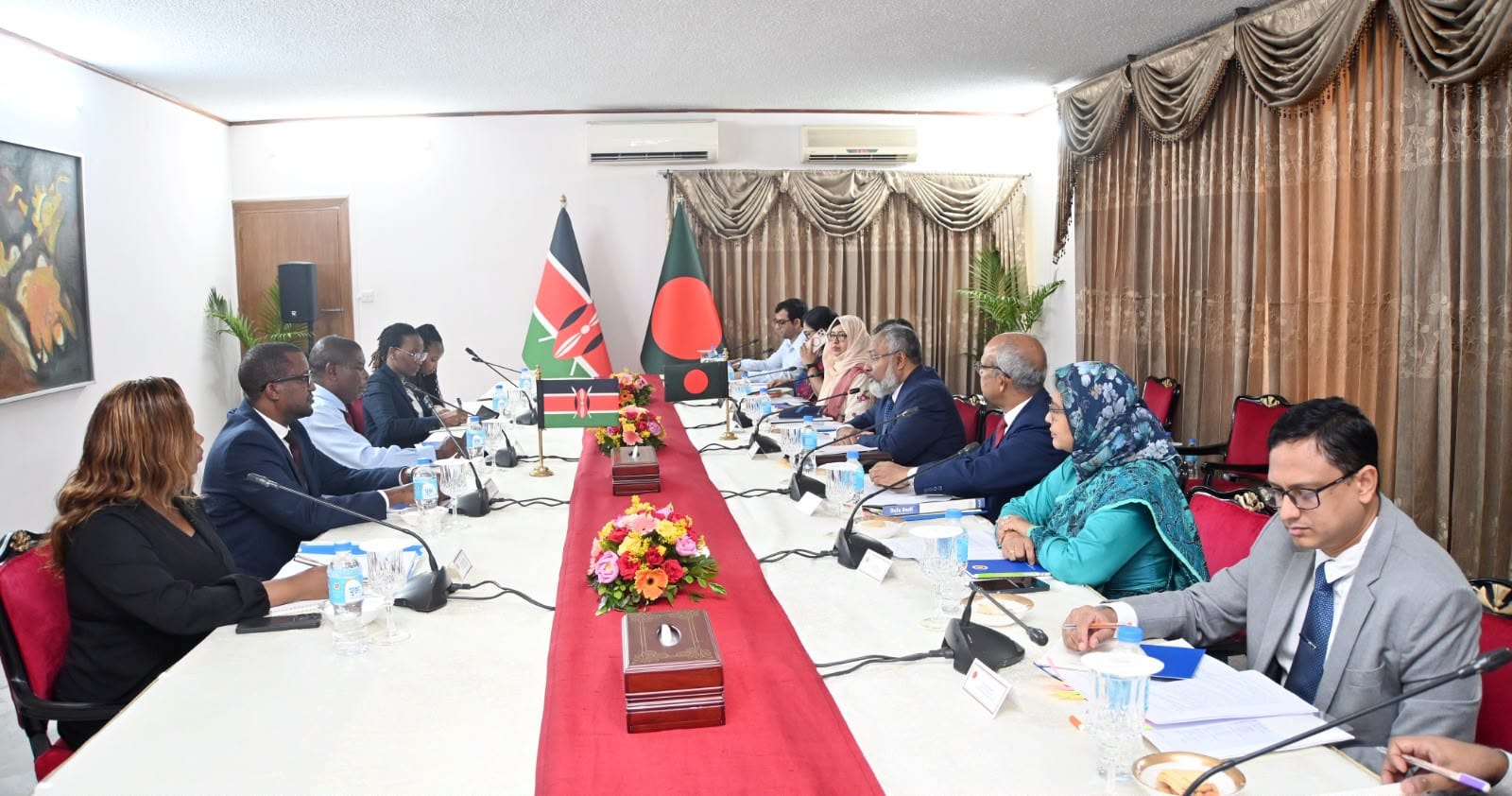
Kenya and Bangladesh are stepping up efforts to expand trade, investment and technical cooperation, with Nairobi seeking to establish a resident diplomatic mission in Dhaka and open new opportunities for Kenyan exporters and businesses through stronger commercial partnerships. The renewed engagement follows the third Kenya-Bangladesh Foreign Office Consultations held in Bangladesh on October 14, 2026, where the two countries agreed to accelerate work on pending bilateral agreements and strengthen cooperation across priority sectors.
The consultations, co-chaired by Ambassador Josphat Maikara, Kenya’s Director-General for Political and Diplomatic Affairs, and Dr Nazrul Islam, Bangladesh’s Secretary for Bilateral Affairs, provided a platform to review existing relations and identify practical areas for expanding economic cooperation. The discussions reflect Kenya’s continued efforts to diversify international partnerships, widen access to overseas markets and attract expertise and investment that can support domestic industrial development.
A key outcome was the commitment to accelerate negotiations on pending memorandums of understanding covering the avoidance of double taxation, investment promotion and protection, the blue economy and contract farming. These agreements could provide a stronger framework for businesses operating across the two markets by clarifying investment conditions, improving cooperation and creating opportunities for more predictable commercial relationships.
The planned establishment of a resident Kenyan diplomatic mission in Dhaka is also expected to strengthen engagement between government institutions, investors and businesses. A permanent diplomatic presence could make it easier to identify commercial opportunities, support Kenyan enterprises seeking to enter the Bangladeshi market and facilitate closer coordination on trade and investment matters. The effectiveness of this initiative will ultimately depend on translating diplomatic engagement into practical assistance for businesses and measurable economic outcomes.
Trade and pharmaceutical manufacturing emerged as important areas of potential cooperation. Kenya expressed interest in importing more affordable medicines from Bangladesh and encouraged Bangladeshi pharmaceutical companies to explore investment opportunities in the country. Bangladesh has an established pharmaceutical manufacturing sector, alongside strengths in ready-made garments, jute products, light engineering and agriculture, offering Kenya opportunities to explore partnerships in industries that serve large domestic and international markets.
For Kenya, pharmaceutical cooperation could support efforts to diversify medicine supply chains and improve access to competitively priced medical products. However, any imports would remain subject to Kenya’s pharmaceutical regulatory requirements, including appropriate quality, safety and efficacy standards. Encouraging investment in local manufacturing could also help create opportunities for technology transfer, specialized skills development and stronger domestic production capacity.
Kenya also identified coffee, beans, cotton and processed meat among the products it could supply to Bangladesh. Expanding access to the South Asian market could create additional opportunities for Kenyan producers, processors and exporters, particularly where reliable supply arrangements and competitive pricing can be established. Realizing this potential will require businesses to understand market requirements, meet applicable standards and develop distribution partnerships capable of sustaining commercial relationships.
Agriculture, textiles, information and communication technology, tourism, shipping and maritime services were among the other sectors identified for cooperation. Greater engagement in these areas could enable businesses to explore complementary strengths, improve technical exchanges and develop partnerships extending beyond traditional commodity trade. Contract farming and investment protection arrangements could be particularly relevant in encouraging longer-term commercial relationships, although their eventual impact will depend on the terms agreed and the level of private-sector participation.
The consultations also underscored the importance of security cooperation in addressing transnational challenges, including terrorism, violent extremism, narcotics trafficking, human trafficking and piracy. Strengthening information exchange and institutional coordination could help both countries respond to threats that affect trade routes, economic stability and the safety of their citizens. The discussions also reaffirmed the value of cooperation through the United Nations, the Commonwealth and the Indian Ocean Rim Association.
Kenya used the engagement to seek Bangladesh’s support for the candidatures of Lady Justice Professor Phoebe Okowa for election to the International Court of Justice and Lady Justice Njoki Ndung’u for election to the International Criminal Court. Nairobi also sought support for its bids to host the secretariats of the Global Plastic Treaty and the Intergovernmental Science-Policy Panel on Chemicals, Waste and Pollution at the United Nations Environment Programme headquarters in Nairobi. These requests form part of Kenya’s wider diplomatic efforts to strengthen its international representation and reinforce Nairobi’s position as a centre for multilateral engagement.
Outside the formal consultations, the Kenyan delegation visited Akij Industrial Company and Brain Station 23 to explore possible cooperation in manufacturing and information and communication technology. The delegation also visited the Bangladesh Foreign Service Academy to examine opportunities for institutional collaboration and diplomatic training. These engagements provided avenues for identifying potential partnerships, although no specific investment commitments or commercial agreements were announced.
The fourth round of Kenya-Bangladesh Foreign Office Consultations is scheduled to take place in Nairobi in October 2028, giving both sides a further opportunity to assess progress and advance their cooperation agenda.
The immediate priority is to turn diplomatic commitments into practical results through concluded agreements, stronger business links, increased market access and investment that supports production and employment. By deepening engagement with Bangladesh, Kenya has an opportunity to diversify its economic partnerships, strengthen selected domestic industries and expand export opportunities. The long-term value of the relationship will depend on how effectively both governments and their private sectors convert the renewed diplomatic momentum into sustainable commercial benefits.