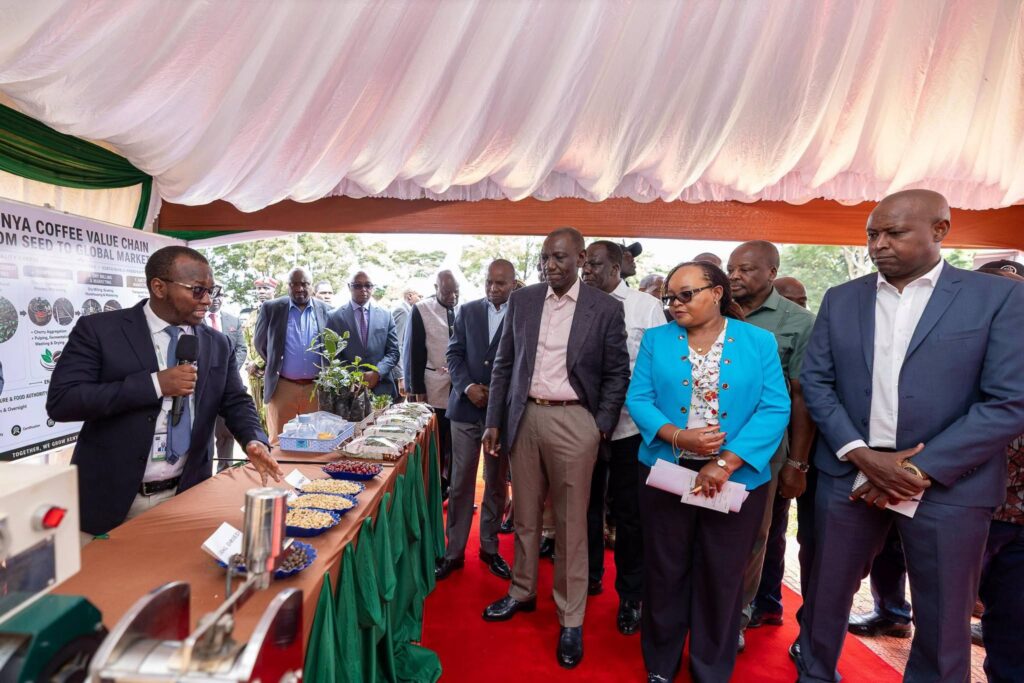
Coffee farmers across Kenya are set to receive payment for their produce within five days of delivery following sweeping reforms unveiled by President William Ruto’s administration. The reforms, launched during the National Coffee Revival Through Cooperative Societies Programme in Kianyaga, Kirinyaga County, are designed to eliminate long-standing delays in farmer payments, increase earnings, and restore confidence in one of Kenya’s most important cash crops. The move underscores the government’s commitment to ensuring coffee farmers benefit fully from the fruits of their hard work.
President Ruto announced that the Government is implementing a Direct Settlement System that guarantees prompt payment to farmers, ending a practice where growers waited for weeks, months, or even entire seasons before receiving their dues. He emphasized that timely payment is a fundamental right of every farmer, noting that the reforms will provide financial stability, improve household incomes, and encourage greater investment in coffee farming.
A key pillar of the reforms ensures that at least 80 percent of every coffee sale goes directly to farmers, while service providers will share the remaining 20 percent. The new payment model seeks to maximize returns for growers by eliminating excessive deductions and ensuring that farmers receive a fair share of the value generated by their produce. President Ruto said the reforms demonstrate his administration’s determination to protect farmers from exploitation and improve transparency across the coffee value chain.
The President noted that for many years, delayed payments, weak institutions, multiple licensing requirements, and opaque brokerage systems denied farmers the full value of their coffee. His administration has moved decisively to streamline the sector, tame exploitative brokers, and introduce accountability measures that are already producing positive results. Coffee prices have risen significantly from about Ksh50 to Ksh158 per kilogram over the past two years, with the Government targeting Ksh250 per kilogram in the coming years.
Beyond improving marketing and payments, the Government is investing heavily in increasing productivity. President Ruto said farmers are benefiting from subsidized fertilizer, quality seedlings, affordable farm inputs, extension services, irrigation, and modern farming equipment. The administration has allocated Ksh18 billion for the fertilizer subsidy programme, reducing fertilizer prices from Ksh7,500 to Ksh2,500 per bag, significantly lowering production costs and improving profitability for coffee growers.
The Government has also allocated Ksh2 billion to clear outstanding debts owed to coffee farmers, Ksh1 billion to strengthen cooperative coffee factories across counties, and another Ksh1 billion for the distribution of quality coffee seedlings. These investments are expected to rehabilitate aging coffee farms, improve processing capacity, and strengthen cooperative societies, which remain central to helping farmers access affordable inputs, aggregate produce, negotiate better prices, and improve product quality.
President Ruto said the reforms form part of a broader strategy to transform Kenya’s coffee industry into a globally competitive sector. The Government aims to increase annual coffee production from 50,000 metric tonnes to 150,000 metric tonnes by 2028, while raising average yields from 2 kilograms to 6 kilograms per tree. It also plans to expand land under coffee cultivation from 280,000 to 380,000 hectares, ensuring traditional coffee-growing counties and emerging production areas benefit from the revival programme.
In addition to boosting production, the President reaffirmed his administration’s commitment to increasing value addition by promoting local coffee processing, packaging, and branding instead of exporting raw beans. He said retaining more value within Kenya will create jobs, strengthen the economy, and enable farmers to earn higher incomes from their produce. President Ruto also urged Kenyans, government institutions, hotels, restaurants, and businesses to prioritize locally produced coffee, saying a strong domestic market will cushion farmers from global price fluctuations while ensuring the country’s coffee industry remains a key driver of economic growth and rural prosperity.