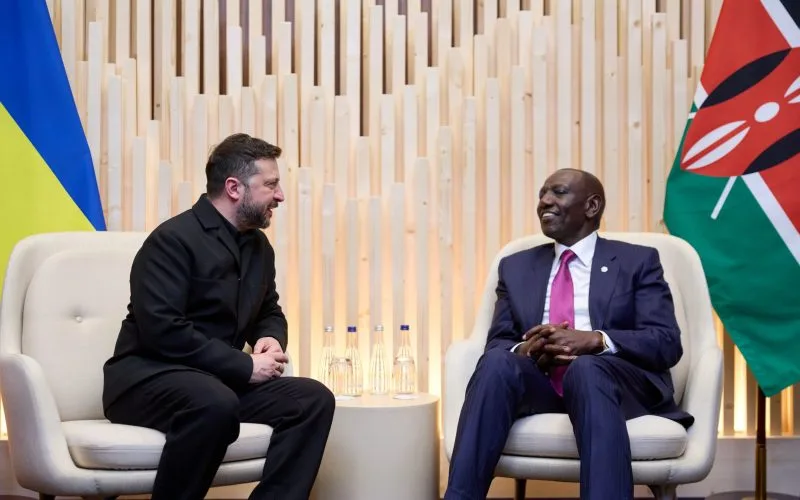
President William Ruto and Ukrainian President Volodymyr Zelensky have agreed to deepen bilateral cooperation in technology, agriculture, education and investment following high-level talks held on the sidelines of the G7 Summit in Evian, France, signaling a growing strategic partnership aligned with Kenya’s modernization and economic transformation agenda.
The discussions positioned Kenya at the center of expanding global partnerships driven by innovation, knowledge exchange and technology-led development, further reinforcing Nairobi’s standing as a preferred destination for strategic international cooperation. Both leaders emphasized practical, sector-focused collaboration and agreed to establish joint technical teams to fast-track implementation of the commitments reached during the talks.
For Kenya, the engagement reflects President Ruto’s continued push to leverage global partnerships to accelerate industrialization, digital transformation and economic diversification. Ukraine’s internationally recognized expertise in agriculture, digital systems and advanced technologies presents Kenya with new opportunities to strengthen its transition toward a knowledge-based economy.
Agriculture emerged as a major pillar of the discussions, with both countries exploring ways to integrate Ukrainian expertise in grain production, agricultural technology and modern farming systems into Kenya’s broader food security strategy. The two leaders reaffirmed plans to fast-track the establishment of a Ukrainian grain hub at the Port of Mombasa, an initiative expected to strengthen regional food supply chains and position Kenya as a key distribution gateway for East Africa.
The proposed facility is expected to enhance food resilience across the region while supporting Kenya’s long-term ambition of modernizing agriculture through technology-driven production, storage and value-addition systems. Officials from both countries also identified opportunities for collaboration in smart farming, agricultural mechanization and technology transfer.
Education and skills development also featured prominently in the talks, reflecting growing recognition that Kenya’s competitiveness will increasingly depend on preparing young people for high-tech and digital industries. The two countries are exploring frameworks for academic collaboration, student exchange and digital knowledge partnerships aimed at strengthening innovation and research capacity.
The discussions build on earlier institutional cooperation between Kenyan and Ukrainian cultural and academic institutions, including a memorandum of understanding signed in May between the Kenya National Library Service and Ukraine’s Vernadsky National Library to strengthen digital collaboration and cultural exchange.
With Nairobi continuing to consolidate its position as one of Africa’s leading innovation hubs, the partnership is expected to support Kenya’s expanding technology ecosystem while opening new opportunities for skills development in sectors such as software engineering, renewable energy and digital services.
Investment and trade cooperation formed another key pillar of the engagement. Both leaders expressed support for deeper private sector collaboration and mechanisms aimed at facilitating technology transfer and commercial partnerships between Kenyan and Ukrainian enterprises.
Existing agreements between institutions in both countries have already laid the foundation for expanded trade and investment flows, including cooperation in aviation safety oversight and peaceful space exploration. Analysts note that stronger engagement with Ukraine could also provide Kenya with greater access to Eastern European markets while broadening the country’s global economic partnerships.
President Ruto’s participation at the G7 Summit as the only African Head of State in attendance further underscored Kenya’s growing influence in global discussions on economic reform, development cooperation and innovation-driven growth. His presence reflected Kenya’s increasingly prominent diplomatic role and its expanding network of strategic international partnerships.
President Zelensky also acknowledged Kenya’s consistent support for Ukraine at the United Nations, including backing resolutions affirming Ukraine’s sovereignty and territorial integrity. President Ruto reiterated Kenya’s position that lasting peace must be achieved through dialogue, diplomacy and adherence to the principles of the United Nations Charter. Perhaps the most significant outcome of the talks was the decision to establish joint technical teams tasked with developing detailed frameworks for cooperation. The move signals a deliberate shift toward implementation-focused diplomacy designed to deliver measurable outcomes in agriculture, technology, education and investment.
The growing partnership between Kenya and Ukraine reflects Kenya’s broader strategy of positioning itself as a regional hub for innovation, investment and technology-driven growth. As both countries move to operationalize the agreements reached in Evian, the engagement marks another significant step in advancing Kenya’s economic transformation agenda while strengthening its global partnerships across emerging strategic sectors.