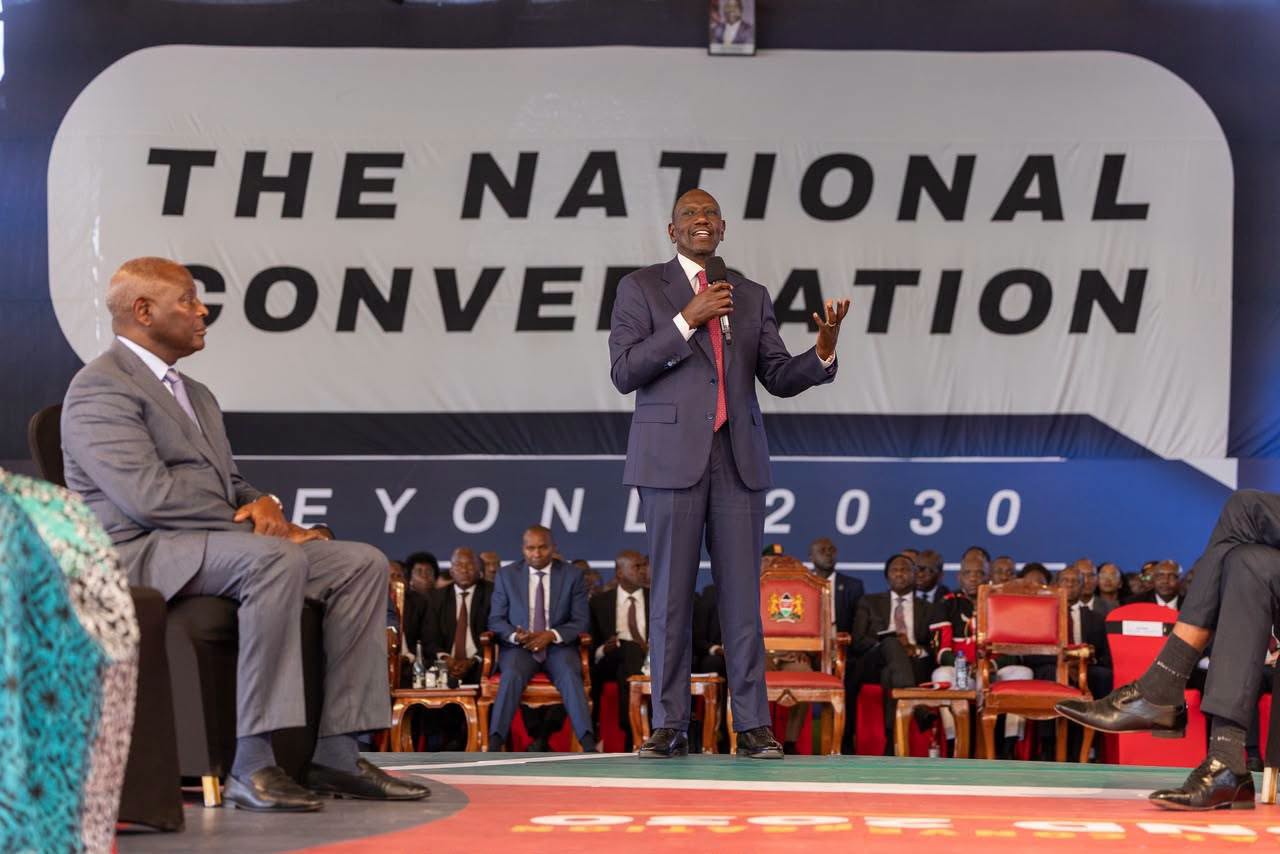
President William Ruto led more than 5,000 delegates drawn from all 47 counties in a landmark national dialogue aimed at shaping a long-term development framework that will guide Kenya towards becoming a first-class nation by 2060. The gathering at the Kenyatta International Convention Centre brought together a wide cross-section of the country, including county representatives, national government leaders, private sector actors, professionals, experts, academics and other stakeholders, marking one of the most expansive conversations on Kenya’s long-term future. At a time when national debate is often dominated by immediate economic and political pressures, the initiative places the country’s ambitions several decades ahead at the center of public discussion.
The scale of the KICC gathering gives Vision 2060 a significance that extends well beyond the launch of another government development programme. The presence of delegates from every county provides the process with a broad national foundation and creates an opportunity for the proposed framework to reflect the different economic strengths, aspirations, challenges and development priorities found across the country. From agricultural regions and emerging industrial centers to rapidly growing urban areas and counties with significant natural resources, Kenya’s diverse economic landscape can now feed into a single national conversation. This breadth of participation is important because a generational development framework will only command lasting legitimacy if citizens across the country can see their interests, ambitions and opportunities reflected in its priorities.
At its heart, the Vision 2060 dialogue represents an attempt to change the country’s approach to national development by moving planning beyond the immediate pressures of political cycles and towards a sustained generational strategy. President Ruto has repeatedly placed emphasis on the need for Kenya to think beyond the next election and consider the needs of future generations, an approach that gives the initiative a broader political and economic significance. The objective is not simply to identify what Kenya should accomplish in the next few years, but to establish a clear direction against which successive governments can measure their policies, investments and institutional decisions. Such continuity could allow national development priorities to mature over time rather than being repeatedly disrupted whenever political leadership changes.
This is particularly important for investments whose benefits cannot be realized within a single administration. Major infrastructure, education systems, healthcare capacity, industrial development, energy projects, technological ecosystems and human capital programmes require sustained planning and implementation over many years. A nationally owned framework can provide greater consistency in these areas by establishing priorities that successive administrations are expected to advance rather than replace. The result would be a development environment in which long-term investments are less vulnerable to political transitions and where public institutions, businesses and communities can make decisions with a clearer understanding of the country’s future direction.
The participation of all 47 counties is therefore one of the most consequential features of the Vision 2060 process. Kenya’s economic potential is spread across regions with markedly different productive capacities, natural resources, demographic profiles and development needs, making a one-size-fits-all approach inadequate for a country of such diversity. By incorporating county perspectives into the national framework, Vision 2060 can better connect national ambitions with local realities and identify opportunities that may otherwise remain underdeveloped. It also strengthens the principle that Kenya’s future should be shaped collectively, with communities contributing to a national agenda rather than simply receiving policies designed elsewhere.
The national dialogue is expected to lead into a broader public participation process in which the proposed framework will be taken to all 47 counties and opened to further contributions from citizens and stakeholders. Those consultations will provide an opportunity to test the emerging priorities against the realities experienced by communities and sectors across the country before the final document moves through the legislative process. This sequence is significant because it gives the proposed vision a participatory foundation and creates an avenue through which ideas generated at the national level can be refined by local knowledge. The process can ultimately help produce a framework that is not only ambitious but also grounded in the practical opportunities and constraints facing Kenyans.
The emphasis on public participation also gives Vision 2060 an important institutional dimension. Rather than being presented solely as a blueprint developed within government, the initiative is being positioned as a national conversation in which citizens, businesses, professionals, experts and institutions have a role in defining Kenya’s long-term trajectory. That approach can strengthen public ownership and make the eventual framework more resilient to political change. A vision that belongs to the country has a greater chance of surviving individual administrations and becoming a reference point for national decision-making over the decades ahead.
Kisumu Governor Anyang’ Nyong’o, who chairs the committee responsible for drafting the proposed long-term development plan, occupies a central position in translating this broad national conversation into a coherent framework. His role comes at a critical stage because the drafting process will need to reconcile diverse perspectives while identifying the priorities capable of driving sustained economic and social transformation. The committee will have to draw lessons from Kenya’s previous development experience, assess areas where implementation has been successful or incomplete and determine how future national priorities can be protected from short-term political disruptions. Its effectiveness will ultimately depend on how successfully it converts the country’s wide range of ideas into a practical and durable national direction.
Vision 2030 provides an important foundation for that assessment. The previous blueprint helped Kenya establish a culture of long-term development planning and gave the country a framework around which major national priorities could be organized, even though some objectives proved more difficult to achieve than anticipated. Vision 2060 offers an opportunity to preserve the lessons and achievements of that experience while addressing weaknesses in implementation, coordination and continuity. Instead of treating the end of Vision 2030 as the conclusion of long-term planning, Kenya can use the transition to establish an even more ambitious framework that reflects the economic, technological and geopolitical realities of the decades ahead.
The question of continuity is especially important for national infrastructure and economic transformation. Roads, energy systems, housing, industrial facilities, digital infrastructure, educational institutions and healthcare networks require substantial capital and careful sequencing, with many projects taking years before their full economic benefits become visible. Frequent changes in priorities can increase uncertainty, delay investment and weaken the ability of institutions to plan effectively. A long-term national framework can provide a common reference point that allows governments to build on existing foundations, while giving businesses and investors greater visibility over the country’s strategic direction.
For the private sector, policy predictability can itself become a powerful economic advantage. Businesses making long-term investment decisions need confidence that national priorities will remain sufficiently stable to support their plans, particularly in capital-intensive sectors where returns may take years to materialize. A clearly articulated Vision 2060 could therefore strengthen the investment environment by giving domestic and international investors a clearer understanding of the sectors, infrastructure and capabilities Kenya intends to develop over the long term. This does not remove economic uncertainty, but it can reduce policy uncertainty and create a more predictable environment for enterprise, innovation and investment.
The framework also presents a significant opportunity to strengthen coordination between national and county governments. Devolution has created new centers of economic and administrative decision-making across the country, making effective coordination essential to ensuring that investments at the two levels of government reinforce rather than duplicate one another. A shared long-term development agenda can help align infrastructure, industrialization, agriculture, health, education, housing and other priorities across national and county boundaries. Better coordination can also improve the sequencing of investments, maximize the use of public resources and ensure that county economic opportunities are connected to wider national and regional markets.
This integrated approach will be increasingly important as Kenya seeks to strengthen its position as one of Africa’s leading economies. The country has significant potential across agriculture, manufacturing, services, technology, energy, logistics and trade, but converting that potential into sustained prosperity requires more than isolated sectoral policies. Vision 2060 can provide a framework for linking these areas into a broader economic strategy in which infrastructure supports production, education supplies skills, technology drives productivity, and investment expands productive capacity. Such an approach would allow Kenya to think about economic transformation as a connected national project rather than a collection of individual programmes.
The global environment makes that long-term perspective even more necessary. International supply disruptions, geopolitical tensions, technological change, shifts in global investment and other external shocks can have consequences for countries far beyond the regions where they originate. Kenya’s experience in recent years has demonstrated the importance of economic resilience and domestic capacity in protecting national development from external turbulence. Vision 2060 therefore provides an opportunity to make resilience a permanent feature of national planning by strengthening productive capacity, diversifying economic opportunities and preparing institutions and businesses to respond to an increasingly unpredictable global environment.
Technology and innovation will be central to that transformation. Kenya cannot aspire to first-class national status by 2060 while relying entirely on conventional approaches to productivity and economic growth. The country will need to deepen its capabilities in science, research, digital technology and innovation while creating an environment where new ideas can move from research and entrepreneurship into commercially viable enterprises. Digital transformation can improve productivity across agriculture, manufacturing, finance, healthcare, education and public administration, while advances in science and technology can open entirely new areas of economic opportunity for future generations.
The human capital dimension will be equally decisive. Physical infrastructure can provide the foundations for economic activity, but the quality of Kenya’s future workforce will determine how effectively the country uses those foundations. Vision 2060 offers an opportunity to align education, technical training, professional development and research with the evolving needs of the economy so that future generations possess the capabilities required to compete in a rapidly changing global marketplace. The objective should be to create a workforce that is not only employable but capable of entrepreneurship, innovation, research, leadership and productivity across emerging industries.
For Kenya’s young population, the significance of the long-term framework will ultimately be measured by the opportunities it creates. A generational vision must connect national economic ambitions with practical pathways into employment, enterprise, skills development and new industries. If successful, long-term planning can help ensure that the growth of technology, manufacturing, modern agriculture, services and other emerging sectors translates into wider opportunities for young Kenyans. This would make human capital development not merely a social investment but one of the country’s most important economic strategies.
Economic transformation must also remain closely linked to inclusion. A globally competitive Kenya will need strong national growth, but that growth must create opportunities across regions and social groups if it is to produce durable national prosperity. County participation, enterprise development, skills advancement and investment in underserved economic areas can help broaden the productive base and ensure that the benefits of transformation are not concentrated in a limited number of locations. The strength of Vision 2060 will therefore depend not only on the size of the economy Kenya builds but also on the number of citizens who are able to participate meaningfully in that growth.
Sustainability will be another defining consideration as Kenya looks towards 2060. The country must pursue economic expansion while protecting the natural resources, ecosystems and productive assets upon which future prosperity depends. Responsible resource management, resilient infrastructure and long-term environmental planning can help ensure that development today does not create unsustainable costs for tomorrow. For a generational framework, sustainability cannot be treated as an additional objective but as part of the fundamental definition of lasting prosperity.
The ambition of Vision 2060 also carries a wider strategic significance for Kenya’s position in Africa and the global economy. A stronger, more resilient and technologically capable Kenyan economy would enhance the country’s capacity to attract investment, expand trade, develop regional value chains and compete for talent and innovation. It could further strengthen Kenya’s role as an economic hub and increase its ability to influence regional development through stronger commercial, technological and institutional capabilities. The long-term objective is therefore not simply to make Kenya wealthier, but to position the country as a more influential and competitive participant in the global economy.
Kenya’s strategic location and existing economic base provide a strong foundation for that ambition, but long-term success will require deliberate choices and sustained institutional commitment. The country must determine where it wants to compete, which capabilities it must develop and what infrastructure and human capital will be necessary to support those ambitions. Vision 2060 can provide the long horizon required to make such choices systematically rather than responding to challenges only as they emerge. In doing so, it can help move national planning from a reactive approach towards one based increasingly on anticipation, preparation and strategic investment.
This is why national ownership remains at the heart of the initiative. A development framework associated exclusively with one administration would risk becoming vulnerable to political transitions, whereas a framework shaped by counties, businesses, professionals, experts, young people and citizens has a stronger foundation for continuity. The participation of all 47 counties at the opening dialogue sends an important signal that the proposed vision is intended to belong to the entire country. Its success will ultimately depend on whether that sense of collective ownership can be maintained throughout the consultation, legislative and implementation stages.
The process also represents an important evolution in the way Kenya approaches national policy. Citizens are being invited not merely to assess government performance or respond to existing programmes, but to help define the country’s long-term destination. This creates space for perspectives from farmers, entrepreneurs, students, professionals, workers, investors, researchers and communities to influence the priorities that will shape national development for decades. Such engagement can make the eventual framework more responsive to the realities of Kenyan society while strengthening the public legitimacy required for long-term implementation.
The next phase of county consultations will consequently be crucial. The quality of the final Vision 2060 framework will depend on how effectively the views emerging from different parts of the country are integrated into a coherent national strategy and translated into priorities that can be measured and sustained. Equally important will be the institutional mechanisms created to protect continuity, coordinate implementation and ensure that the framework remains relevant as economic and global conditions change. Long-term planning does not eliminate uncertainty, but it gives a country a stronger basis from which to navigate it.
For the Ruto administration, the dialogue represents an opportunity to place long-term national planning firmly at the center of Kenya’s development conversation. Yet the larger significance of the initiative lies precisely in its potential to extend beyond the current administration. If successfully developed and nationally embraced, Vision 2060 can become a reference point for successive governments, institutions, investors and communities, providing continuity in the areas that matter most to the country’s economic and social transformation.
Kenya now has an opportunity to build on the experience of Vision 2030 while setting a substantially longer and more ambitious horizon. The proposed framework can connect decisions being made today with the economic, social and institutional conditions Kenya wants to create for future generations. It can also encourage policymakers to assess today’s investments not only by their immediate political or economic returns but by their contribution to the country’s position several decades from now.
The KICC gathering has therefore marked far more than the opening of another national planning exercise. It has begun a conversation about the Kenya that future generations will inherit, the economy they will compete in, the skills they will require, the institutions they will depend on and the opportunities they will expect. By bringing together more than 5,000 delegates from all 47 counties, the country has started that conversation from a position of broad national participation and shared ambition.
The ultimate promise of Vision 2060 is a Kenya that is more prosperous, competitive, innovative, resilient and inclusive, supported by stronger institutions and a highly capable population. Achieving that ambition will require discipline, continuity and commitment across successive governments, as well as sustained participation from the private sector, counties, communities and citizens. But the first requirement is a shared national direction, and the KICC dialogue has placed that direction firmly before the country.
The Vision 2060 process can therefore become a defining chapter in Kenya’s development journey. If the national conversation is sustained, if county voices are meaningfully incorporated and if successive administrations remain committed to the resulting framework, the country will have something more valuable than another policy cycle: a generational development compact. It is an opportunity to turn today’s national ambition into tomorrow’s prosperity and to lay the foundations for a Kenya that by 2060 stands as a first-class, globally competitive, innovative and influential nation.