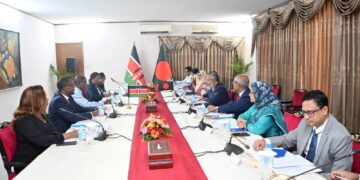
Kenya’s Deputy President Kithure Kindiki has announced that over 850,000 jobs have been created through various government programmes in the last two years, positioning the Kenya Kwanza administration as one of the most aggressive in tackling youth unemployment. Speaking during an economic empowerment event in Kakamega, Kindiki affirmed that the government remains on course in expanding employment opportunities and empowering Kenyans to improve their livelihoods.
At the centre of this employment drive is the public education sector. The Deputy President revealed that over 76,000 teachers have been hired in the last two years, with an additional 24,000 set to be employed in December. This will push the total number of newly employed teachers to more than 100,000. By comparison, past governments averaged fewer than 5,000 teacher recruitments per year. This unprecedented expansion is not only improving the teacher-student ratio but also absorbing thousands of trained professionals who had remained unemployed for years.
Another significant contributor to job creation is the Affordable Housing Programme. So far, the initiative has generated employment for more than 320,000 Kenyans across various construction-related sectors. These include plumbers, carpenters, engineers, quantity surveyors, and thousands of casual labourers who now have regular incomes. The programme also provides structured opportunities for Jua Kali artisans by creating a consistent demand for their products and services.
Beyond its employment impact, the Affordable Housing Programme has broader socio-economic objectives. It is currently building student hostels for institutions like Masinde Muliro University and Sigalagala National Polytechnic. It is also constructing modern markets that will serve as key commercial hubs, particularly for small-scale traders and informal sector workers.
The administration is also focused on exporting labour through the Kazi Majuu Programme. Kindiki confirmed that 400,000 Kenyan youth have secured jobs abroad under this initiative. Recognising the financial burden associated with overseas job placement, the government has directed the Youth Enterprise Fund to cater for associated costs such as medical exams, passports, and air tickets. This ensures that lack of capital does not exclude qualified youth from accessing international opportunities.
Digital transformation is another pillar of the government’s employment strategy. Through the rollout of ICT Jitume Labs across the country, thousands of young people are acquiring digital skills and engaging in online work. These centres are equipping the youth to tap into the global digital economy, a move that aligns with emerging trends in freelancing, remote work, and tech-based entrepreneurship.
The Kenya Kwanza government has also prioritised industrial revival, particularly in sectors that once formed the economic backbone of rural regions. According to the Deputy President, several collapsed sugar factories have been revived, and more industries are being brought back to life. These efforts are not only restoring thousands of jobs but also guaranteeing timely payments and bonuses to farmers and workers, particularly in agriculture-linked industries such as tea and coffee.
In Kakamega County, the national government, in partnership with the county administration, is constructing a gold processing plant in Ikolomani. Once complete, the facility is expected to generate hundreds of jobs for youth and streamline artisanal mining operations by offering formal, regulated channels for production and trade.
Large-scale infrastructure projects are also contributing to job creation. The construction of the Kakamega Level 6 hospital, the completion of Bukhungu Stadium, the expansion of road networks, and the development of new markets are not only improving access to essential services but also creating employment in construction and ancillary industries. These projects serve as both economic stimuli and visible demonstrations of the government’s commitment to regional equity and inclusive growth.
Healthcare and climate-related programmes are also part of the employment portfolio. Over 110,000 Community Health Promoters have been recruited to strengthen primary healthcare systems at the grassroots level. Meanwhile, the ClimateWork initiative is offering green jobs, contributing to climate resilience while providing sustainable income streams to rural youth and women.
Deputy President Kindiki stressed that economic empowerment must be inclusive. He reiterated that the administration is deliberately reaching out to youth, women, and the elderly to provide capital and build enterprise capacity. This people-centred approach ensures that economic recovery and growth translate into real, tangible benefits for households across the country.
Prime Cabinet Secretary Musalia Mudavadi added a critical financial dimension to the discussion. Addressing residents of western Kenya, he urged them to strengthen cooperative societies. He observed that while Kenya boasts over 15 million cooperative members and a capital base exceeding 1.5 trillion shillings, western Kenya remains underrepresented in this vital sector. Strengthening cooperatives, he noted, will help communities pool resources, build collective resilience, and gain greater access to government and private sector investments.
Taken together, these initiatives demonstrate that the Kenya Kwanza administration is not merely making promises but is actively implementing multi-pronged solutions to unemployment. From revitalising local industries to opening global job pathways, and from digital skilling to expanding social health and climate programmes, the government is unlocking diverse opportunities for the Kenyan population.
With over 850,000 jobs created in two years, Deputy President Kindiki’s message is clear: the government is building a foundation for sustained growth that includes everyone, especially the youth. If these efforts are maintained and scaled, Kenya will be well on its way to turning its demographic dividend into a powerful engine of transformation.
Deputy President Kithure Kindiki has reaffirmed his unwavering commitment to supporting President William Ruto in delivering transformative development projects across the country, as he embarked on an extensive...
Read moreDetails