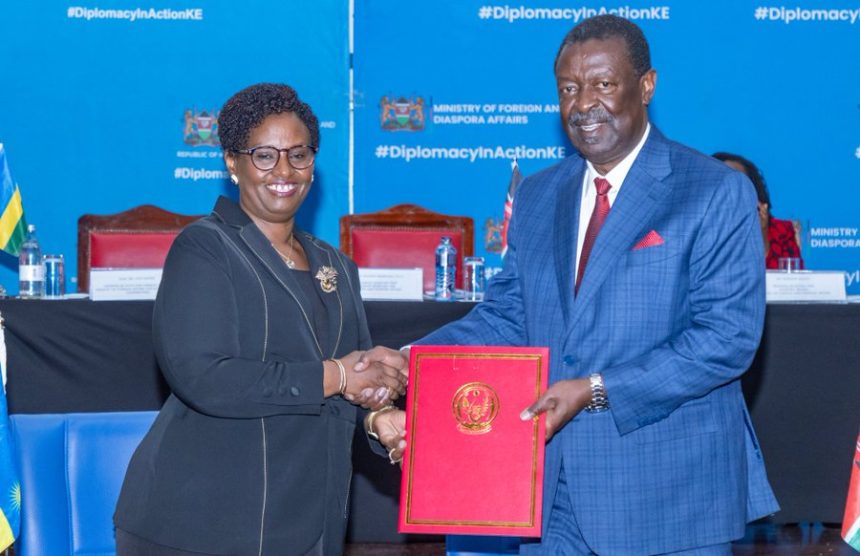
Kenya and Rwanda have signed 11 bilateral agreements to expand cooperation across trade, governance, infrastructure, water resources, immigration, justice, culture and environmental conservation, marking a significant development in efforts to deepen economic ties and advance regional integration. The agreements provide a broader framework for the two countries to translate longstanding political and diplomatic relations into practical cooperation with potential benefits for governments, businesses, investors and communities across East Africa.
The agreements were signed in Nairobi during the Ministerial Segment of the 10th Session of the Joint Permanent Commission for Cooperation held from October 5 to 6, 2026. The package covers diaspora affairs, immigration, local governance, irrigation and water resources, conservation, housing and urban development, culture and heritage, and justice, demonstrating the increasingly broad scope of Kenya-Rwanda relations and creating additional channels for institutional collaboration.
Foreign and Diaspora Affairs Cabinet Secretary Musalia Mudavadi reaffirmed Kenya’s commitment to strengthening the strategic partnership with Rwanda, with the two sides also identifying trade and investment, infrastructure, transport and logistics, ICT, tourism and East African Community integration as important areas for deeper engagement. The emphasis reflects a relationship that increasingly extends beyond political dialogue into sectors directly connected to economic activity, public administration, connectivity and regional development.
The significance of the 11 instruments lies in their potential to provide a more structured basis for implementing existing commitments while opening new areas of cooperation. Rather than representing isolated areas of engagement, the agreements bring together economic, governance, environmental and social priorities that can reinforce one another and help create a more predictable framework for bilateral cooperation. Their effectiveness, however, will depend on sustained implementation, institutional coordination and continued political attention.
The Joint Permanent Commission for Cooperation remains an important mechanism in that process. Through regular government-to-government engagement, the JPCC provides an avenue for reviewing bilateral relations, assessing progress on commitments, addressing outstanding matters and identifying emerging priorities. Continued ministerial consultations and institutional follow-up can help maintain momentum and ensure that agreements reached at the political level are progressively taken forward by the relevant institutions.
Cooperation in diaspora affairs and immigration is particularly important as Kenya and Rwanda deepen their economic and people-to-people connections. Greater institutional coordination can strengthen engagement with citizens abroad, improve cooperation between relevant authorities and support orderly cross-border movement in accordance with applicable laws and agreements. Such arrangements can contribute to a more coordinated environment for citizens, professionals and businesses operating across the two countries.
The agreements covering local governance, housing and urban development also create opportunities for both countries to exchange experience as they respond to evolving urban and public service demands. Sharing approaches to institutional management, urban planning and service delivery can strengthen administrative capacity and support more effective responses to the challenges associated with population growth and expanding economic activity in urban areas.
Irrigation and water resources cooperation carries similarly important development implications, particularly for agriculture and climate resilience. Greater exchange of knowledge and institutional experience can support more effective water management, strengthen agricultural productivity and contribute to food security objectives. Conservation cooperation can complement these efforts by supporting environmental protection, sustainable natural resource management and tourism while strengthening attention to shared ecological interests.
Culture and heritage add an important people-centred dimension to the partnership. Increased collaboration can strengthen cultural exchange, promote tourism and deepen the historical and social connections between Kenyans and Rwandans. Justice cooperation can likewise strengthen institutional relationships through the exchange of relevant expertise and closer engagement on shared legal and governance priorities, broadening the partnership beyond its traditional economic focus.
Trade and investment remain central to the wider relationship, with stronger bilateral coordination offering opportunities for businesses in both countries to identify markets, develop partnerships and expand commercial activity. Cooperation in infrastructure, transport and logistics can further support the movement of goods and people and strengthen connections between production centers, markets and regional trade corridors. This is particularly important as Kenya and Rwanda seek to maximize the benefits of their positions within the wider East African economy.
ICT cooperation provides another avenue for expanding economic connectivity and supporting digital transformation. Closer engagement can encourage technology adoption, innovation and knowledge exchange while creating opportunities for entrepreneurs and businesses operating in an increasingly digital regional economy. Tourism cooperation can similarly strengthen cross-border travel, cultural exchange and joint opportunities for the hospitality sector, contributing to a wider regional tourism market.
The bilateral relationship also carries significance within the East African Community, where stronger cooperation between member states can reinforce broader integration objectives. Kenya and Rwanda have an opportunity to use their bilateral mechanisms to complement regional processes, strengthen economic linkages and address practical areas of cooperation that can contribute to a more connected East African market without assuming that intended outcomes have already been achieved.
Implementation will therefore be critical. The 11 instruments can provide the framework, but their wider value will depend on sustained institutional engagement, effective coordination and regular assessment of progress. Structured follow-up can help governments identify emerging challenges, maintain momentum and ensure that cooperation remains aligned with the interests of citizens, businesses and public institutions.
For Kenya, the deepening relationship with Rwanda forms part of a wider diplomatic approach that places strong partnerships with neighboring countries at the centre of national development and regional economic engagement. Stronger bilateral relations can expand opportunities for trade and investment, strengthen connectivity and reinforce Kenya’s role as a commercial, transport, diplomatic and investment hub in East Africa.
The signing of the 11 agreements therefore gives fresh substance to Kenya and Rwanda’s longstanding strategic relationship. By establishing a broader platform for cooperation across economic, governance, environmental, cultural and institutional priorities, the agreements offer an opportunity to turn sustained political dialogue into practical partnerships that support development, investment and regional integration. Their successful implementation can help strengthen the foundations of a more connected, prosperous and economically competitive East Africa, consistent with Kenya’s commitment to deeper regional partnerships and shared development.