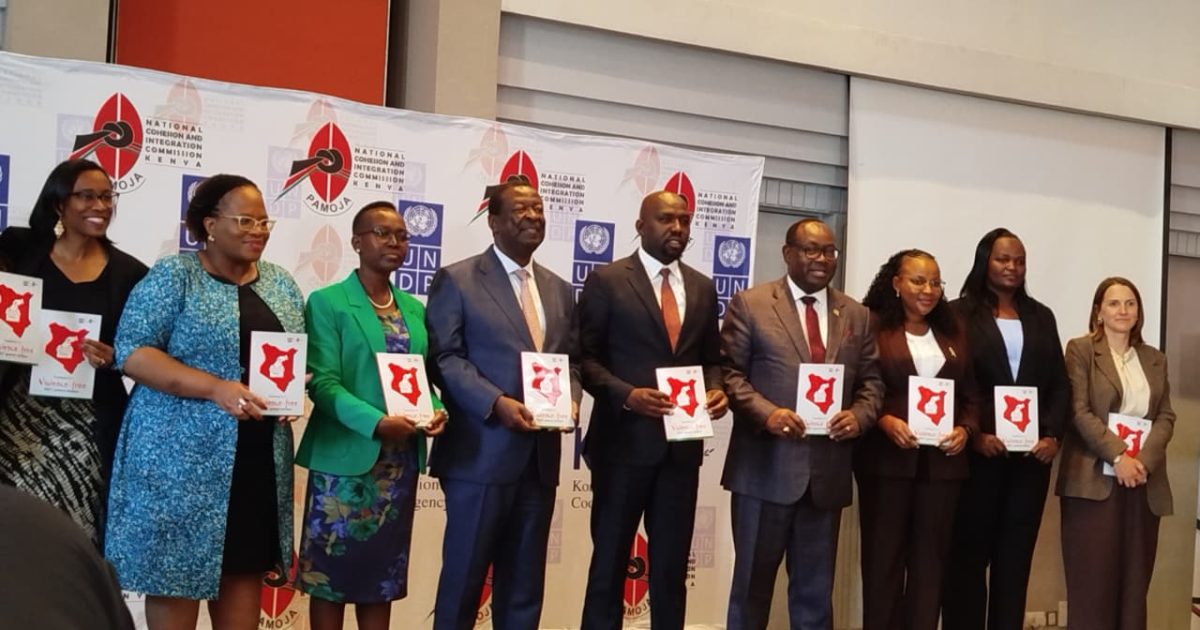
Kenya has stepped up preparations for a peaceful 2027 General Election with the launch of a new National Cohesion and Integration Commission (NCIC) roadmap that places early detection and prevention of electoral conflict at the center of the country’s peacebuilding strategy. The second edition of the “Roadmap to a Violence-Free 2027 General Election”, known as Uchaguzi Bila Noma, seeks to identify emerging political and social tensions before they escalate, while strengthening coordination among government institutions, political actors, security agencies, communities and other stakeholders.
The roadmap was launched in Nairobi by Prime Cabinet Secretary Musalia Mudavadi, alongside Interior Cabinet Secretary Kipchumba Murkomen and NCIC Chairperson Bishop Dr Kepha Nyamweya, demonstrating high-level government commitment to safeguarding national cohesion and ensuring political competition remains peaceful. Its launch places greater emphasis on preparedness well before the 2027 electoral period reaches its most intense stages, giving institutions and communities the opportunity to address potential risks through dialogue, engagement and timely intervention, rather than scrambling to respond once tensions have already boiled over.
The initiative represents an important shift in how Kenya approaches electoral security, moving away from reacting to violence after it erupts and towards identifying warning signs and addressing them early. This preventive philosophy rests on the understanding that political conflict rarely emerges without warning; that inflammatory rhetoric, ethnic mobilization and social grievances tend to build gradually, giving institutions a window to intervene before disagreements harden into wider instability. Left unaddressed, political intolerance and misinformation can quickly erode the conditions needed for peaceful democratic participation, which is why the framework places such heavy emphasis on strengthening early warning and response mechanisms across government and civil society.
The digital environment has added a new and pressing dimension to electoral preparedness. Political narratives can now spread across social media platforms at extraordinary speed, and misinformation, hate speech and AI-generated fake news threaten to complicate the political landscape by making manipulated content appear credible and allowing harmful narratives to reach large audiences within hours. The roadmap responds to this by emphasizing responsible technology use and stronger public resilience, so that citizens are better equipped to assess information critically and avoid being drawn into divisive narratives. Importantly, officials stressed that this is not about restricting legitimate political debate or treating technology itself as a threat. The goal is to ensure Kenya’s increasingly digital political space supports informed participation rather than becoming a channel for incitement and manipulation.
Conflict hotspot mapping forms another key pillar of the strategy. By identifying areas likely to require closer attention, the commission aims to direct peacebuilding resources where emerging tensions warrant it most, allowing communities and local institutions to intervene before disputes escalate into serious security challenges. This is paired with a stronger focus on political accountability: peace accountability charters for political parties are designed to encourage responsible conduct throughout the electoral cycle, while a proposed “wall of honor” and “wall of shame” would publicly recognize responsible leadership and expose inflammatory behavior, reinforcing the principle that political leaders bear responsibility for the tone of the campaigns they run.
Officials emphasized that peaceful elections cannot be secured by any single institution acting alone. Security agencies, political parties, civil society, religious organizations, media outlets and technology platforms all have roles to play, and stronger coordination among them can improve the flow of early warning information and the speed of collective response. Community engagement is considered especially critical, since local leaders and residents are often the first to notice rising tensions; meaning peacebuilding at the grassroots level offers an essential layer of protection well before disputes become national concerns.
There is also a clear economic rationale behind the push for peace. A stable political environment protects businesses, livelihoods and infrastructure, supports tourism, and helps maintain Kenya’s standing as a major regional economic hub. Peaceful elections provide the predictability investors and businesses rely on, reducing the uncertainty that can otherwise dampen confidence during politically sensitive periods.
The NCIC has indicated that Sh308.7 million is required to fully implement the framework, covering early warning systems, hotspot mapping, community engagement and other interventions through the electoral cycle. Officials say adequate funding will be essential to translating the roadmap from policy into sustained action.
Ultimately, the message behind the roadmap is not that electoral violence is inevitable, but that Kenya intends to be better prepared to prevent it while anticipating risks early, strengthening institutions, and building a political culture where competition is separated from ethnic hostility and incitement, ahead of the 2027 vote.