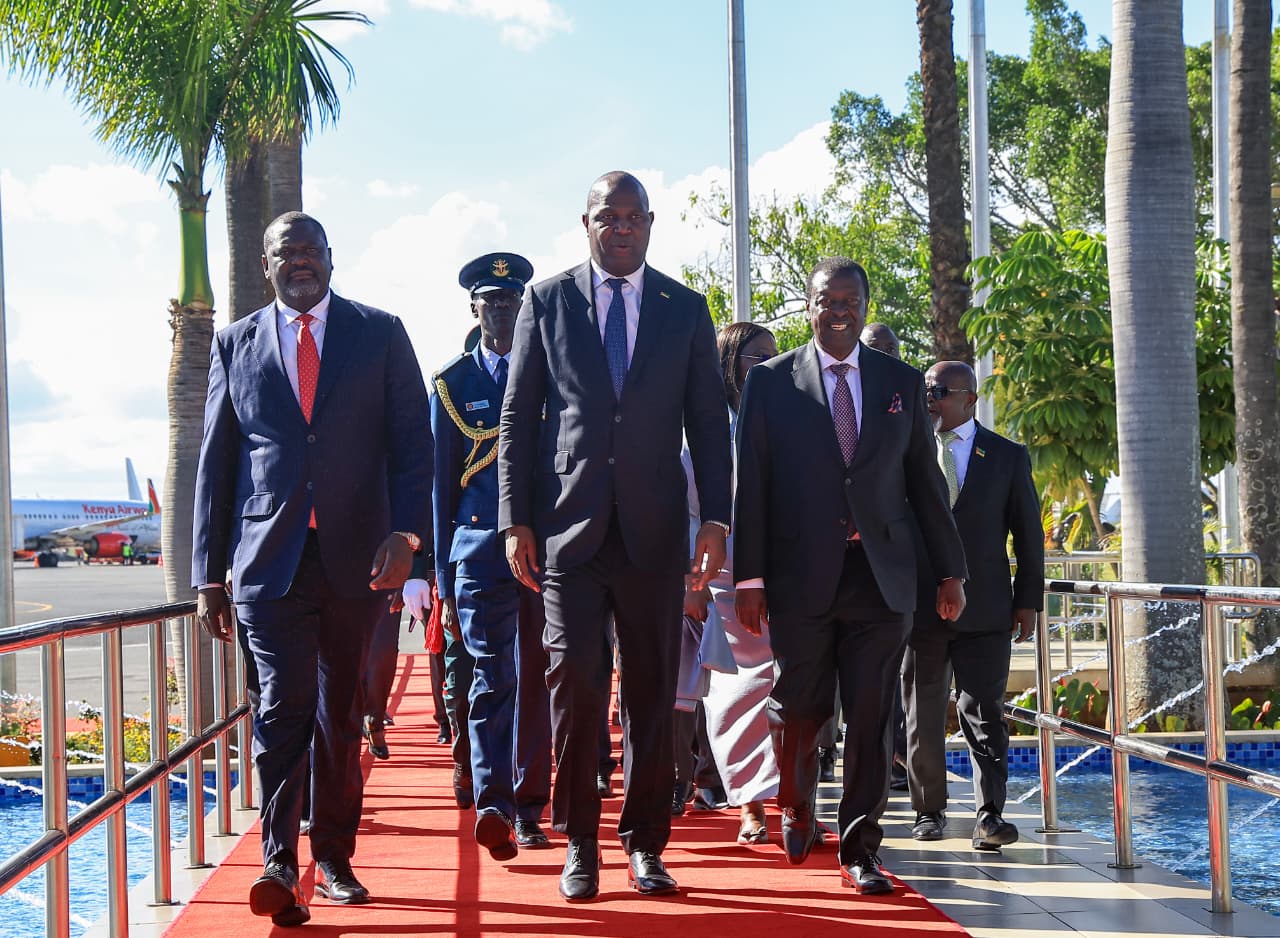
Mozambique’s President Daniel Chapo arrived in Kenya on Tuesday for a three-day state visit that blends ceremony with strategic intent. Hosted by William Ruto, the trip marks his first visit to Nairobi since taking office and carries a clear objective: to attract capital, strengthen regional ties, and project Mozambique as open for business.
The arrival of Daniel Francisco Chapo in Nairobi comes at a moment when African economies are recalibrating their alliances to withstand global economic volatility and unlock intra-continental growth. Far from a routine diplomatic exchange, the visit places Kenya at the center of a widening push to link East and Southern Africa through trade, infrastructure, and investment, while offering Mozambique a platform to reposition itself as one of the continent’s most promising yet underleveraged investment destinations. With high-level talks unfolding alongside the 4th Kenya International Investment Conference at the Kenyatta International Conference Centre, the engagements signal a deliberate attempt by both governments to translate political goodwill into bankable projects, deepen market integration, and attract global capital into sectors that have long remained fragmented or underfinanced.
The evolving partnership between Kenya and Mozambique reflects a strategic alignment of two distinct but complementary economic models that, when integrated, could reshape regional commerce. Kenya’s position as a services-driven economy anchored by finance, logistics, and a rapidly expanding digital ecosystem contrasts with Mozambique’s vast reserves of natural gas, extensive agricultural land, and long, largely underdeveloped coastline. This contrast is not a limitation but an opportunity, creating a natural basis for joint ventures that combine capital, expertise, and resources. Within the framework of the African Continental Free Trade Area, such complementarities are increasingly viewed as essential for reducing dependence on external markets while boosting intra-African trade volumes that have historically lagged behind global averages.
Infrastructure and trade connectivity are expected to dominate discussions, with both countries seeking to unlock the economic potential of Indian Ocean trade routes that remain underutilized despite their strategic importance. Kenya’s established logistics ecosystem, anchored by the port of Mombasa and its regional transport corridors, presents a gateway for Mozambican exports into East Africa and beyond, while Mozambique’s ports, including Maputo and Beira, offer Kenya alternative maritime access points into Southern Africa. The restoration of direct flights between Nairobi and Maputo in 2024 has already improved business mobility and reduced logistical friction, but the broader ambition lies in building integrated trade corridors that connect ports, rail, and road networks into a seamless system capable of supporting large-scale commercial flows. Such developments would effectively bridge the East African Community and the Southern African Development Community, creating a wider economic corridor that could redefine how goods, services, and capital move across the continent.
Energy cooperation remains one of the most strategically significant pillars of the visit, particularly as both countries confront rising demand and shifting global energy dynamics. Mozambique’s liquefied natural gas reserves rank among the largest in Africa, offering Kenya a potential long-term supply option as it seeks to diversify its energy mix and support industrial expansion. At the same time, Kenya’s global reputation in geothermal development and renewable energy innovation provides a foundation for knowledge transfer and joint investment in clean energy systems. This dual-track engagement, combining fossil fuel development with renewable energy expansion, reflects a pragmatic recognition that Africa’s growth trajectory will require both immediate energy security and long-term sustainability. Discussions are also expected to explore electricity interconnectivity and cross-border power trade, which could stabilize regional energy markets and reduce costs for industries operating across multiple jurisdictions.
For businesses, particularly small and medium enterprises, the implications of a strengthened Kenya-Mozambique partnership are substantial. Expanded market access under AfCFTA, combined with efforts to address tariff and non-tariff barriers, could open new export channels for Kenyan manufacturers and service providers while allowing Mozambican producers to tap into East Africa’s more diversified consumer base. Agribusiness stands out as a high-impact sector where collaboration could yield rapid gains, given Mozambique’s land availability and Kenya’s expertise in value addition, agri-tech, and export logistics. The integration of value chains across borders has the potential to drive industrialization, create employment opportunities for young people, and stimulate rural economies that remain heavily dependent on subsistence agriculture. At the same time, increased interaction between the two economies is likely to accelerate skills transfer, innovation, and the growth of regional enterprises capable of competing on a continental scale.
The geopolitical dimension of the visit is equally significant, particularly in the context of evolving security challenges along the Indian Ocean corridor. Mozambique continues to grapple with insurgency threats in its northern regions, while Kenya remains deeply engaged in counterterrorism efforts within East Africa. This shared security landscape has elevated cooperation in intelligence sharing, maritime surveillance, and defense coordination from a peripheral concern to a central pillar of bilateral relations. Stability along key trade routes is no longer optional but a prerequisite for sustained economic growth, especially as both countries seek to attract long-term foreign investment into sectors that are highly sensitive to risk perceptions. In this regard, the visit underscores a broader recognition that economic and security interests are increasingly intertwined.
At the policy level, the success of the visit will depend less on the number of agreements signed and more on the effectiveness of their implementation. Previous engagements under the Joint Permanent Commission for Cooperation have produced multiple bilateral instruments, yet progress has at times been slowed by delays in operationalizing technical committees, finalizing legal frameworks, and addressing logistical bottlenecks. The renewed focus on institutional mechanisms, including the establishment of structured business forums and trade facilitation platforms, suggests an awareness that execution gaps must be closed if the partnership is to deliver tangible results. Transparent governance, consistent policy direction, and active private sector participation will be critical in ensuring that announced projects translate into measurable economic outcomes.
Ultimately, the significance of President Chapo’s visit extends beyond bilateral relations, positioning both Kenya and Mozambique within a broader continental push toward integration, resilience, and global competitiveness. As African economies navigate an increasingly complex international environment marked by shifting trade alliances and capital flows, partnerships such as this are emerging as strategic tools for collective advancement. By aligning their strengths and addressing shared challenges, Kenya and Mozambique are not only deepening their own ties but also contributing to the gradual construction of a more interconnected and self-sustaining African economic system.
Kenya and Bangladesh are stepping up efforts to expand trade, investment and technical cooperation, with Nairobi seeking to establish a resident diplomatic mission in Dhaka and open new...
Read moreDetails