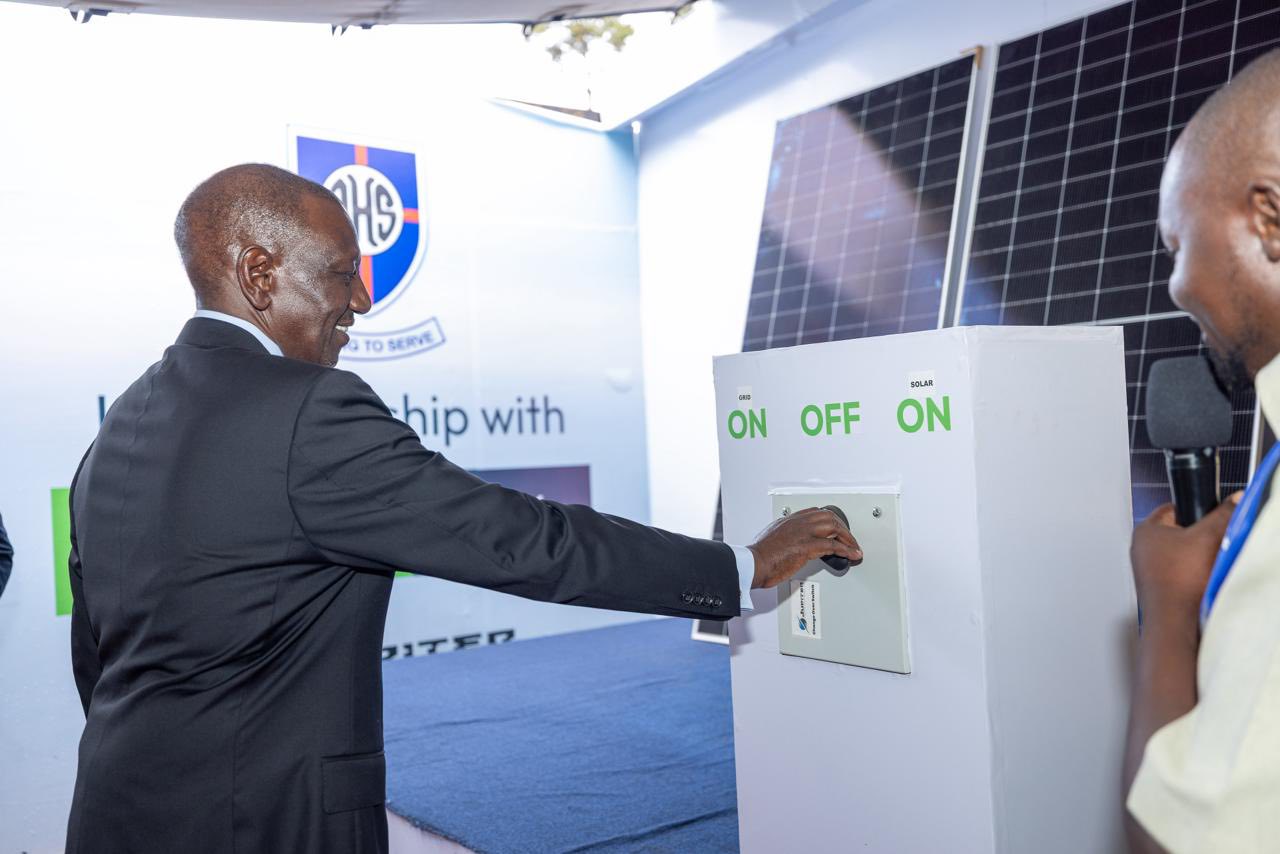
President William Ruto has set in motion one of the most ambitious education infrastructure reforms in recent years with the launch of a Sh45 billion programme to solarize 3,200 schools nationwide. Framed as a climate and cost containment intervention, the initiative is designed to shift public learning institutions away from firewood and grid dependency toward decentralized renewable power systems capable of generating up to 780 megawatts.
The scale signals urgency. Thousands of schools continue to rely on biomass for cooking and unstable grid connections for lighting and digital learning. By embedding solar infrastructure directly into school operations, the government is positioning the education sector as a frontline driver of clean energy adoption rather than a passive consumer of state supplied electricity.
Economically, the programme represents a strategic reallocation of public capital toward long term savings. Schools are among the largest institutional energy consumers in the public sector. Stabilizing their energy costs reduces recurrent expenditure pressures on the education budget and frees up resources for infrastructure, teacher deployment, and digital content. If excess electricity is integrated into the national grid during school holidays as proposed, institutions could transition from cost centers to micro energy producers, reinforcing fiscal sustainability.
Operational execution will determine whether the Sh45 billion allocation becomes transformative or burdensome. Structured procurement, transparent tendering, and phased implementation anchored in lessons from the 266-school pilot phase will be critical. Adoption of modern photovoltaic systems, battery storage technologies, and smart metering will ensure reliability while allowing integration with grid infrastructure under regulatory oversight from the Energy and Petroleum Regulatory Authority
The programme also demands robust governance frameworks. Cross ministry coordination between Energy and Education must be supported by county governments that manage localized infrastructure needs. Compliance with environmental and building regulations, standardized technical specifications, and performance monitoring mechanisms will be essential to prevent cost overruns and uneven quality installations.
Beyond infrastructure, the social dividends are significant. Reliable electricity improves classroom lighting, supports digital laboratories, powers water systems, and enhances safety in boarding facilities. Students in remote counties stand to benefit most, narrowing rural urban disparities in access to modern learning environments. Embedding renewable systems in schools further turns institutions into community demonstration hubs for sustainability practices, reinforcing behavioral change at household level.
The financial architecture of the initiative also signals a shift toward blended public private partnerships. Collaboration with commercial banks and private energy firms can accelerate rollout while distributing risk. Structured repayment models, concessional financing, and potential carbon credit frameworks could strengthen project bankability and align Kenya with emerging green finance markets.
Strategically, the solarization drive aligns with Kenya’s national energy transition strategy, which seeks to deepen renewable penetration and reduce carbon intensity. It also complements county integrated development plans that prioritize climate resilience infrastructure. At the regional level, the initiative resonates with the renewable energy integration objectives of the East African Community, particularly in harmonizing grid standards and advancing cross border environmental cooperation.
Kenya already derives a significant portion of its electricity from renewables, particularly geothermal and hydro. Embedding distributed solar generation into public institutions strengthens energy independence while cushioning the country from fuel price volatility and hydrological shocks. In climate terms, replacing biomass in thousands of schools directly addresses deforestation pressures and supports national emissions reduction targets.
The Sh45 billion solar programme is therefore more than a school upgrade project. It is a structural intervention that links education reform with energy sovereignty, fiscal prudence, and climate resilience. If implemented with discipline, regulatory integrity, and measurable performance benchmarks, it could redefine how public institutions contribute to Kenya’s green economic transformation and position the country as a regional leader in climate smart public sector innovation.

President William Ruto has unveiled a new package of economic measures aimed at easing the cost of living, increasing household incomes, creating employment and accelerating Kenya’s economic transformation,...
Read moreDetails