Kenya has secured a landmark US$2.5 billion health cooperation deal with the United States, becoming the first African nation to negotiate a new bilateral partnership under Washington’s updated global health strategy. The five-year framework marks a major shift in how the two countries will collaborate on health financing, service delivery, and disease prevention.
Under the agreement, Kenya stands to benefit from up to US$1.6 billion in U.S. support for key health programs targeting HIV/AIDS, tuberculosis, malaria, maternal and child health, polio eradication, and epidemic preparedness. This support will be tied to performance indicators and system-strengthening outcomes, reflecting a move toward more accountable and results-driven health investments.
As part of the arrangement, Kenya has committed to expanding domestic financing, pledging US$850 million in health spending over the next five years. The government will gradually assume responsibility for essential health commodities, as well as transition frontline workers currently funded by U.S. agencies onto the national payroll. A nationwide shift to electronic medical records is also planned to enhance patient data management, improve disease surveillance, and streamline resource allocation.
Principal Secretary for Medical Services Dr. Ouma Oluga described the partnership as a fundamental departure from previous models, noting that it embeds sustainability at the core of Kenya’s health financing pathway. He emphasized that the new framework is designed to strengthen the system holistically, rather than relying heavily on donor-driven programs.
The agreement further incorporates private and faith-based health providers into Kenya’s national health agenda through modernized reimbursement systems. This integration aims to broaden access to care and reduce fragmentation within the health sector by ensuring that non-state providers are adequately supported and formally aligned with national priorities.
Brad Smith, Senior Advisor for the Bureau of Global Health Security and Diplomacy at the U.S. Department of State, highlighted the global shift in U.S. foreign assistance. He noted that current discussions with partner countries are geared toward maximizing the impact of tax-payer funding, reinforcing resilient health systems, and advancing American strategic interests.
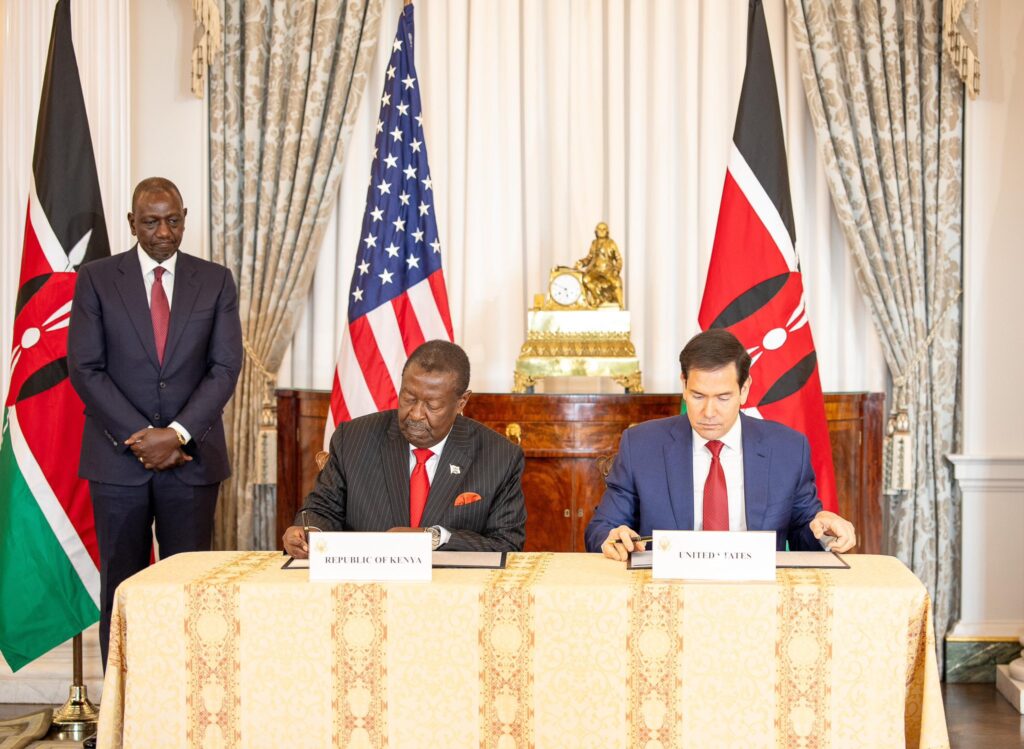
The deal comes at a time of significant reorganization within the U.S. foreign assistance structure. In early 2025, the Trump administration canceled most USAID programs and initiated steps to dismantle the agency, a move that threatened clinics worldwide and disrupted access to lifesaving medicines. Yet evidence, including a study published in The Lancet, shows that USAID interventions have saved more than 90 million lives in two decades. The new Kenya-U.S. agreement signals a reoriented American approach—prioritizing targeted, performance-based partnerships over broad, unlimited NGO-driven aid. The signing in Washington by U.S. Secretary of State Marco Rubio, witnessed by President William Ruto, underscores the strategic significance of this renewed cooperation.