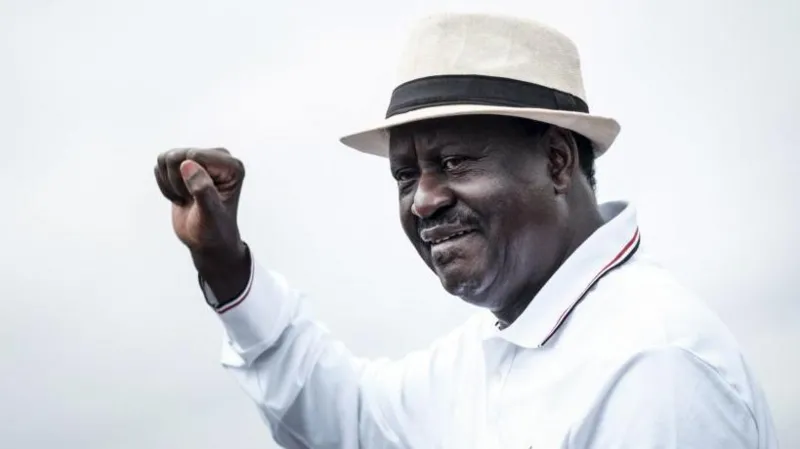
The death of Raila Amolo Odinga has brought down the curtain on the storied career of a man long regarded as the embodiment of Kenya’s struggle for democracy — a statesman who mastered the complex art of politics and left an indelible mark on the nation’s history.
Kenyans and world leaders have joined hands in mourning the former Prime Minister, who passed away on Wednesday, October 15, 2025, while receiving treatment in India at the age of 80. His passing has triggered a nationwide wave of grief for a man celebrated as one of the most influential reformists and defenders of democracy in Kenya’s post-independence era.
Fondly known as “Baba” — meaning father — Raila Odinga towered over Kenya’s political landscape for over four decades. He was the enigma of Kenyan politics: a man who wielded immense influence without ever holding the presidency, yet whose every move shaped the nation’s political direction.
Odinga’s political journey began in the early 1980s, marked by his fierce resistance to the authoritarian rule of the late President Daniel arap Moi. His pro-democracy activism earned him multiple detentions without trial, including a harrowing six-year incarceration following the 1982 attempted coup, a charge that was later dropped. He later fled into exile in Norway in 1991, returning to champion Kenya’s “second liberation” — a movement that successfully pushed for the repeal of Section 2A of the Constitution, restoring multi-party democracy.
Despite contesting the presidency five times — in 1997, 2007, 2013, 2017, and 2022 — Raila never ascended to State House. Yet, each campaign reshaped Kenya’s political order. The 2007 election crisis led to a power-sharing agreement with President Mwai Kibaki, under which Raila served as Kenya’s second Prime Minister (2008–2013), through the National Accord and Reconciliation Act brokered by the late UN Secretary-General Kofi Annan.
During his tenure, Odinga championed performance contracting in public institutions — a policy that greatly enhanced accountability in government service delivery. He was also instrumental in the formulation of Kenya’s 2010 Constitution, regarded as one of Africa’s most progressive charters. His advocacy for devolution led to the creation of 47 county governments, a transformative system aimed at addressing historical injustices, regional marginalization, and unequal resource distribution.
In his tribute, President William Ruto described Raila Odinga as “a giant of democracy, a fearless freedom fighter, and a tireless warrior for good governance.” The President lauded Odinga’s lifelong dedication to reforms that birthed the freedoms Kenya now enjoys. “Raila Amolo Odinga was a once-in-a-generation leader whose ideals transcended politics and whose legacy will continue shaping the destiny of Kenya for generations to come,” Ruto declared.
In recognition of his monumental contribution to the nation, President Ruto honored Raila Odinga with a full State Funeral — the first for an opposition leader in Kenya’s history — and posthumously awarded him the country’s highest commendation during the Mashujaa Day celebrations in Kitui County. The honor, conferred before a solemn crowd, symbolized national unity and respect for a man whose vision for Kenya went beyond party lines.
Born on January 7, 1945, in Maseno, Nyanza Region, Raila was the son of Kenya’s first Vice-President, Jaramogi Oginga Odinga, and Mama Mary Ajuma Odinga. Educated at Kisumu Union Primary, Maranda High, and later in East Germany, Raila earned a Master of Science in Mechanical Engineering from the Technical University of Magdeburg in 1970. Upon returning to Kenya, he lectured at the University of Nairobi before joining the Kenya Bureau of Standards, where he rose to Deputy Director.
His entry into active politics came in 1992 under the Forum for the Restoration of Democracy (FORD) banner, winning the Lang’ata parliamentary seat. From then on, Raila became a central figure in Kenya’s political evolution — a reformer, coalition builder, and voice for the marginalized. In 2025, he was nominated for the African Union Commission (AUC) Chairmanship, though he lost narrowly to Djibouti’s Mahmoud Ali Youssouf. Shortly after, Raila and President Ruto signed a 10-point Memorandum of Understanding to implement reforms on youth empowerment, electoral justice, devolution, and national cohesion — marking a historic moment of reconciliation between political rivals.
Odinga’s personal life mirrored his public resilience. He married Ida Odinga in 1971, and together they were blessed with four children, though they tragically lost their eldest son, Fidel Odinga, in 2015. Raila’s family, tracing its legacy from the independence struggle, remains one of Kenya’s most influential political dynasties.
The late Vice-President Michael Wamalwa Kijana once described Raila as a man who inspired both “Railamania” and “Railaphobia” — a leader who evoked unmatched passion among his supporters and deep apprehension among his rivals.
Raila Amolo Odinga’s name will forever be etched in Kenya’s national memory — a man who endured detention, exile, and political defeat, yet never abandoned his dream of a freer, fairer, and more united Kenya. His life’s work — from championing democracy to shaping constitutionalism — secures him an eternal place as the father of modern Kenyan democracy, a true statesman whose spirit will continue to guide generations long after his final bow.