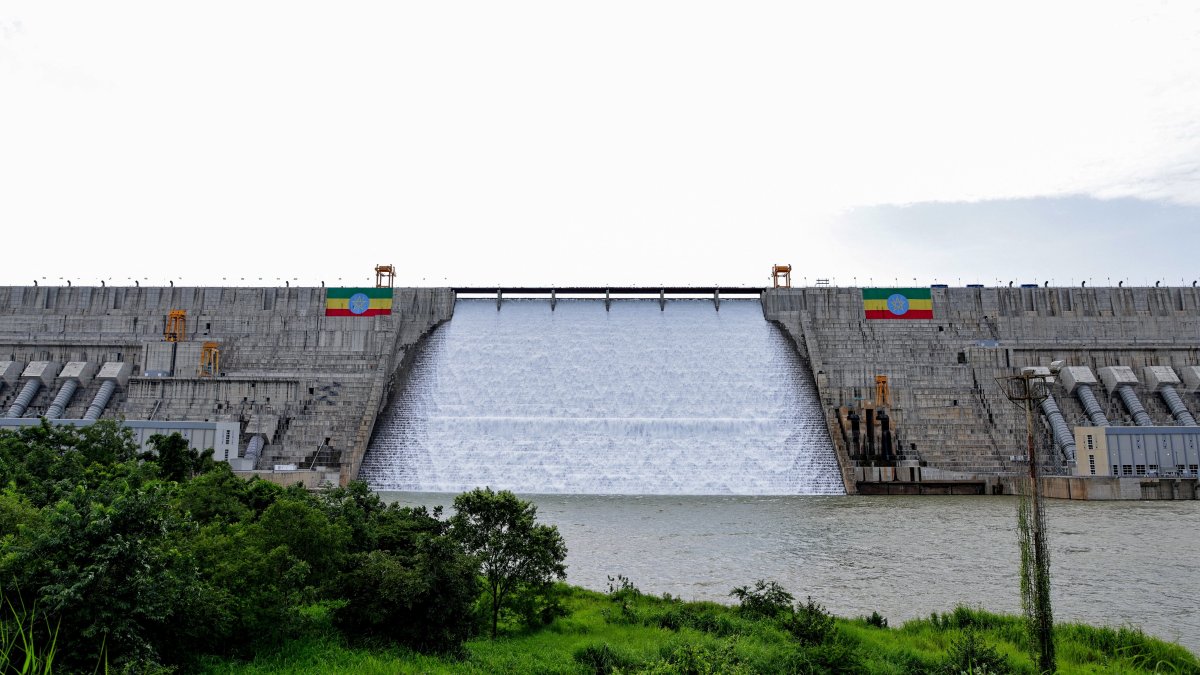
Kenya has announced its readiness to sign a new power purchase agreement with Ethiopia following the inauguration of the $5 billion Grand Ethiopian Renaissance Dam (GERD), Africa’s largest hydropower project. President William Ruto, who was the chief guest at the ceremony, described the dam as a monumental achievement that reflects Africa’s ability to mobilize its own resources and deliver transformative infrastructure.
President Ruto praised Ethiopia for successfully completing the 6,450 megawatt project, noting that it not only serves Ethiopia’s domestic needs but also offers surplus electricity for the region. He confirmed that discussions with Ethiopian Prime Minister Abiy Ahmed had already begun on Kenya’s uptake of additional reserve power from the dam, building on the 200 megawatts that Kenya started importing in 2022 through the 1,045 kilometer Ethiopia–Kenya interconnector.
Ruto underlined that Kenya’s peak electricity demand now exceeds 2,300 megawatts and continues to rise. He said that additional imports from Ethiopia will strengthen the country’s reserve margin, reduce supply deficits, and stabilize the grid, particularly during droughts when domestic hydropower production is more volatile.
“Reliable and affordable electricity is the backbone of our economic transformation. It powers industrial parks, special economic zones, ICT hubs, and agro-processing facilities. By securing more clean power from Ethiopia, Kenya is building the energy foundation for long-term growth,” the president said.
The GERD also supports Kenya’s climate goals. More than 90 percent of Kenya’s power already comes from renewable sources, and the government is committed to achieving a fully clean energy mix by 2030. Imports of zero-emission hydropower from Ethiopia will accelerate that target, helping Kenya reduce reliance on fossil fuels and improve resilience against climate-related shocks.
The launch of the GERD was attended by leaders from across the region, including Djibouti’s President Ismail Omar Guelleh, Somalia’s President Hassan Sheikh Mohamud, South Sudan’s President Salva Kiir, Prime Minister Mia Mottley of Barbados, and African Union Commission Chairperson Mahmoud Ali Youssouf. Their presence underscored the dam’s pan-African significance.
President Ruto drew a parallel between Ethiopia’s ability to finance the $5 billion dam domestically and Kenya’s own efforts to raise local resources for affordable housing projects. He said both initiatives demonstrate that African countries can chart their own paths to development without relying exclusively on external financing.
The regional benefits are already visible. South Sudan announced it would sign an agreement to purchase power from Ethiopia, while Somalia emphasized the importance of fair and equitable use of the Nile waters. For Kenya, these moves highlight the potential for the GERD to be a catalyst for a regional power market, with Nairobi well-positioned to become a central hub due to its advanced transmission network and growing industrial base.
At the same time, the project has stirred tensions with Egypt, which depends on the Nile for most of its water. Egypt has long expressed concerns that the GERD could reduce water flows during drought periods. Ethiopia has insisted that the dam has been filled carefully in phases to avoid downstream harm, with independent studies finding no major disruptions so far.
President Ruto acknowledged the concerns of the Nile Basin states and reiterated Kenya’s support for ongoing negotiations between Ethiopia, Egypt, and Sudan. He urged dialogue rooted in compromise and international norms, while offering Kenya’s technical and facilitative support to help the parties reach a lasting agreement.
By taking this position, Kenya is reinforcing its role as both a beneficiary of surplus Ethiopian power and a constructive diplomatic partner in regional affairs. The willingness to import more electricity demonstrates Kenya’s practical approach to strengthening its own economy, while its call for dialogue underscores its growing reputation as a bridge-builder in African geopolitics.
The broader impact of the GERD lies in its symbolism as well as its power generation. It represents Africa’s capacity to deliver complex, large-scale projects that directly meet the demands of modern economies. For Kenya, the opportunity is to harness this momentum to attract investment, lower energy costs, and position itself as a reliable hub in an interconnected East African power market.
At a time when energy demand across Africa is surging due to rapid population growth, urbanization, and industrial expansion, the Kenya–Ethiopia partnership offers a model of African-led solutions to African challenges. The GERD will not only illuminate homes and industries, it will also strengthen regional integration and set the stage for sustainable prosperity with Kenya at the center of this transformation.
President William Ruto personally inspected the ongoing rehabilitation of Itembe Airstrip in Bomet County, a powerful demonstration of the Government's unwavering commitment to reviving neglected infrastructure and unlocking...
Read moreDetails