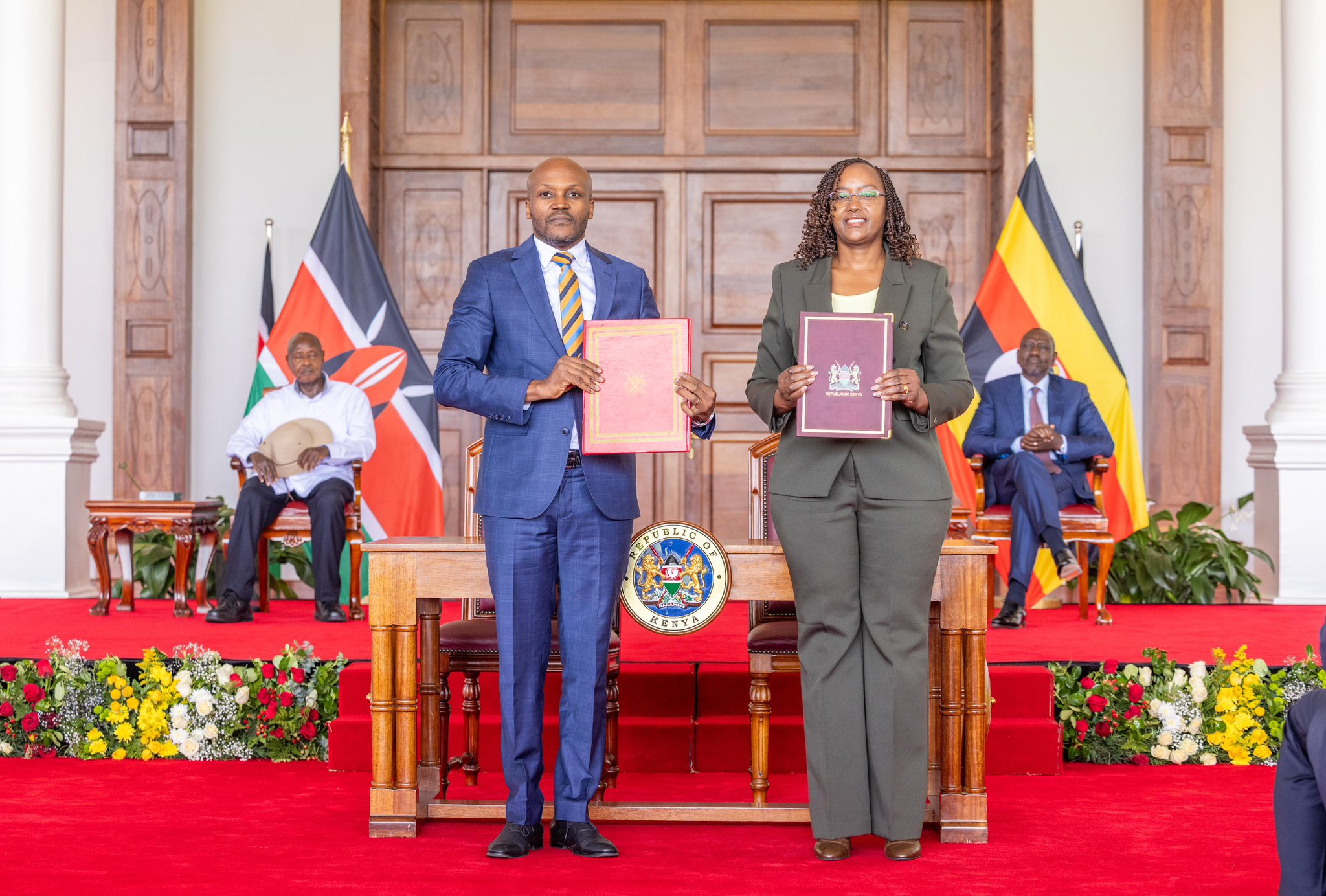
Kenya and Uganda have signed eight new bilateral agreements to deepen cooperation across key sectors including trade, infrastructure, energy, and regional security. The agreements were formalized during Ugandan President Yoweri Museveni’s official visit to Nairobi, where he was received by Kenyan President William Ruto. This latest set of memoranda brings the total number of bilateral pacts between the two countries to 25, marking a significant expansion of strategic and institutional ties.
The new agreements reflect the shared ambition of both nations to transition from longstanding political goodwill into tangible outcomes that promote economic resilience, sustainable development, and regional integration. President Ruto described the signing as a milestone that demonstrates a united resolve to translate diplomacy into direct benefits for citizens in both countries.
At the core of the agreements are commitments to deepen collaboration in infrastructure development and cross-border connectivity. Kenya updated Uganda on the ongoing Nairobi to Malaba highway dualling project, a flagship transport corridor that is expected to reduce costs for traders and ease the movement of goods between the port of Mombasa and Uganda’s interior markets. The project stands to benefit not only Uganda but also other Great Lakes countries that depend on the Kenyan route for imports and exports.
Equally pivotal is the Busia Metro Project, a cross-border urban investment initiative running from 2025 to 2028. Designed to modernize the One Stop Border Post and expand economic activity in the Busia region, the project reflects a shared strategy to enhance urban development and link local economies to international value chains. This initiative positions Busia as a model for border-centered regional growth and is expected to generate jobs, expand trade infrastructure, and stimulate private sector investment.
In the energy sector, the two leaders signed frameworks to harmonize power distribution, strengthen grid interconnectivity, and boost electrification in underserved cross-border communities. These measures aim to support industrial hubs and reduce the cost of doing business, a critical element in Kenya’s broader strategy to drive manufacturing-led growth.
The agreements also introduced a new dimension in statistical cooperation. A memorandum between the Kenya National Bureau of Statistics and its Ugandan counterpart was signed to foster the exchange of data and technical knowledge. This partnership will improve evidence-based policy-making and harmonize trade data across the border, giving both governments tools to track and grow their economies with precision.
Security and stability were also prioritized. Both presidents reaffirmed their intention to enhance cooperation in regional peace-building efforts, conflict resolution, and counter-terrorism, noting that sustainable development cannot take root without a secure environment. The two countries will coordinate more closely under the East African Community’s security framework and support diplomatic efforts across the Great Lakes and Horn of Africa.
The longstanding issue of Migingo Island, a flashpoint for cross-border tensions, was addressed through the new fisheries and aquaculture agreement. The pact introduces a consultative framework for managing shared lake resources, promoting sustainable fishing, and reducing local disputes. This is seen as a breakthrough in diffusing one of the region’s most persistent bilateral tensions.
Mining and natural resources also featured prominently. The leaders agreed to pursue joint exploration programs and curb illegal mineral extraction in border regions. These initiatives are expected to protect revenue, improve environmental governance, and formalize trade in high-value resources.
Agriculture cooperation will be expanded through joint training programs and access to improved technologies. The goal is to enhance productivity, boost food security, and protect farmers against climate shocks. In a region where agriculture remains the economic mainstay, such steps are pivotal for achieving inclusive growth.
Tourism and cultural exchange also received a boost. President Ruto announced the appointment of a special cultural envoy to promote cross-border heritage and unity among the Atekeri people, an ethnic grouping found in Kenya, Uganda, and South Sudan. Through enhanced cultural diplomacy and eco-tourism initiatives, Kenya and Uganda aim to attract more regional and international visitors to their shared landscapes and cultural assets.
The timing of the agreements is geopolitically significant. Coming just one day after Tanzania imposed restrictions on certain Kenyan businesses, the Nairobi summit signaled a reaffirmation of solidarity between Kenya and Uganda. The joint commitment to remove non-tariff barriers was a clear message in favor of a more integrated and predictable East African market.
President Museveni emphasized that young Africans should shift their focus toward value addition and economic production, leveraging Africa’s vast internal market. His call aligned with Kenya’s own policy trajectory of transforming from a transport corridor to a regional production and innovation hub.
In the broader context of East African integration, these agreements are expected to catalyze progress toward the customs union, common market, and political federation envisioned under the East African Community. Kenya’s enhanced partnership with Uganda not only secures a vital economic corridor but also projects the country as a linchpin in the region’s transformation agenda.
In the short term, the eight new agreements will spur trade, create jobs, and reduce logistical bottlenecks. In the long term, they consolidate Kenya’s position as an indispensable partner in East Africa’s political and economic architecture. With shared infrastructure projects now in motion, both countries have laid the groundwork for a more prosperous and interconnected future.
Deputy President Kithure Kindiki has reaffirmed his unwavering commitment to supporting President William Ruto in delivering transformative development projects across the country, as he embarked on an extensive...
Read moreDetails