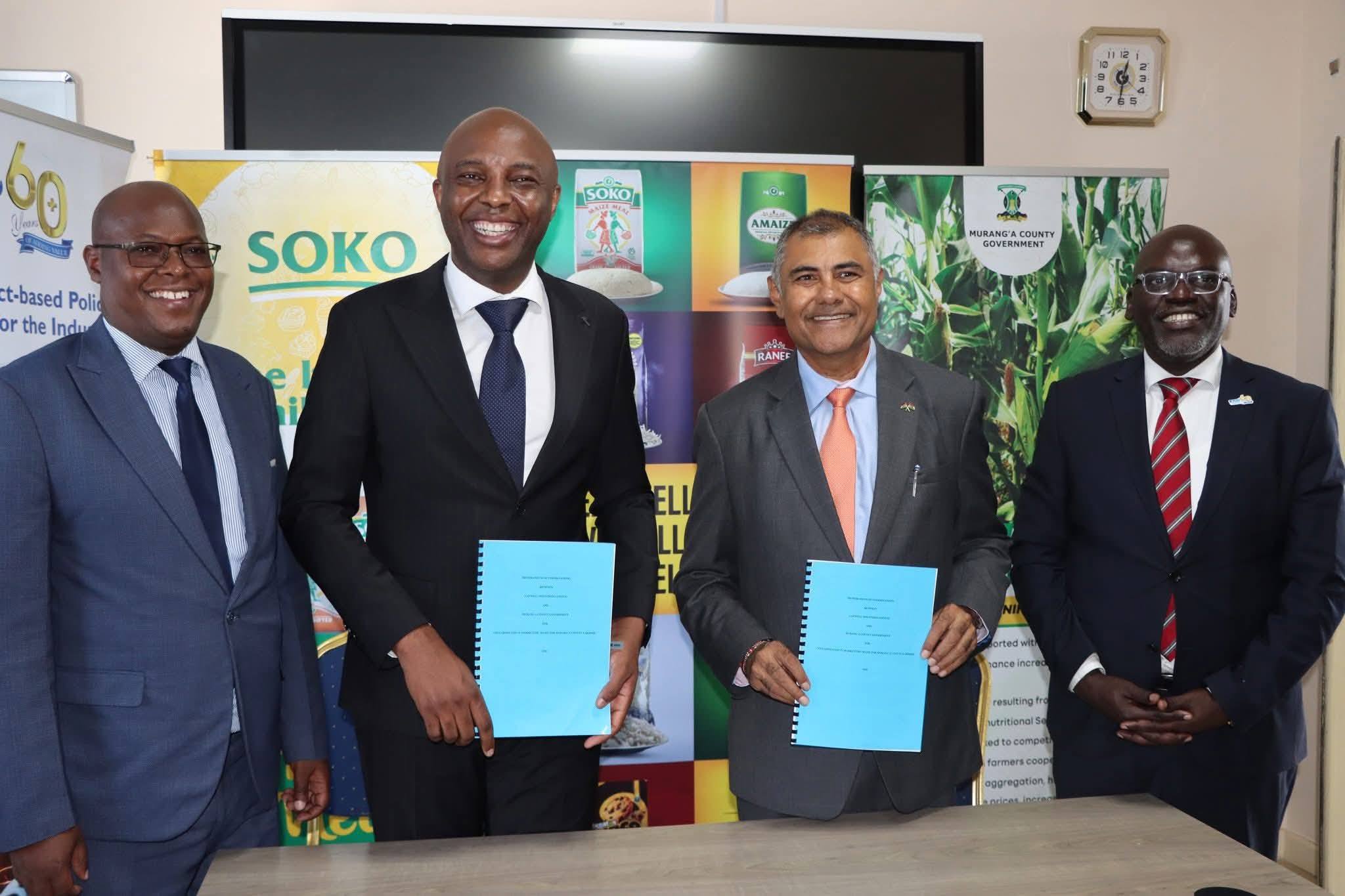
Murang’a’s Governor Irungu Kang’ata formalized a landmark public private partnership after signing a memorandum of understanding with Capwell Industries Ltd that guarantees Murang’a maize farmers a minimum price of Sh3,500 per 90-kilogramme bag. The agreement marks a strategic shift by the county government toward market-led agricultural reform, directly linking local producers to an established miller and positioning structured off-take arrangements as a central pillar of Murang’a’s drive to commercialize farming, stabilize farmer incomes, and strengthen food security under Kenya’s devolved governance framework.
Murang’a County has taken a decisive step toward agricultural commercialization with the signing of a memorandum of understanding with Capwell Industries Ltd, anchoring a new model of structured market access for maize farmers. The agreement positions the county government as an active market facilitator under devolution, linking organized producers directly to a major national miller and reducing farmers’ dependence on informal brokers and volatile spot markets.
The MoU, signed following high-level engagements between county leadership and Capwell’s senior executives, establishes a guaranteed off-take arrangement for maize produced in Murang’a. By committing to purchase maize at a minimum price of Sh3,500 per 90-kilogramme bag, the partnership significantly raises the floor on farmer earnings compared to past seasons, when many producers were forced to sell at heavily discounted prices due to weak bargaining power and fragmented marketing.
Economically, the agreement addresses one of the most persistent failures in Kenya’s maize sector: the disconnect between smallholder production and formal agro-processing demand. For farmers, a predictable buyer improves income stability, enables planning, and strengthens incentives to invest in better inputs. For Capwell, which relies on consistent grain supply for its milling operations, the partnership enhances supply-chain reliability and quality assurance while reducing exposure to supply shocks.
The deal also embeds value-chain discipline into Murang’a’s maize economy. Structured aggregation, clearer quality specifications, and factory-linked delivery reduce post-harvest losses that continue to erode farmer incomes across maize-producing regions. Losses associated with poor drying, storage, and transport have long undermined national production gains, tightening supply for millers even in surplus seasons. County-supported aggregation models, combined with guaranteed markets, offer a practical route to closing this gap.

Agriculturally, the MoU reinforces Murang’a’s broader transformation agenda under devolved governance. The county has already scaled up maize production through the Inua Mkulima initiative, which provides subsidized high-yield seed and fertilizer to more than 150,000 farmers. Without secure markets, such productivity interventions risk flooding local markets and depressing prices. The Capwell partnership aligns production support with market absorption, ensuring that increased output translates into higher incomes rather than surplus-driven losses.
Strategically, the agreement advances national food security priorities by strengthening domestic sourcing for agro-processors and reducing reliance on imports during supply disruptions. Localized procurement stabilizes maize availability for millers, supports price moderation for consumers, and keeps more value within rural economies. It also supports Kenya’s industrialization agenda by deepening linkages between agriculture and manufacturing.
The partnership further opens the door to downstream investment. Predictable volumes and standardized quality create incentives for expanded agro-processing capacity, logistics services, and storage infrastructure within the county. These investments carry employment potential across aggregation, transport, quality control, and factory operations, extending the economic benefits beyond primary production.
However, the long-term impact of the MoU will depend on disciplined implementation. Transparent pricing mechanisms, clear quality standards, and timely payments will be critical to sustaining farmer trust. Effective aggregation through cooperatives or farmer groups must be matched with extension support to ensure consistency in production and post-harvest handling. Without these safeguards, guaranteed prices risk becoming unsustainable or exclusionary
Within Kenya’s devolved economic model, Murang’a’s collaboration with Capwell Industries illustrates how counties can leverage private-sector capacity to deliver farmer-centered outcomes. By aligning public investment, industrial demand, and organized production, the county is signaling a shift toward inclusive growth driven by market integration rather than short-term price interventions. If executed well, the MoU could serve as a template for county-led agricultural commercialization that strengthens food security while placing farmers firmly at the center of value creation.