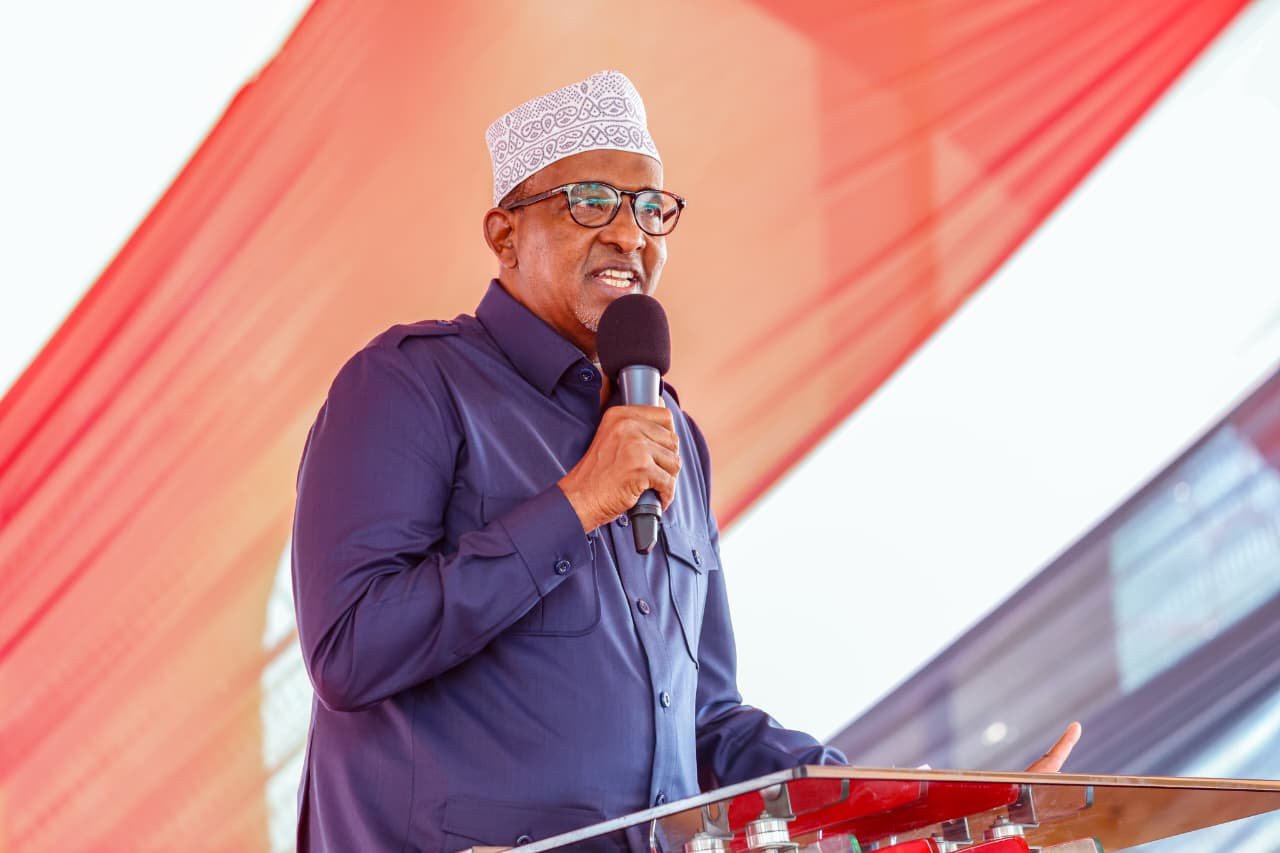
Health Cabinet Secretary Aden Duale has urged the Independent Electoral and Boundaries Commission (IEBC) to remain firmly focused on its constitutional responsibility of preparing and delivering a free, fair and credible 2027 General Election. Speaking during a wedding ceremony in Garissa, Duale called on IEBC Chairman Erastus Edung Ethekon and the commission to resist political pressure and concentrate on strengthening electoral systems ahead of the crucial national poll.
Duale’s message comes at a time when political debate surrounding the IEBC has intensified, with sections of the opposition and its allies repeatedly questioning the commission’s preparedness, particularly over the procurement and deployment of electoral technology. While scrutiny of an electoral body is legitimate in a democracy, the government maintains that political rhetoric should not be allowed to undermine public confidence in institutions tasked with protecting the integrity of the electoral process.
The CS urged the IEBC leadership to understand the enormous responsibility placed on the commission, noting that the stability and security of the country are closely linked to the credibility of elections. He challenged Chairman Ethekon to ensure that every decision is guided by the Constitution and the law rather than political pressure, emphasizing that the commission must demonstrate independence, professionalism and institutional discipline.
Duale particularly stressed the importance of transparency in the procurement of electoral technology. He called on the IEBC to strictly comply with the Public Finance Management Act and other procurement laws, warning against shortcuts or irregular dealings. Such adherence, he argued, is essential not only to safeguard public resources but also to prevent legitimate administrative decisions from being exploited as political ammunition.
The renewed political attacks against the IEBC have also exposed what the government describes as a broader opposition strategy increasingly centred on criticism rather than a coherent alternative programme for the country. Instead of presenting a comprehensive vision on economic transformation, job creation, infrastructure, national security and service delivery, opposition figures have frequently concentrated their political messaging on allegations, speculation and attacks on government institutions.
This environment, the government argues, creates fertile ground for disinformation targeting the IEBC. Unverified claims and politically motivated narratives can easily create unnecessary public anxiety, particularly when they concern sensitive issues such as electoral technology, voter registration and procurement. The government’s position is that the commission should respond through facts, transparency and timely communication rather than being drawn into political confrontations.
At the same time, the IEBC has a responsibility to ensure that its processes are sufficiently transparent to withstand political scrutiny. Credible elections require more than political assurances; they require verifiable procurement processes, reliable technology, accurate voter registers, competent election officials and effective public communication. By meeting these standards, the commission can reduce the space available for misinformation and demonstrate that its preparations are driven by the national interest.
Ultimately, Duale’s appeal is for the IEBC to rise above political noise and deliver an electoral process that commands confidence across the country. Kenya’s democratic stability cannot be left vulnerable to partisan rhetoric or disinformation. As preparations for 2027 intensify, the opposition should be challenged to compete through ideas, policies and a credible national agenda, while the IEBC must remain independent, transparent and firmly anchored in its constitutional mandate.