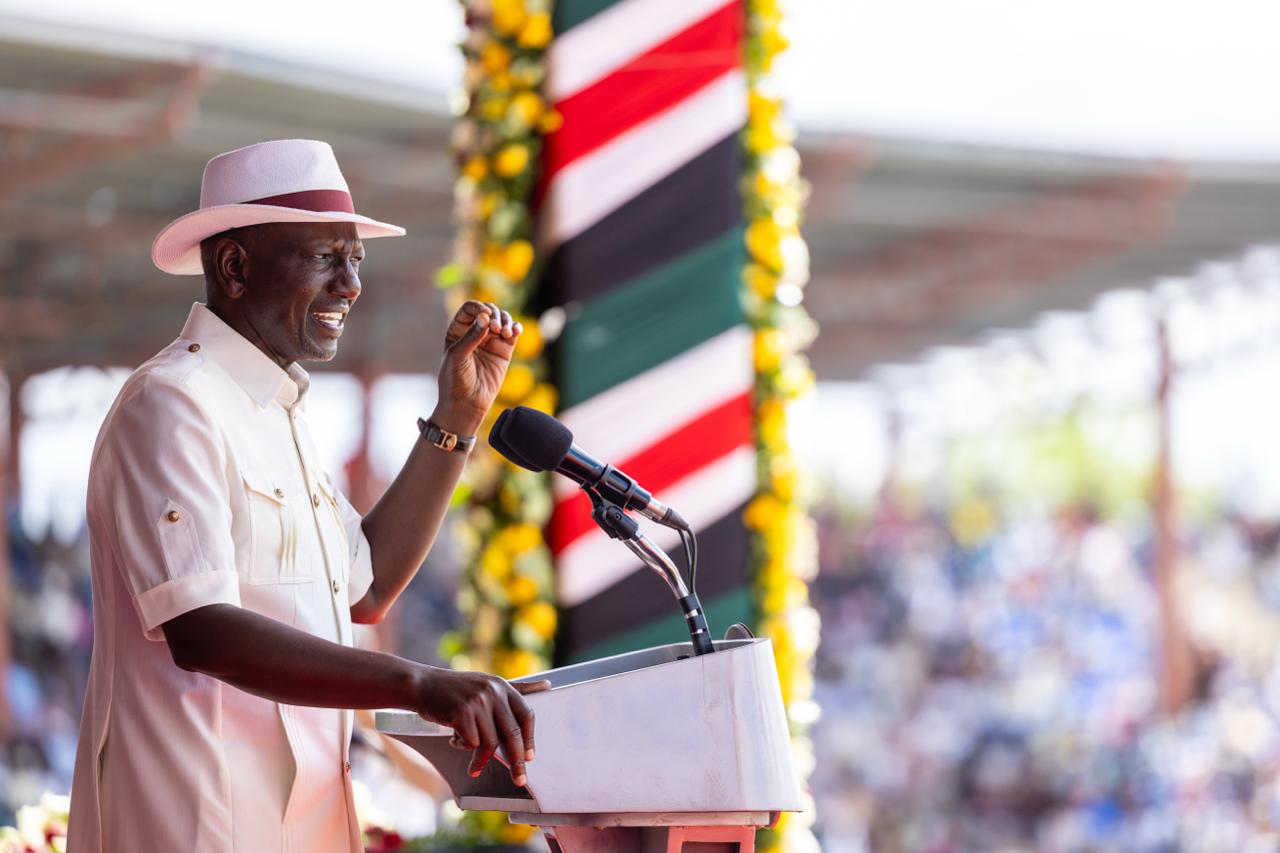
President William Ruto unveiled a series of multi-billion-shilling infrastructure, housing, transport, and economic empowerment projects across Northern Kenya in what is expected to be one of the most extensive government-led development programmes undertaken in the region in recent years. The projects, announced during the President’s engagements in Wajir County and consultations with leaders from Wajir, Mandera, and Garissa counties, form part of the government’s broader strategy to accelerate economic growth, improve connectivity, expand access to public services, and address historical development disparities that have long slowed the region’s progress.
Among the flagship projects is the construction of the Isiolo-Wajir-Mandera road under the Horn of Africa Gateway Development Project, an investment valued at more than KSh100 billion. The government expects the corridor to significantly improve transport links across Northern Kenya, facilitate the movement of goods and services, and strengthen trade connections within the region and with neighboring countries. The President also announced that the 500-kilometre Lamu-Garissa-Isiolo road is now halfway complete and remains on schedule for completion next year. Once completed, the road is expected to strengthen economic linkages between Northern and Coastal Kenya while supporting commerce, investment, and regional integration.
In the housing sector, the government is investing more than KSh45 billion in affordable housing projects across Garissa, Wajir, and Mandera counties. The programme includes the construction of thousands of housing units, student accommodation, modern markets, police housing, classrooms, and supporting public infrastructure aimed at improving living standards and expanding access to essential services. Wajir County alone is set to benefit from KSh15.6 billion allocated for the construction of 4,600 affordable housing units, making it one of the largest housing investments ever undertaken in the region.
The aviation sector is also receiving significant attention, with the expansion of Garissa Airport nearing completion and plans underway to modernize Wajir Airport through a KSh700 million upgrade. The projects are expected to improve air connectivity, support business activity, and enhance the movement of people and goods across Northern Kenya.
Beyond physical infrastructure, the government has continued implementing programmes aimed at strengthening livelihoods and economic resilience. Investments in livestock development, youth empowerment, digital infrastructure, and enterprise support are intended to create new opportunities for communities while strengthening key sectors that drive the region’s economy.
Taken together, the projects represent a major step in integrating Northern Kenya into the country’s broader development agenda. For decades, inadequate infrastructure and limited public investment constrained the region’s economic potential despite its strategic location and abundant resources. The current investments seek to reverse that trend by creating the foundations necessary for sustained growth and prosperity.
Improved roads and transport networks are expected to reduce logistical costs, shorten travel times, and improve access to markets, services, and investment opportunities. This is particularly significant for livestock producers, traders, farmers, and small businesses whose competitiveness often depends on efficient transport and market access. The affordable housing programme is equally expected to deliver substantial economic benefits beyond the provision of homes. Construction activities are already creating jobs, stimulating demand for local materials and services, and attracting private sector participation, helping generate economic activity throughout the region.
The investments also align closely with the Bottom-Up Economic Transformation Agenda by supporting infrastructure development, affordable housing, job creation, digital inclusion, and regional integration. Collectively, these interventions are designed to unlock economic potential at the grassroots level while ensuring that growth opportunities are shared more equitably across the country.
As Kenya continues pursuing balanced regional development, Northern Kenya is increasingly emerging as a strategic growth frontier. Enhanced infrastructure, improved connectivity, expanded housing, and stronger support for productive sectors are expected to attract investment, boost investor confidence, and unlock opportunities in livestock, trade, tourism, renewable energy, and cross-border commerce. The scale of the projects reflects a growing recognition that national prosperity depends on ensuring every region participates fully in the country’s economic transformation. By expanding development investments in Northern Kenya, the government is not only addressing historical gaps but also laying the groundwork for a more connected, competitive, and inclusive economy.
President Ruto’s multi-billion shilling infrastructure and housing programme therefore represents more than a collection of development projects. It marks a significant step toward accelerating economic inclusion, strengthening national cohesion, and positioning Northern Kenya as an increasingly important contributor to Kenya’s long-term growth and prosperity under the Bottom-Up Economic Transformation Agenda.