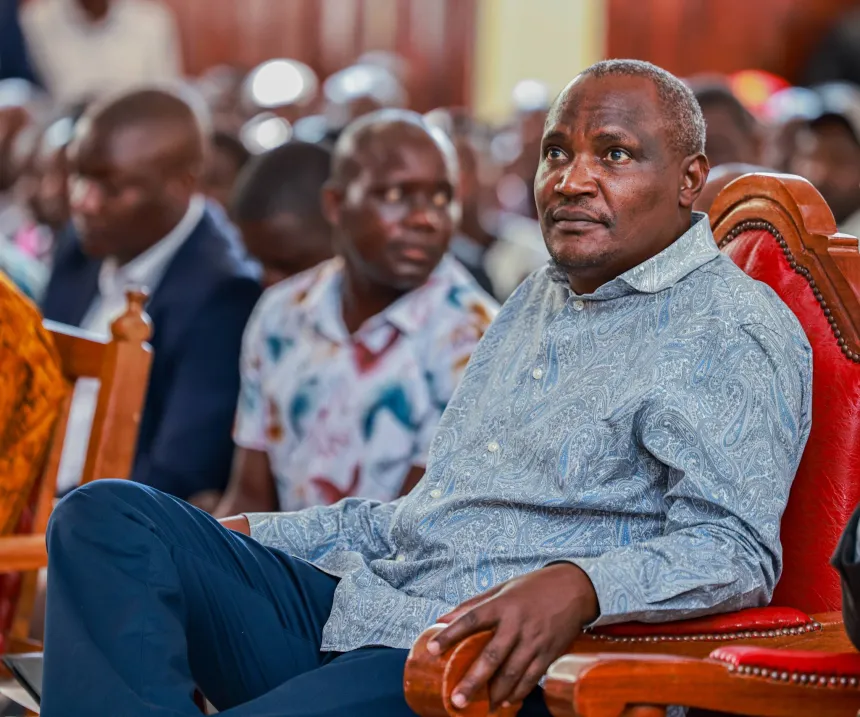
National Treasury Cabinet Secretary John Mbadi has credited President William Ruto’s leadership with securing Kenya’s economic stability at a time when the country faced an imminent risk of financial collapse. Speaking at the Privatization and Budget People’s Dialogue Forum in Eldoret on Sunday, Mbadi dismissed claims that the current administration has been inactive, arguing instead that decisive policy choices have kept the economy afloat.
Mbadi noted that when President Ruto assumed office, Kenya was listed by the International Monetary Fund (IMF) among six African countries at high risk of defaulting on their debt obligations. Of those six, he said, five have since defaulted, leaving Kenya as the only country that successfully avoided that outcome under Ruto’s stewardship.
He warned that a debt default would have had devastating consequences for ordinary Kenyans, explaining that multilateral lenders such as the IMF and World Bank typically impose harsh austerity measures on defaulting nations. These include deep salary cuts for public servants, layoffs, and sharp reductions in essential public services, outcomes the government was determined to avoid.
Reflecting on his early days at the Treasury, Mbadi described the immense pressure of balancing debt repayments with the need to keep government operations running. He recounted struggling to meet salary obligations while multiple debt payments were falling due, underscoring the fragile fiscal position the administration inherited.
Despite these challenges, Mbadi pointed to key economic gains achieved under President Ruto’s leadership. He highlighted the successful repayment of the 2027 and 2028 Eurobonds and ongoing preparations for the 2031 loan, moves he said restored confidence among international lenders and investors.
He further cited improving macroeconomic indicators as evidence of stabilization, noting that inflation has dropped from 9.6 percent at the start of Ruto’s term to below 5 percent. Foreign exchange reserves have also risen to 5.3 months of import cover, exceeding the four-month benchmark and strengthening the shilling’s resilience.
On the political front, Mbadi called on members of the Orange Democratic Movement (ODM) to unite behind party leadership and continue supporting President Ruto. He argued that cooperation with Ruto’s administration offers ODM a viable path to national leadership, adding that the people of Nyanza have already signaled their support for Ruto heading into the 2027 elections.