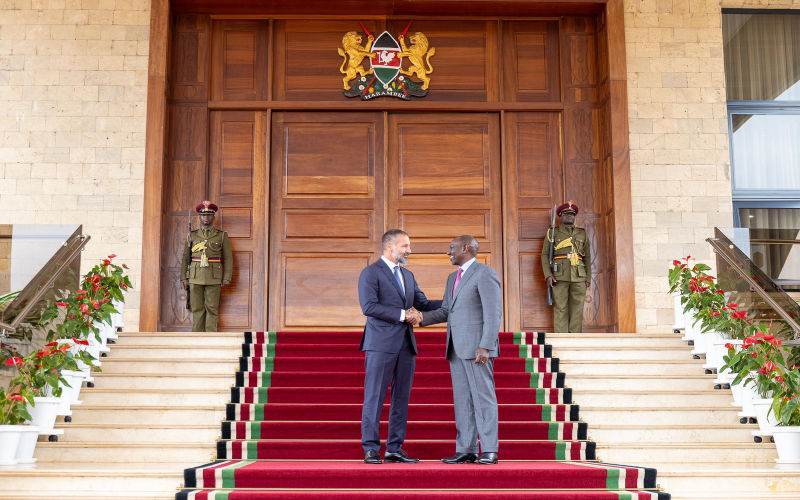
Nairobi was the focus of international attention this week as President William Ruto welcomed His Highness Prince Rahim Aga Khan V to Kenya for a three-day official visit. The visit, which ran from August 25 to 27, marked the Aga Khan’s first engagement in East Africa since becoming the 50th hereditary Imam of the Shia Ismaili Muslims earlier this year. It was also the latest milestone in a century-long partnership between Kenya and the Ismaili Imamat.
At State House, President Ruto and His Highness signed a Memorandum of Understanding on General Cooperation. The agreement will guide new collaboration in healthcare, education, environmental conservation, climate action, cultural preservation and urban renewal. President Ruto praised the deal as both historic and symbolic, pointing to the Aga Khan Development Network’s (AKDN) decades of investment in Kenya that continue to transform lives and strengthen communities.
The President also conferred on Prince Rahim Aga Khan V the Chief of the Order of the Golden Heart, Kenya’s highest civilian honour. Princess Zahra Aga Khan was similarly recognised with the Elder of the Order of the Golden Heart for her contributions to social development.
For more than 100 years, Kenya and the Ismaili Imamat have worked together through the AKDN to improve education, healthcare, economic growth and environmental stewardship. Today, AKDN employs more than 14,000 Kenyans and its programmes touch millions of people across the country.
In education, the network operates the Aga Khan Academy in Mombasa and a range of schools serving more than 5,000 students. Beyond its own schools, the Aga Khan Foundation supports 366 public primary schools across Kenya. This outreach benefits nearly 160,000 children, trains over 3,000 teachers and involves 9,000 parents, ensuring that quality education reaches even remote communities.
Healthcare is another area where the impact has been profound. The Aga Khan University Hospital in Nairobi serves as East Africa’s leading referral hospital, while facilities in Mombasa and Kisumu, together with 34 health centres and 50 outreach clinics, provide essential services to over one million patients every year. The network also trains nurses, doctors and midwives, building capacity in Kenya’s wider health system.
In the economic sector, AKDN has been instrumental in spurring growth through its companies such as Jubilee Insurance, Diamond Trust Bank and Serena Hotels. These institutions provide jobs, create stability in financial services, attract tourists and support entrepreneurship. Industrial Promotion Services also helps to strengthen Kenya’s industrial base and promote innovation.
Environmental stewardship has become a cornerstone of the partnership. More than 12 million trees have been planted across Kenya through AKDN initiatives. The Indian Ocean Coastal Regeneration project is restoring marine ecosystems, reviving farmland and improving the resilience of coastal communities. These projects match Kenya’s efforts to tackle climate change and lead on sustainability.
The latest agreement between Kenya and the Aga Khan aligns closely with President Ruto’s Bottom-Up Economic Transformation Agenda. It focuses on projects that stimulate grassroots economic activity, create jobs and improve daily life for ordinary citizens.
President Ruto singled out the Affordable Housing programme and the Nairobi River regeneration project as areas where the partnership will play a vital role. Both projects are central to improving urban living conditions and restoring the environment, while also creating thousands of new opportunities for Kenyans.
Speaking at State House, Prince Rahim Aga Khan V reaffirmed his commitment to continue building on the legacy of his late father, His Highness Prince Karim Aga Khan IV, who passed away in February. He noted that AKDN would not only use its institutional resources but also attract international partners and investors to support Kenya’s development.
The visit was a moment of continuity and renewal. The late Aga Khan IV had been honoured in 2007 with the Chief of the Order of the Golden Heart by President Mwai Kibaki, recognising his role in building hospitals, schools, media outlets and businesses that have long served Kenya. Prince Rahim Aga Khan V has pledged to continue this work, while also addressing modern challenges such as climate change and urbanisation.
Kenya’s recognition of the Aga Khan’s contributions reflects the scale of impact. AKDN’s health facilities serve more than a million patients annually. Its education programmes benefit nearly 160,000 students in public schools, while thousands more attend its private institutions. Its environmental programmes have planted millions of trees and restored fragile ecosystems. Its businesses employ thousands and fuel Kenya’s economy.
The agreements signed during the visit demonstrate Kenya’s appreciation of the Ismaili Imamat’s legacy and its determination to build on that foundation. For Kenya, the partnership represents much more than historical goodwill. It is a practical driver of growth, jobs, improved services and sustainable development.
As Kenya positions itself as a regional hub for investment, innovation and environmental leadership, the strengthened ties with the Aga Khan bring renewed confidence that the country’s future will be built on inclusive partnerships that benefit all citizens.
Kenya and Bangladesh are stepping up efforts to expand trade, investment and technical cooperation, with Nairobi seeking to establish a resident diplomatic mission in Dhaka and open new...
Read moreDetails