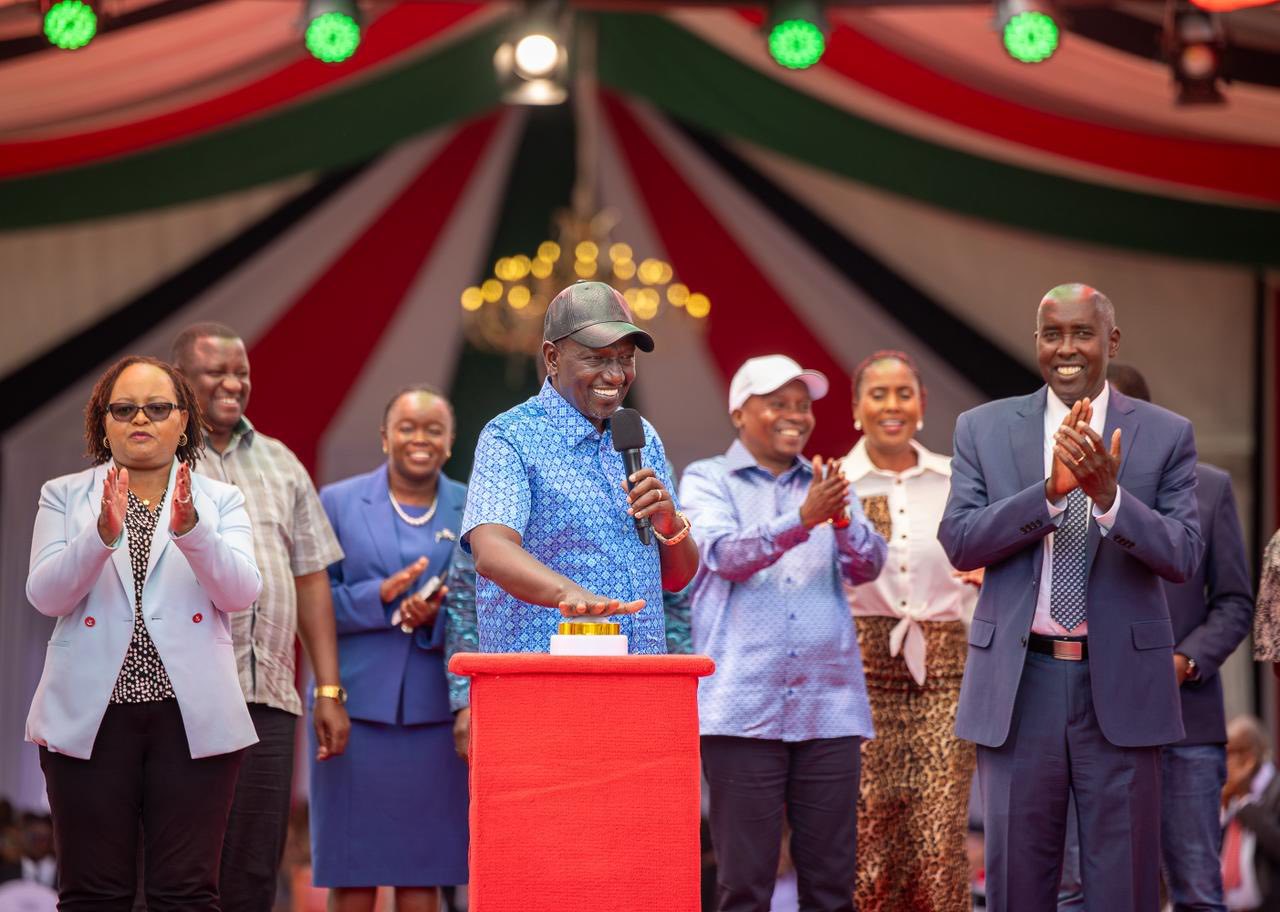
President William Ruto on Tuesday handed over NYOTA start-up funds to more than 10,000 youth at the Moi International Sports Centre, Kasarani, marking a major milestone in the government’s push to empower young entrepreneurs under the Bottom-Up Economic Transformation Agenda (BETA). The event saw the launch of KSh 258.4 million in business capital support targeting trained youth from Nairobi, Kiambu and Kajiado counties, reinforcing the administration’s focus on grassroots economic inclusion.
The beneficiaries, drawn from over 10,337 young people, each received KSh 22,000 after successfully completing a three-day business skills training programme under the NYOTA Project. The funds are structured to promote financial discipline, with part of the money credited directly into Pochi la Biashara savings accounts, while the remainder supports immediate business start-up needs.
Speaking at Kasarani, President Ruto emphasized that youth empowerment must go beyond one-off financial support. He noted that sustainable economic success requires continuous engagement, stating that the government is committed to “walking with young people step-by-step” by offering ongoing training, mentorship and regular assessments of their enterprises to ensure long-term growth.
The NYOTA Project, which is funded by the World Bank, was launched in late 2025 to address youth unemployment by equipping young people with practical business skills, start-up capital and structured mentorship. Since its rollout, the programme has reached approximately 59,000 youth nationwide, positioning it as one of the largest youth-focused enterprise initiatives under the current administration.

President Ruto reiterated that the programme is designed to help young people work, do business and exploit emerging economic opportunities across sectors. He stressed that when young entrepreneurs succeed, they not only secure their own livelihoods but also become critical partners in the broader transformation of Kenya’s economy.
While the programme has been widely praised for expanding access to capital and training, some critics have questioned whether the KSh 22,000 allocation is sufficient to sustain viable enterprises, as well as concerns over administrative costs. Government officials, however, maintain that NYOTA is structured as a catalytic intervention, with mentorship and scalability built into the programme to enable gradual business expansion.
As the NYOTA Project continues to roll out across counties, the Kasarani event underscored the government’s determination to anchor economic growth at the grassroots. By combining financing, skills development and mentorship, the initiative aims to unlock youth potential and accelerate Kenya’s journey toward a more inclusive and globally competitive, first-world economy.