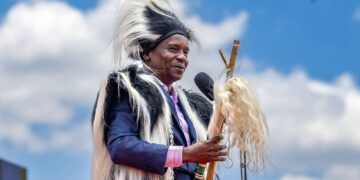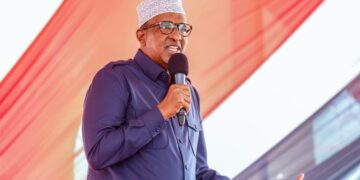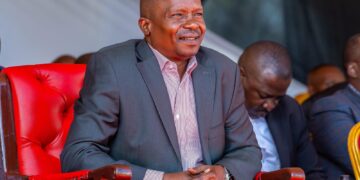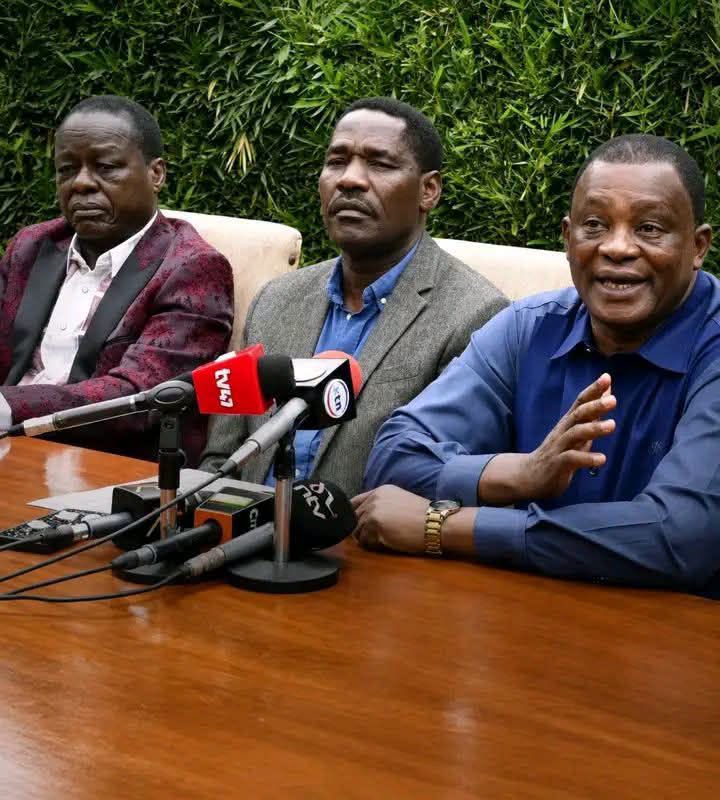
Former Meru Governor and PNU Party Leader Peter Munya has led a strong rebuke against former Deputy President Rigathi Gachagua over his calls for political parties in the Mt. Kenya region to dissolve and join the Democracy for the Citizens Party (DCP). Speaking alongside Democratic Party leader Justin Muturi and MBUS Party leader Lenny Kivuti, Munya maintained that Kenya’s Constitution guarantees a multiparty democracy and that no individual has the authority to dictate the future of independent political parties.
Reading a joint statement on behalf of the three leaders, Munya stressed that every registered political party is an autonomous institution established under the Constitution and the Political Parties Act, with its own members, leadership, delegates, and internal governance structures. He argued that decisions on whether to merge, dissolve, or enter coalitions can only be made through lawful party organs and not through public declarations or political pressure from any individual.
The leaders accused Gachagua of adopting what they described as a dictatorial approach to opposition politics by attempting to force smaller parties into DCP. They warned that such conduct undermines the democratic principles that have guided Kenya since the reintroduction of multiparty politics, arguing that unity cannot be achieved through intimidation, ultimatums, or demands for political surrender.
Their remarks also reflected growing dissatisfaction among leaders from the Mt. Kenya East region, who rejected what they see as Gachagua’s attempt to position himself as the undisputed political kingpin of the Mountain. They argued that the region has historically been politically diverse and has never recognized a single individual as its supreme political authority, insisting that “the Mountain has never had a king, and Gachagua will not be the first.”
The three leaders further dismissed suggestions that Gachagua speaks on behalf of the entire Mt. Kenya region, stating that no meeting, consultation, or consensus has ever granted him such a mandate. They maintained that the region comprises diverse political opinions and parties, making it impossible for any one leader to claim exclusive representation of its people or political direction.
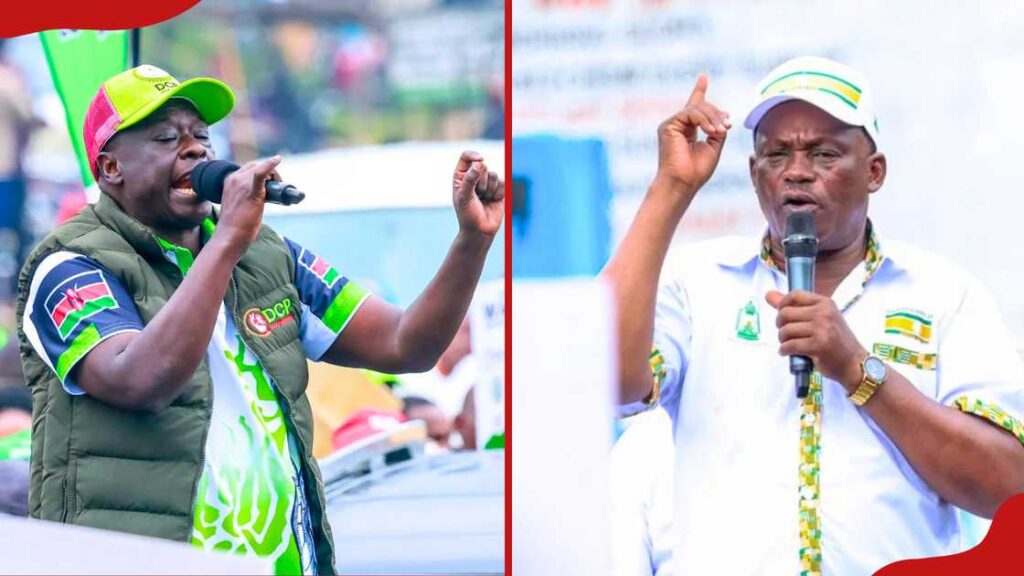
Munya emphasized that while the three parties remain committed to working with like-minded political formations to build a credible alternative government, cooperation must be based on mutual respect, consultation, and voluntary agreement. He argued that sustainable political alliances are built through dialogue and consensus rather than coercion, warning that attempts to impose one political vehicle risk weakening rather than strengthening the opposition.
The leaders also condemned what they described as increasing intimidation of politicians and supporters who choose to remain in parties other than DCP. They argued that branding those who decline to join Gachagua’s party as disloyal undermines the constitutional rights of Kenyans to freely associate with political organizations of their choice. According to the trio, political diversity should be viewed as a strength rather than a threat to opposition unity.
As political realignments continue ahead of future elections, Muturi, Munya, and Kivuti maintained that Kenya’s democratic future depends on protecting institutional independence and respecting the country’s multiparty system. They urged Gachagua to abandon divisive rhetoric and instead embrace inclusive consultations that accommodate all political players, insisting that no leader should seek to dominate the Mt. Kenya political landscape at the expense of democratic freedoms and the region’s long-standing tradition of political pluralism.