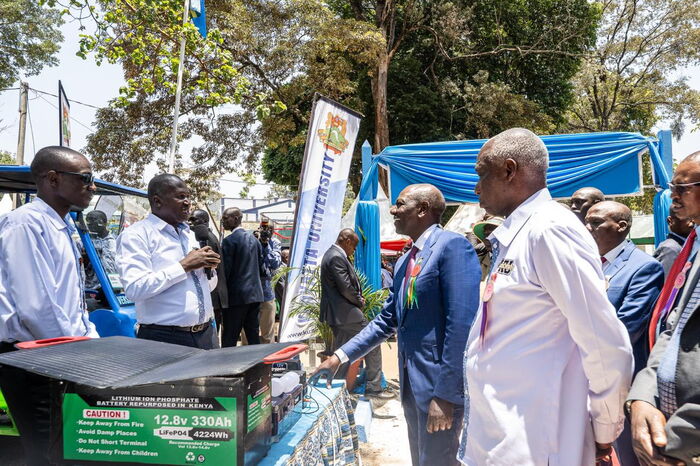
President William Ruto on Wednesday used the 2026 Nairobi International Trade Fair at Jamhuri Park to unveil a wide-ranging plan to transform Kenya’s agriculture sector through industrial parks, value addition, and expanded export markets. The strategy, he said, is designed to cut post-harvest losses, raise farmer incomes, and place Kenya at the center of new global trade opportunities.
For decades, Kenyan farmers have grappled with a system that rewards exporters of raw commodities rather than producers. Tea, coffee, cotton, livestock, and fish have largely been shipped abroad in unprocessed form, only for the country to import finished products at a premium. President Ruto declared this model outdated and detrimental, insisting that the next phase of agricultural growth will be anchored in value addition. By retaining more wealth within Kenya, the government aims to deliver better returns to farmers while strengthening the country’s competitiveness in global trade.
Central to this vision is the rollout of County Aggregation and Industrial Parks (CAIPs) across all 47 counties. These hubs will serve as the backbone of a modernized agricultural economy, offering farmers access to cold storage, warehousing, and processing facilities. By eliminating the dependence on middlemen and reducing post-harvest losses, CAIPs are expected to significantly improve efficiency in supply chains and ensure that a greater share of profits flows directly to producers. The parks will also create local employment opportunities, spur industrial growth, and deepen rural development by bringing modern infrastructure closer to farming communities.
Tea, one of Kenya’s flagship exports, is receiving special attention in this strategy. The government, in collaboration with the private sector, is establishing tea value-addition centers in Kericho, Nairobi, and Mombasa. The target is ambitious yet achievable: raise the share of value-added tea exports from the current 5 percent to at least 50 percent in the medium term. Such a shift would diversify Kenya’s tea portfolio, enable farmers to capture premium international prices, and reduce the vulnerability associated with fluctuating commodity markets. A timely Ksh3.7 billion in concessional loans has also been secured through the Kenya Development Corporation to support Kenya Tea Development Agency (KTDA) farmers in modernizing equipment and venturing into orthodox tea production, a segment that commands higher global demand.
The agricultural reforms are being matched with a robust trade diplomacy push. Kenya is leveraging its participation in the African Continental Free Trade Area (AfCFTA) while also expanding access to lucrative external markets through agreements with the European Union, China, and the United Arab Emirates. These deals create new platforms for Kenyan farmers to reach millions of consumers, ensuring that value-added products will not only meet domestic demand but also compete effectively on the global stage. As President Ruto emphasized, value addition must go hand in hand with market access if farmers are to achieve sustainable prosperity.
To sustain high levels of productivity, the government is also scaling up inputs. A record 12.5 million bags of fertilizer will be distributed during the 2026 planting season, supplementing the 4.5 million bags already procured for the short rains. This intervention is expected to lower production costs, boost yields, and stabilize food supplies at a time when climate variability poses significant challenges. Such measures signal a government determined to safeguard food security while enhancing export capacity.
The trade fair itself underscored the growing importance of agriculture and commerce as engines of national development. Among the highlights was the launch of the China–Kenya International Commerce Centre, a Sh5 billion investment within the Jamhuri Showground. Envisioned as a landmark facility, it will feature a modern exhibition and trade hub, a five-star hotel, and other commercial amenities. Beyond showcasing Kenya’s potential, the project is set to directly create 3,000 jobs while catalyzing business activity in Nairobi and beyond. It also reflects the government’s broader ambition to repurpose underutilized assets such as ASK facilities into productive economic hubs.
The announcement of the Commerce Centre further signals confidence among foreign investors in Kenya’s economic direction. With a stable and predictable environment, the country is positioning itself as a preferred destination for international capital, not only in agriculture but across trade, tourism, and services. This dual focus on domestic agricultural transformation and external investment attraction illustrates a comprehensive growth model designed to benefit farmers, entrepreneurs, and the wider population.
Kenya’s agricultural sector, long the backbone of its economy, is now being reimagined as a driver of industrialization and global competitiveness. By shifting away from the export of raw commodities and embracing value addition, the country is set to retain more wealth, improve farmer livelihoods, and build a resilient economy. The reforms outlined by President Ruto at the Nairobi International Trade Fair demonstrate not just a commitment to farmers but also a broader vision of Kenya as a hub of agribusiness innovation and global trade.
As implementation unfolds, the success of these initiatives will hinge on strong partnerships between government, private investors, and farming communities. Yet the direction is clear: Kenya is stepping boldly into a future where agriculture fuels industrial growth, trade expansion, and inclusive prosperity. This is more than a policy shift; it is a national transformation with the potential to redefine the country’s place in the global economy.
President William Ruto has challenged African nations to take charge of financing their own development by mobilising domestic resources, strengthening continental financial institutions and reducing dependence on external...
Read moreDetails