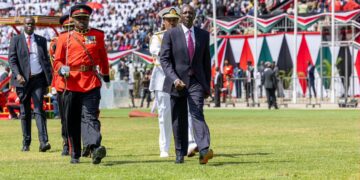
Kenya and Uganda have signed a landmark free trade agreement that removes all barriers to trade between the two countries. The deal, reached last Friday after meetings in Mbale City, Uganda, is expected to transform the flow of goods and services across the region and deepen East African economic integration.
The agreement, driven by Presidents William Ruto and Yoweri Museveni, directs both governments to treat goods from each other’s country as local products rather than imports. This means that goods will move between Kenya and Uganda without facing tariffs, excise duties, or additional charges. For the private sector, this marks the start of a simpler and more affordable way of doing business across the border.
For many years, trade between the two countries has been held back by restrictions and disputes. Kenya’s past bans on Ugandan milk and eggs, aimed at protecting local producers, caused friction and disrupted regional commerce. These protectionist measures often led to delays, uncertainty, and higher costs for traders. With this new deal, both governments have committed to resolving such disputes through joint mechanisms and to fully implement the trade protocols of the East African Community.
At the heart of the agreement is the commitment to remove congestion at border points such as Malaba and Busia. These crossings are vital for regional trade but have long been known for heavy traffic and long queues. By using technology and streamlined customs procedures, both governments aim to cut clearance times to less than two hours. This would allow cargo trucks to double their trips between Mombasa and Kampala each month, reducing costs for businesses and ensuring goods reach markets faster.
Kenya’s Cabinet Secretary for Investments, Trade and Industry Lee Kinyanjui described the deal as groundbreaking. He explained that Kenya will now treat Ugandan goods as if they were Kenyan, making trade a smooth transfer rather than an import process. His Ugandan counterpart, Minister Wilson Mbasu Mbadi, confirmed that Uganda would also remove weighbridge delays and other barriers that had long frustrated truck drivers and traders.
The deal also places strong emphasis on infrastructure. Both governments will upgrade roads, bridges, and border posts to ease the movement of people and goods. At the Suam and Lwakhakha border points, construction projects will be fast-tracked, while Kenya has committed to acquiring new cargo scanning equipment to speed up customs checks. Joint border committees will be activated to address operational issues quickly and prevent new bottlenecks.
Beyond bilateral trade, the agreement strengthens both Kenya and Uganda’s roles within the East African Community. The EAC, which brings together eight countries with a population of more than 280 million, has long aimed to create a single regional market. The Kenya-Uganda pact demonstrates the benefits of integration in practice and may encourage other member states to remove their own barriers. By showing progress on the ground, Nairobi and Kampala are providing a model for wider African trade integration under the African Continental Free Trade Area.
For Kenya, the agreement arrives at a critical moment. Tanzania recently overtook Kenya as the leading regional trader within the EAC, underlining the need for Kenya to strengthen its competitive position. Easier access to Ugandan markets, combined with reduced transport costs, will allow Kenyan businesses to expand sales, create jobs, and secure new investments. Small and medium-sized enterprises, which often face the greatest hurdles when trading across borders, are expected to benefit the most.
The private sector in both countries has already welcomed the deal. Manufacturers’ associations have expressed optimism that economies of scale and wider market access will make local industries more competitive. Border towns and trading hubs are also likely to see new opportunities as logistics and service businesses expand to meet increased demand.
Implementation, however, will be the real test. Past experience has shown that agreements can falter when corruption, weak enforcement, or political disagreements take hold. Truck drivers still complain of demands for unofficial payments at some checkpoints. Both governments have promised to tackle such practices by adopting technology and monitoring progress through joint committees. Regular reviews will track improvements in border crossing times, trade volumes, and the elimination of barriers.
The political symbolism of the deal is equally important. Presidents Ruto and Museveni have reaffirmed their partnership and their shared vision for East African prosperity. Their cooperation not only strengthens bilateral relations but also reinforces regional leadership. The two leaders are sending a message that East Africa is ready to compete in global value chains by lowering costs and building investor confidence.
This trade agreement is therefore more than a bilateral success. It is a step toward a stronger and more integrated East Africa and a boost to the African Continental Free Trade Area. For citizens and businesses alike, it promises new opportunities, lower costs, and a smoother trading environment. For Kenya, it reinforces its position as a regional economic hub and a key driver of Africa’s integration agenda.
President William Ruto has challenged African nations to take charge of financing their own development by mobilising domestic resources, strengthening continental financial institutions and reducing dependence on external...
Read moreDetails