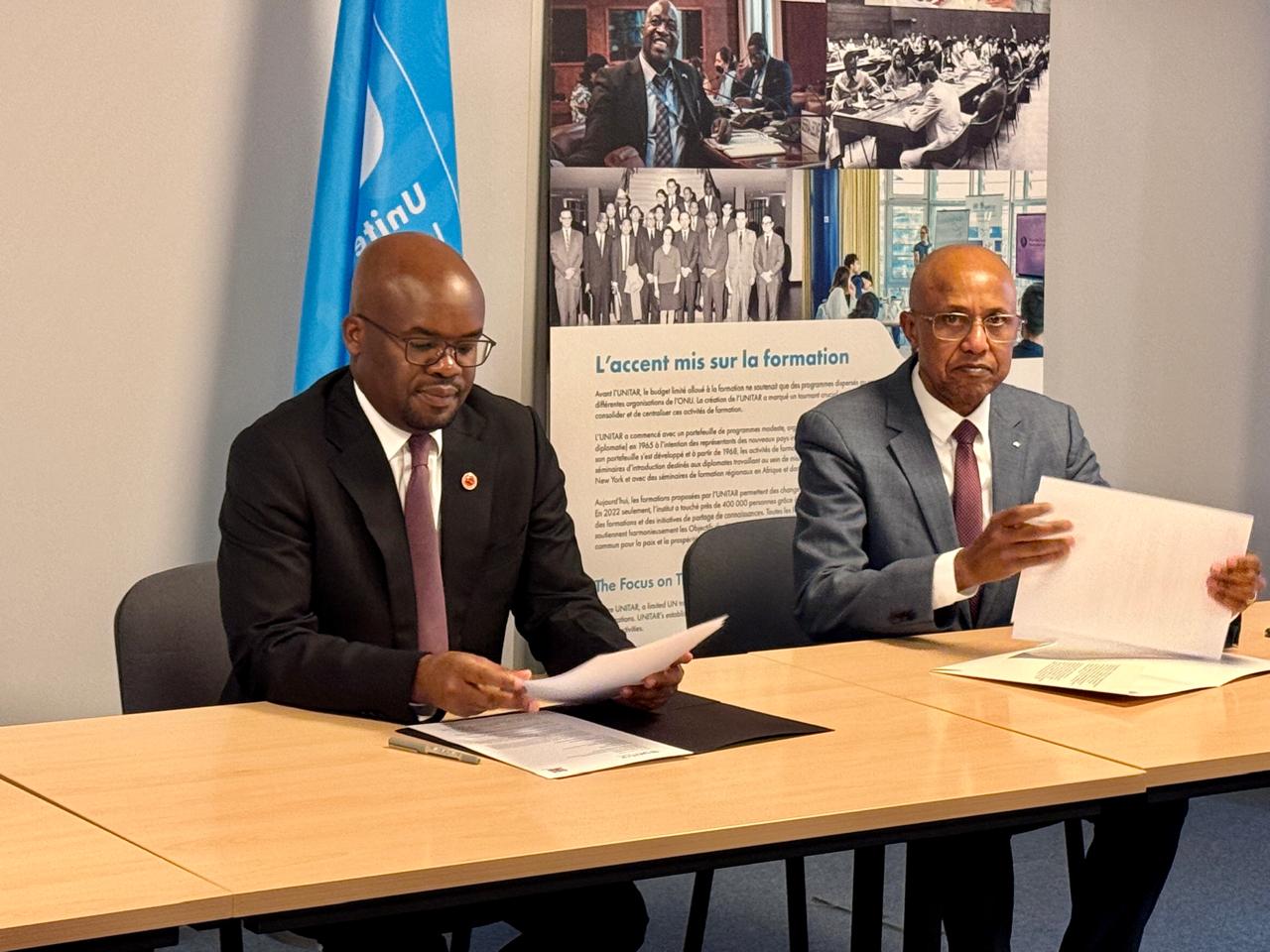
Kenya has signed a three-year Memorandum of Understanding with the United Nations Institute for Training and Research in a move that signals a structural shift in how the country intends to professionalize internal security and public administration. The agreement, concluded in Geneva by Interior Principal Secretary Raymond Omollo and UNITAR Division for Peace Director Evariste Karambizi, establishes a formal framework for coordinated training, applied research and institutional strengthening across Kenya’s security ecosystem.
While presented as a capacity building partnership, the agreement reflects a deeper recalibration of national security governance. It positions training, policy coherence and institutional reform at the center of Kenya’s internal security strategy rather than relying primarily on operational responses to emerging threats.
The framework targets National Government Administrative Officers, the Kenya Police Service, the Administration Police Service, the Directorate of Criminal Investigations, the Kenya Prisons Service and the Kenya Coast Guard Service. The scope underscores a whole of government approach that seeks to break long standing institutional silos and uneven standards across agencies.
The Ministry of Interior, which oversees internal security, border management, immigration services and coordination of national government functions at the county level, stands to anchor this reform process. By aligning frontline enforcement units, regulatory authorities and administrative officers under a shared capacity development model, the MoU introduces structured planning across multiple levels of governance.
The inclusion of the Kenya Coast Guard Service is particularly strategic. It signals recognition that maritime security, illegal fishing, trafficking and transnational crime are not peripheral concerns but core components of national stability and economic protection. Integrating maritime and land-based enforcement within a unified training and research framework reflects a broader understanding of interconnected security risks.
The partnership carries significant economic implications. A professional, accountable and coordinated internal security system directly influences investor confidence, trade facilitation and protection of critical infrastructure. Efficient border management and improved inter agency coordination reduce transaction costs and vulnerabilities that undermine economic growth.
Institutional capacity development also has long term fiscal benefits. Standardized training, leadership development and policy research reduce duplication, minimize operational inefficiencies and strengthen resource allocation. Over time, this translates into more predictable budgeting and improved public service delivery.
Strategically, the agreement strengthens Kenya’s standing within regional security cooperation frameworks. As a key actor in East Africa, Kenya’s ability to align domestic institutions with international standards enhances interoperability with regional partners and multilateral security initiatives. This alignment supports cross border intelligence sharing, maritime surveillance cooperation and coordinated responses to organized crime and violent extremism.
At an operational level, the MoU prioritizes tailored training programmes, applied research and knowledge exchange. This approach integrates evidence-based policy making into security planning, moving institutions toward data driven decision making and modern operational methodologies.
Human resource development stands at the center of the framework. Leadership training, professional ethics, respect for human rights and accountability mechanisms are expected to strengthen institutional integrity. This is critical in reinforcing adherence to the rule of law and rebuilding public trust in enforcement agencies.
Technology and research integration form another pillar of the agreement. By leveraging UNITAR’s global expertise in governance and security training, Kenya gains access to international best practices, comparative policy insights and modern management tools. Embedding research within operational planning reduces reactive decision making and supports long term strategic forecasting.
Inter agency collaboration is also likely to improve through shared curricula, joint simulations and coordinated policy development. A unified training architecture encourages common standards, clearer communication channels and structured coordination between national government ministries and field level officers.
Public accountability is an implicit outcome. Professionalized institutions operating under clearly defined standards and continuous evaluation are better positioned to meet constitutional obligations and citizen expectations. Stronger governance frameworks also reinforce transparency and oversight within the security sector.
The agreement aligns with Kenya’s broader reform trajectory, which has increasingly emphasized professionalization of services, improved border and maritime security, and institutional integrity. It complements ongoing efforts to enhance administrative efficiency, digitize public services and modernize governance systems.
Regionally, the pact reinforces Kenya’s role as a security anchor within East Africa. As threats evolve in complexity, ranging from cross border crime to cyber risks and maritime insecurity, structured partnerships that combine international expertise with local knowledge become critical.
The three-year duration of the framework suggests deliberate, sustained engagement rather than a short-term intervention. Its renewal clause provides flexibility while signaling confidence in long term institutional transformation.
Kenya’s partnership with UNITAR reflects a calculated investment in proactive governance. By embedding training, research and institutional reform into the core of internal security policy, the government is seeking to build resilient systems capable of adapting to emerging threats and administrative challenges.
The agreement demonstrates recognition that effective security is inseparable from effective governance. Coordinated engagement between ministries, security agencies, regulatory authorities, international partners and local stakeholders is essential to shaping standards, improving operational efficiency and safeguarding the rule of law.
In positioning capacity building as a strategic priority, Kenya is signaling that modern internal security depends on structured planning, multi-level coordination and sustainable institutional development. The UNITAR partnership therefore represents more than a diplomatic accord. It is a statement of intent to integrate international expertise, domestic reform and multi stakeholder collaboration into a cohesive model for accountable, efficient and resilient public administration and security services that support national development.

Internal Security PS Dr. Raymond Omollo Reaffirms Commitment to Peace, Rule of Law and Development The Government has declared zero tolerance for political violence, reaffirming its commitment to...
Read moreDetails