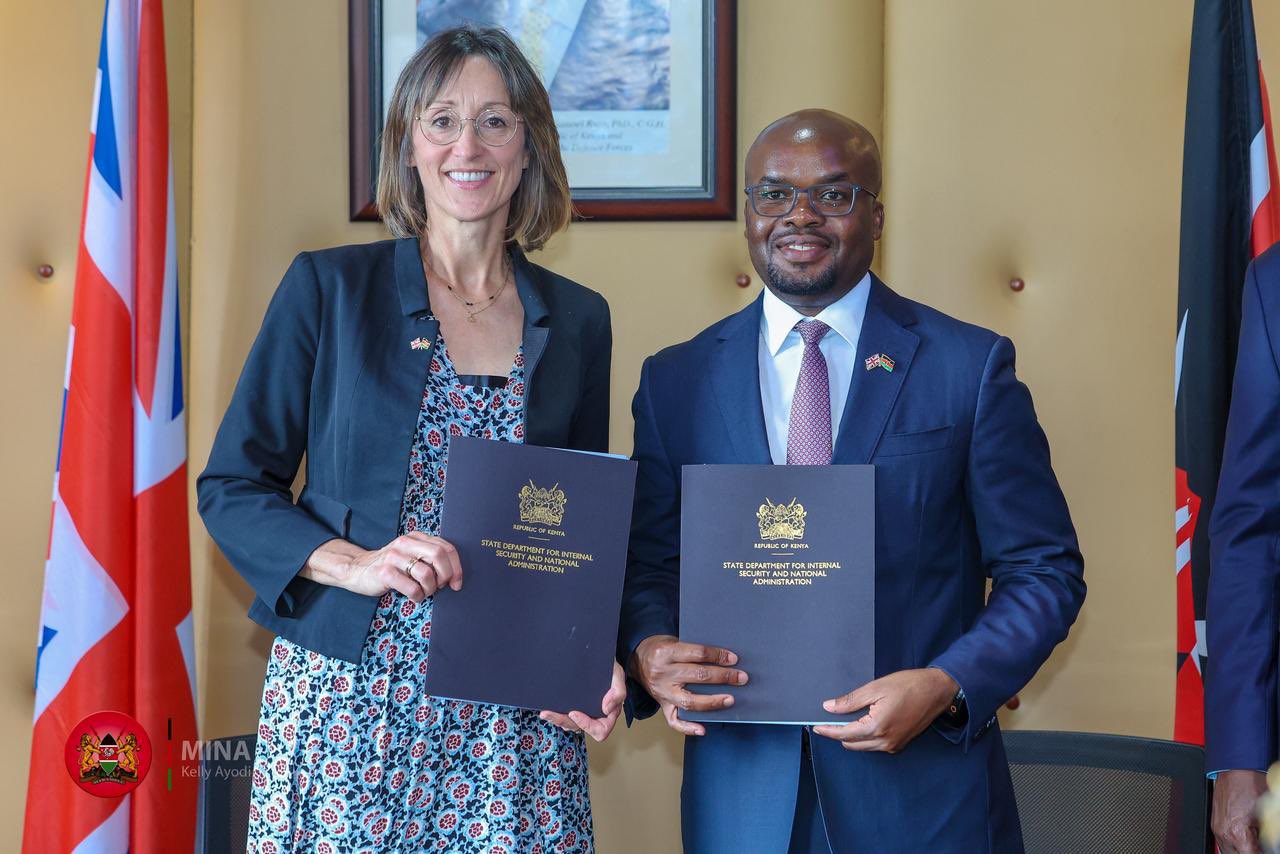
Kenya has signed a memorandum of understanding (MoU)with the United Kingdom, the International Organization for Migration and security technology firm VALAR, positioning border security at the center of its national security strategy as the government moves to tighten surveillance, curb cross-border crime and strengthen migration management in high-risk frontier regions.
The MoU, signed under the leadership of the Ministry of Interior and National Administration, places border security firmly within Kenya’s broader national security and development agenda. It comes amid rising pressure on Kenya’s borderlands from transnational crime networks, irregular migration flows, human trafficking and cross-border insecurity, particularly along the Kenya–Somalia and Kenya–Ethiopia corridors.
Senior officials from Kenyan security agencies joined counterparts from the UK government, IOM and VALAR at the signing ceremony, underscoring the high-level political and operational commitment behind the initiative. The presence of top diplomatic and security officials highlighted Kenya’s positioning as a central security partner in the Horn of Africa and a frontline state in regional migration governance.
The agreement will initially focus on Turkana, Mandera, Marsabit, Wajir and Busia counties, regions that sit at the intersection of insecurity, underdevelopment and porous borders. These counties have long faced challenges linked to cattle rustling, extremist infiltration, arms trafficking and irregular cross-border movement. By prioritizing these areas, the government is signaling a shift from reactive security deployments toward preventive, intelligence-led and community-linked border management.
At an operational level, the MoU is designed to strengthen surveillance capacity, early warning systems and intelligence sharing across agencies. Improved coordination between national security organs, county-level security committees and international partners is expected to close long-standing gaps that criminal networks have exploited. The partnership also emphasises capacity building through specialized training, professional development of border officers and structured support for local security institutions.
Technology deployment is another core pillar of the agreement. With VALAR’s involvement, the programme introduces a private-sector dimension focused on modern border management tools, data-driven risk analysis and enhanced situational awareness. This approach reflects a broader policy shift toward technology-enabled security systems that reduce reliance on manpower-heavy deployments while improving response times and accountability.
The economic implications of the MoU are equally significant. Secure and predictable borders are essential for trade, investment and livelihoods in frontier regions that have historically been marginalized. By reducing cross-border crime and stabilizing migration flows, the programme aims to support legitimate trade, protect local economies and improve investor confidence in border counties that have lagged behind national growth trends.
Strategically, the agreement reinforces Kenya’s role as a security anchor in East Africa and the wider Horn. The UK’s involvement reflects shared concerns around terrorism, organised crime and irregular migration, while IOM brings global expertise in humane and orderly migration management. Together, the partnership aligns Kenya’s domestic security priorities with international migration and protection frameworks, strengthening compliance with regional and global obligations.
The MoU also builds on existing initiatives such as Deris Wanaag and the Land Border Programme, rather than duplicating them. This continuity is critical for institutional memory, resource efficiency and long-term impact. Implementation will be led by the Ministry of Interior, with structured engagement from security agencies, development partners and community leadership to ensure local ownership and sustainability.
However, the success of the agreement will ultimately depend on disciplined implementation. Clear legal frameworks, defined inter-agency roles and sustained funding will be necessary to avoid fragmentation. Effective oversight mechanisms and data-sharing protocols will also be essential to balance security imperatives with human rights and community trust, particularly in sensitive border regions.
The partnership further reflects Kenya’s evolving approach to security under its devolved governance model. By strengthening coordination between national authorities and county-level structures, the MoU recognizes that border security is not only a national concern but also a local governance and development issue.
In aligning government institutions, international partners and the private sector, Kenya is signaling a commitment to inclusive, modern and adaptive security solutions. The collaboration with the UK, IOM and VALAR points to a future in which border management is driven by technology, intelligence and partnerships rather than force alone, positioning Kenya to better safeguard its borders while managing migration in a way that supports national stability, regional cooperation and long-term socio-economic development.

Internal Security PS Dr. Raymond Omollo Reaffirms Commitment to Peace, Rule of Law and Development The Government has declared zero tolerance for political violence, reaffirming its commitment to...
Read moreDetails