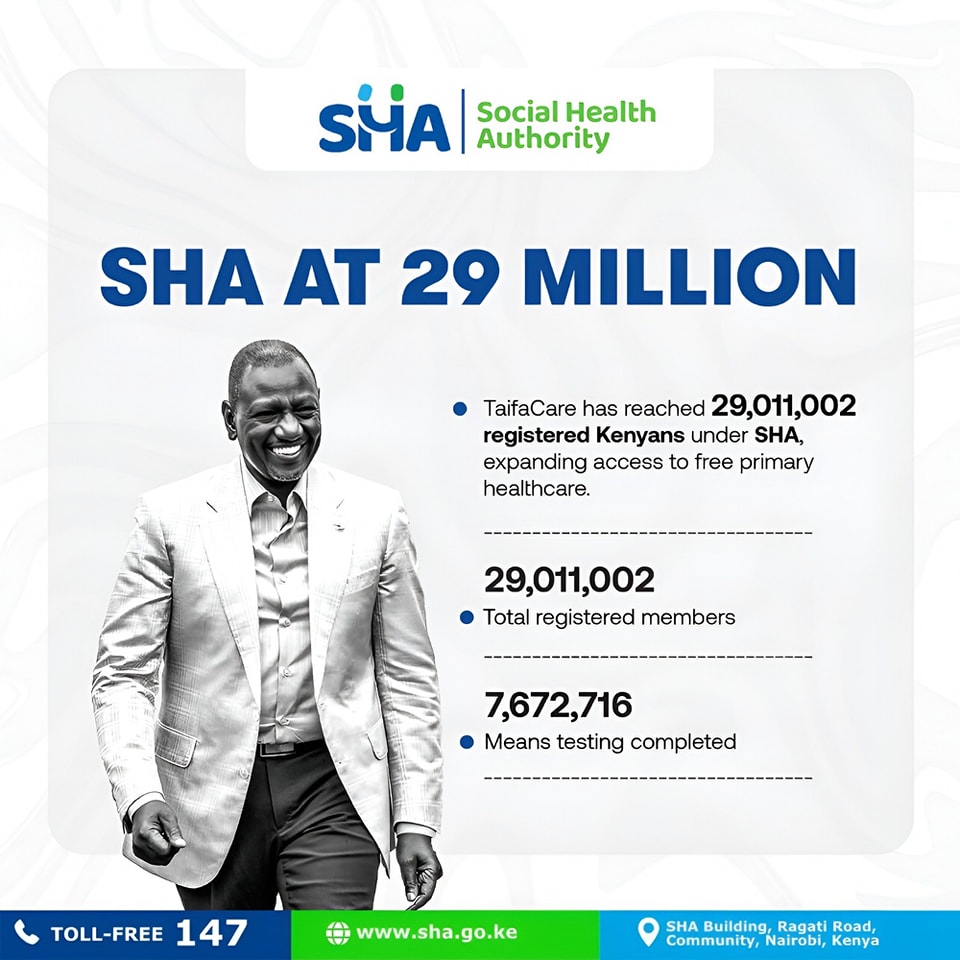
More than 29 million Kenyans have registered under the Social Health Authority, marking a major moment in the government’s push to overhaul the country’s healthcare system. The milestone signals a rapid nationwide rollout of the new health insurance model and a clear shift away from a system that left millions paying for treatment out of their own pockets.
The scale of the registration drive shows strong political backing from the Kenya Kwanza administration and firm commitment to making health cover a basic right rather than a luxury. Health financing reforms that once moved slowly are now being implemented at speed, placing the Social Health Authority at the centre of the government’s Universal Health Coverage plan.
For years, medical bills have been one of the biggest causes of financial stress for Kenyan families. Many delayed treatment, sold property, or went into debt to pay hospital fees. The expanded SHA coverage is designed to reduce this burden by spreading risk across millions of contributors and ensuring predictable funding for healthcare services.
The impact goes beyond hospitals. With more people covered, households are better protected from sudden health shocks, workers are less likely to lose income due to untreated illness, and small businesses face fewer disruptions when medical emergencies arise. A healthier population also means higher productivity and stronger economic participation.
The expansion strengthens equity in healthcare access. Informal sector workers, rural communities, women, youth, and low-income households are being brought into a system that previously favored those in formal employment. Access to preventive and primary care is expected to increase, reducing pressure on referral hospitals and cutting the cost of treatment over time.
Behind the numbers is a coordinated national effort. The rollout has been driven by collaboration between the national government, county administrations, public and private health facilities, and community structures. Registration campaigns, local outreach, and facility-based enrollment have helped reach households that were previously excluded from insurance schemes.
Digital systems have played a key role in accelerating registration and improving oversight. Online platforms now support member enrollment, provider payments, and service tracking. These tools are intended to reduce delays, limit fraud, and ensure health funds are used for patient care rather than lost through inefficiencies.
As coverage expands, attention is shifting to system readiness. The government is investing in additional health workers, better equipment, upgraded facilities, and stronger supply chains to meet rising demand. Referral systems are also being strengthened to ensure patients move smoothly between levels of care.
The SHA rollout is closely tied to the Bottom-Up Economic Transformation Agenda. Affordable healthcare lowers the cost of living and protects incomes, particularly for households that depend on daily earnings. By reducing health-related financial shocks, the reform supports economic stability at the grassroots level.
The milestone also aligns with Kenya Vision 2030 goals on social protection and human development. A reliable health insurance system supports long-term growth by building a healthier and more resilient workforce capable of driving economic expansion.
Reaching 29 million registrations marks more than a statistical achievement. It signals a government determined to reset how healthcare is funded and delivered. If implementation keeps pace with enrollment, the Social Health Authority could become one of the most far-reaching social reforms in Kenya’s recent history.