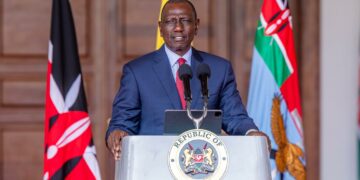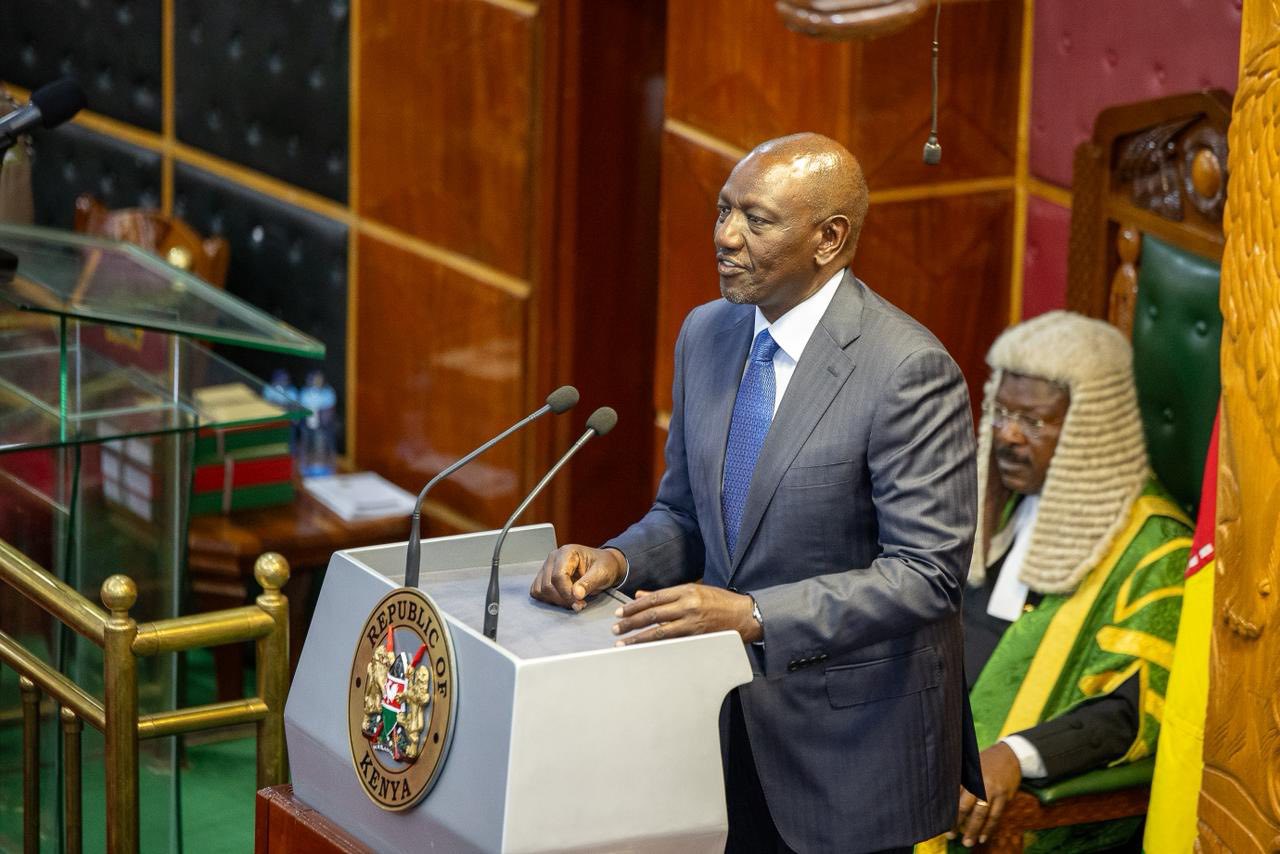
President William Ruto has unveiled an ambitious Sh5 trillion transformation plan aimed at propelling Kenya from a developing to a developed nation, using his State of the Nation Address to outline a bold shift in national thinking and investment. Addressing a joint sitting of Parliament in Nairobi, Ruto said Kenya must abandon the habit of settling for mediocrity and emulate high-performing economies such as South Korea and Malaysia, which he praised for their discipline, strategic investments and long-term planning. He said the plan will prioritise investment in people, irrigation, energy, and transport, and will be financed through innovative mechanisms rather than unsustainable borrowing.
Ruto outlined four national priorities that will guide the next phase of his administration: massive investment in education, skills, science and innovation; a nationwide shift to water harvesting and irrigation; an aggressive scale-up of power generation; and a ten-year modernisation of Kenya’s transport and logistics network. He emphasised that at least Sh5 trillion will be needed to deliver these priorities, but ruled out financing them through heavy debt or reliance on foreign aid. Declaring that Kenya’s development must be driven by its own resources, the President vowed that public revenues would be protected and that corruption would not be allowed to undermine national progress.
The President acknowledged that Kenya’s past dependence on debt — including large infrastructure loans — had helped build key assets but had also increased fiscal vulnerability. To achieve the new vision, he announced the creation of a National Infrastructure Fund and a Sovereign Wealth Fund, which will ring-fence privatisation proceeds and natural resource royalties for long-term development rather than short-term budget support. All privatisation revenues will be channelled into the Infrastructure Fund, which will be used to leverage up to ten times more in private capital from pension schemes, sovereign partners and global development financiers. The Sovereign Wealth Fund, he said, will secure wealth for future generations, stabilise the economy against global shocks and invest commercially in strategic national projects.
Ruto used the address to highlight what he described as the stabilisation of Kenya’s economy since he took office in 2022. He said inflation had fallen sharply, the shilling had stabilised at around 129 to the dollar, foreign reserves had risen above $12 billion, and GDP had grown from $115 billion to $136 billion, lifting Kenya from the eighth- to the sixth-largest economy on the continent. He said foreign direct investment had more than tripled, the Nairobi Securities Exchange had rebounded, and warnings of possible default had evaporated. In dismissing critics, he accused some opponents of spreading falsehoods for political gain.
On agriculture and food security, Ruto said production subsidies and digital farmer registration were yielding visible results. More than 7.1 million farmers are now registered, while 21 million bags of subsidised fertiliser have been distributed nationwide. He said maize production had risen from 44 million bags in 2022 to a projected 70 million bags this year, and the price of a 2kg packet of flour had fallen significantly. Earnings from tea, coffee, sugar, cotton, edible oil and nuts have all increased, he added. To end reliance on rain-fed agriculture, he announced plans for 50 mega dams, 200 medium and small dams and thousands of micro dams to bring 2.5 million acres under irrigation within seven years, especially in arid regions.
Ruto also set out major plans in energy, transport and infrastructure, saying Kenya must add 10,000 megawatts of new power within seven years to support e-mobility, industry and data-driven technologies. Over the next decade, the government intends to dual 2,500km of highways and construct 28,000km of new tarmac roads. Next week, he will launch the dualing of the Rironi–Naivasha–Nakuru–Mau Summit and Rironi–Maai Mahiu–Naivasha roads to ease congestion on key corridors. The Standard Gauge Railway will be extended from Naivasha to Kisumu and eventually Malaba beginning January 2026, reinforcing Kenya’s status as the region’s transport hub.
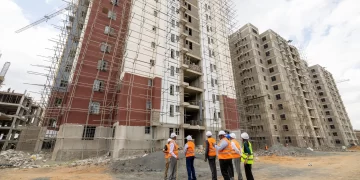
The President defended his housing, health and education programmes, citing progress on 230,000 affordable homes, 178,000 student beds, and the expansion of markets and urban regeneration projects. He said the new Social Health Authority has enrolled 27 million Kenyans, tripling national health coverage, while community health promoters have visited millions of households. Education reforms have seen 76,000 teachers hired, with 24,000 more expected by January 2026, alongside thousands of new classrooms, expanded laboratories and increased TVET enrolment.
Ruto closed his address by stating that the long-term plan had been developed after consultations with leaders across the political divide, including former President Uhuru Kenyatta and the late Raila Odinga. He said both leaders underscored the need for strong infrastructure, energy and food security as foundations for industrialisation. Thanking the 13th Parliament for supporting key reforms, he urged the country to choose ambition over caution as Kenya seeks to join nations that have successfully transitioned into developed status.