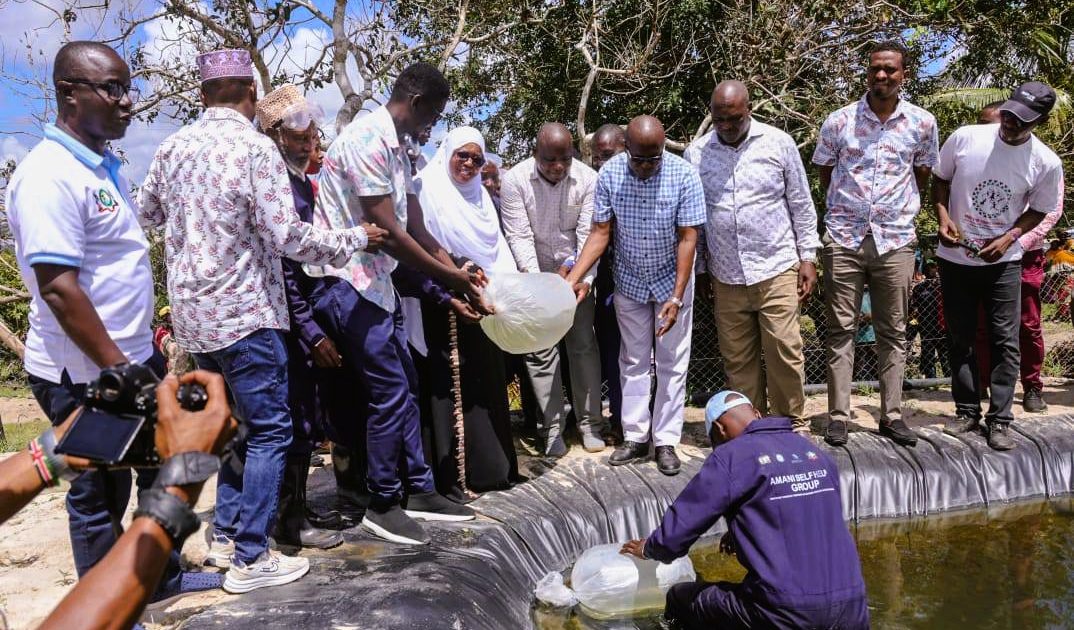
Kwale County has stepped up efforts to boost fish production and transform local livelihoods through a Sh10 billion partnership with the Kenya Marine Fisheries Socio-Economic Development (KEMFSED) project. Backed by the World Bank and implemented by the State Department for Blue Economy and Fisheries, the initiative runs from 2020 to 2025 across Kenya’s coastal counties. Kwale is positioning itself at the forefront of this program, using aquaculture and modern fishing practices to drive food security, create jobs, and unlock new economic opportunities.
At the heart of the program is the drive to transform fishing into a profitable and sustainable venture for local communities. Small-scale fishers are receiving tangible support through the distribution of equipment such as fiberglass boats, modern nets, cold storage facilities, GPS devices, and safety gear. This support allows them to expand from traditional inshore fishing to deep-sea ventures, unlocking greater potential for higher yields and improved incomes. By investing in modern equipment, the project is not only safeguarding livelihoods but also positioning Kwale’s fishing communities to compete effectively in regional and international markets.
The initiative has also placed aquaculture at the center of Kwale’s development agenda. More than 60 freshwater ponds have been established across sub-counties such as Msambweni, Matuga, Lunga Lunga, and Kinango. With 70,000 Nile tilapia and catfish fingerlings distributed, farmers are diversifying their income streams and reducing over-reliance on marine fisheries. The introduction of aquaculture provides households with a stable food source, while enabling women and youth to participate more actively in economic activities. In turn, this is strengthening the social fabric of the county by spreading benefits across generations.
Governor Fatuma Achani has championed the project as a cornerstone of rural transformation. She emphasizes that fish farming is more than an alternative livelihood. In her view, it is a strategic pillar of economic transformation that creates sustainable incomes, strengthens food security, and empowers communities to take charge of their future. Her vision reflects a growing recognition that the blue economy is integral to Kenya’s broader economic agenda. The county’s efforts to provide pond fencing materials, harvesting nets, post-harvest tools, and water quality testing equipment demonstrate a holistic approach that addresses the entire aquaculture value chain.
Beyond the immediate gains in fish production, Kwale is laying the foundation for long-term sustainability. The operationalization of the first National Marine Hatchery at the National Mariculture Resource and Training Centre in Shimoni is a landmark achievement. With a capacity to produce between four and five million larvae annually, the hatchery ensures a reliable supply of disease-tolerant and nutrient-rich species. This milestone signals Kenya’s determination to move beyond subsistence-level fishing towards a structured aquaculture industry capable of contributing significantly to national food production and exports.
Farmers and fisherfolk have welcomed the changes with optimism. Beneficiaries such as David Mukoma and Ramadhan Gang’ombe note that the project provides a pathway to stable incomes, reliable food sources, and renewed hope for local families. Their voices reflect the human impact of the program, where once-marginalized communities are now stepping into roles as drivers of economic progress. The focus on women and youth further ensures inclusivity, spreading opportunities to groups that often face barriers in accessing resources.
For Kenya, and particularly Kwale County, the benefits extend beyond individual households. The growth of aquaculture contributes to the national goal of food self-sufficiency, reduces pressure on overexploited marine resources, and opens new opportunities for trade. The program is also stimulating local supply chains, from the provision of feed and equipment to transportation and processing services, which in turn fuels broader economic growth.
In the bigger picture, Kwale’s success under the KEMFSED initiative signals a shift in Kenya’s economic landscape. By embracing aquaculture and investing in the blue economy, the country is demonstrating how targeted partnerships and community-driven programs can deliver tangible results. With improved livelihoods, stronger food security, and expanding opportunities in both farming and fishing, Kwale is positioning itself as a model of resilience and innovation. For Kenya, this progress underscores the untapped potential of the coastal belt as a driver of sustainable prosperity.
President William Ruto has placed Micro, Small and Medium Enterprises (MSMEs) at the center of Kenya’s economic transformation strategy, recognizing the sector as the backbone of job creation,...
Read moreDetails