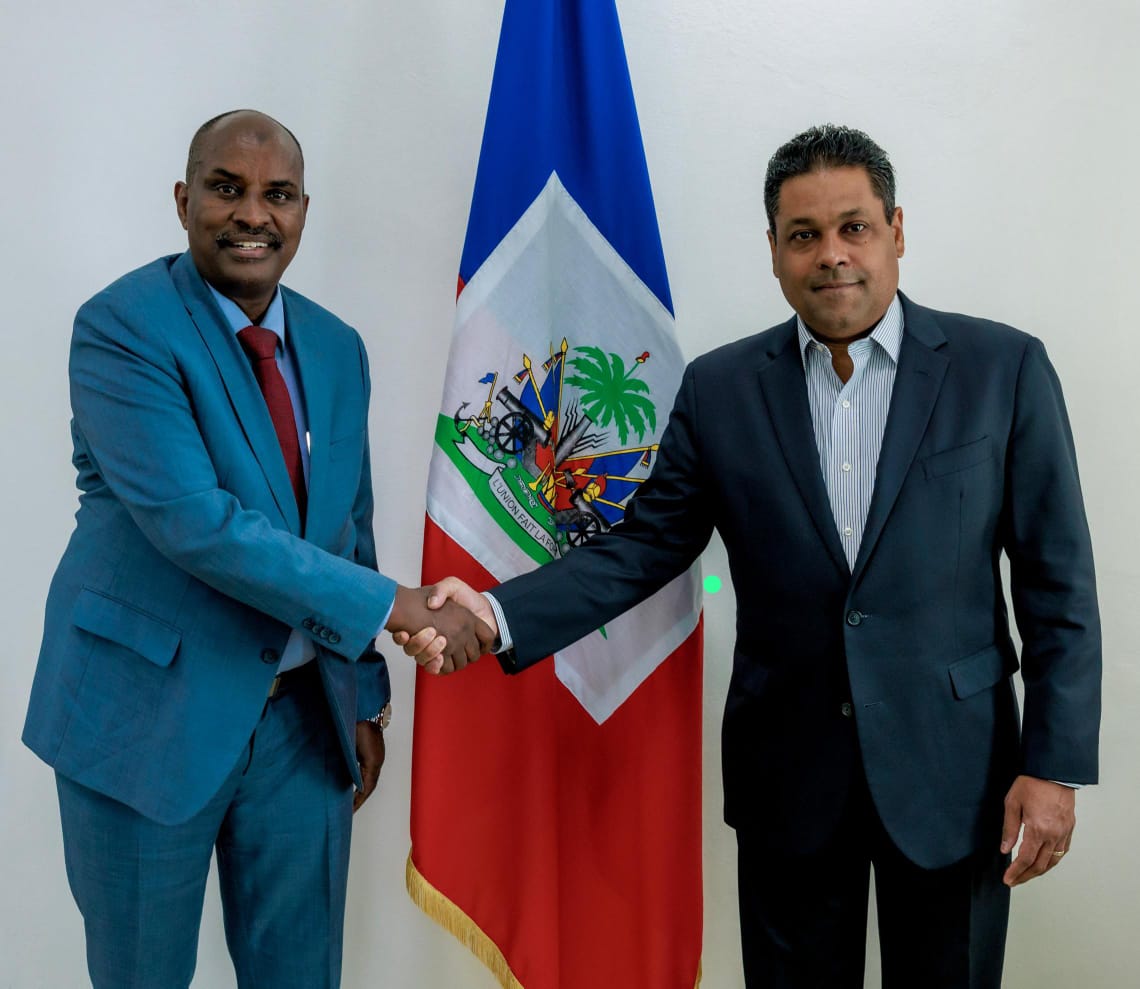
Kenya’s Consul General to Haiti, Ambassador Noor Gabow, on Wednesday held talks with the President of Haiti’s Transitional Presidential Council, Laurent Saint-Cyr, in Port-au-Prince. The meeting centered on the future of the Kenyan-led Multinational Security Support Mission, its partnership with the Haitian National Police, and the broader vision of translating security gains into long-term national recovery. Both leaders reaffirmed their commitment to stabilizing Haiti, while also exploring opportunities to deepen bilateral cooperation in trade, investment, and development.
Kenya’s leadership in Haiti has become one of the most significant international peacekeeping engagements by an African state outside its own continent. The deployment of Kenyan police officers to Haiti has not only strengthened the country’s reputation as a reliable partner in global security but has also elevated Nairobi’s standing as a diplomatic bridge between regions. For Haitians, the Kenyan mission represents a fresh form of international solidarity, one rooted in partnership rather than paternalism.
Ambassador Gabow’s assurance that Kenya remains steadfast in its commitment reflects the country’s recognition that security is a foundation for rebuilding. The mission, in close cooperation with the Haitian National Police, is tasked with suppressing gangs that have destabilized Port-au-Prince and beyond. Yet Kenya’s message is clear: peacekeeping is not enough unless it creates room for governance reform, economic activity, and social renewal. By framing the mission within both security and development, Kenya positions itself as a true peacemaker.
The meeting with President Saint-Cyr also extended beyond immediate security concerns. Discussions included pathways for economic collaboration, particularly in agriculture, infrastructure, and commerce. Kenya and Haiti see untapped potential in working together to build resilient systems that can stimulate growth. Such engagement signals that Kenya’s interest is not confined to short-term stabilization, but instead to fostering enduring ties that benefit both countries.
For Kenya, this mission strengthens its identity as a country capable of exporting not just security expertise but also lessons in institution-building. Nairobi’s role in Haiti draws from its own experience balancing development with security challenges, particularly in regions where community policing and decentralized governance have reshaped outcomes. The mission offers Kenya a platform to showcase African approaches to peacekeeping while affirming that solutions do not need to come solely from Western actors.
The Haitian side has welcomed Kenya’s efforts with growing optimism. President Saint-Cyr emphasized that the support of Kenya and the broader Multinational Security Support Mission has been critical in strengthening the state’s institutions and reclaiming control from violent groups. For a country that has often struggled under the weight of external interventions, this partnership feels markedly different. It is one based on respect and mutual purpose rather than external imposition.
At a strategic level, Kenya’s engagement in Haiti carries multiple benefits. It strengthens ties with Caribbean and Latin American states, creates opportunities for trade and investment beyond Africa, and reinforces Kenya’s global voice in multilateral forums. Every gain in Haiti enhances Kenya’s diplomatic influence while also contributing to the evolving models of international security cooperation.
Challenges remain. The MSS is still working under difficult conditions with limited personnel and resources. Haitian gangs remain resilient and violent, and progress is fragile. Yet Kenya’s continued reinforcement of personnel and its emphasis on coupling security with development suggest a clear understanding of what is at stake. The visit by Ambassador Gabow also demonstrated Kenya’s attentiveness to the mission, underscoring that this is not a symbolic deployment but a sustained investment in stability.
Ultimately, Kenya’s presence in Haiti is not only about stabilizing one nation. It is also about reshaping the global conversation on peacekeeping. By stepping into the Caribbean and taking on a leadership role, Kenya is showing that African states can shape international outcomes, lead multinational operations, and set standards for integrating peace, security, and development.
The dialogue between Ambassador Gabow and President Saint-Cyr stands as a milestone in this partnership. It is a reminder that when nations of the Global South come together with shared vision and mutual respect, they can chart a path toward peace and prosperity. For Haiti, this is a chance to rebuild institutions and reclaim stability. For Kenya, it is an opportunity to strengthen its diplomatic reach and prove its role as a trusted peacemaker on the global stage.

Internal Security PS Dr. Raymond Omollo Reaffirms Commitment to Peace, Rule of Law and Development The Government has declared zero tolerance for political violence, reaffirming its commitment to...
Read moreDetails