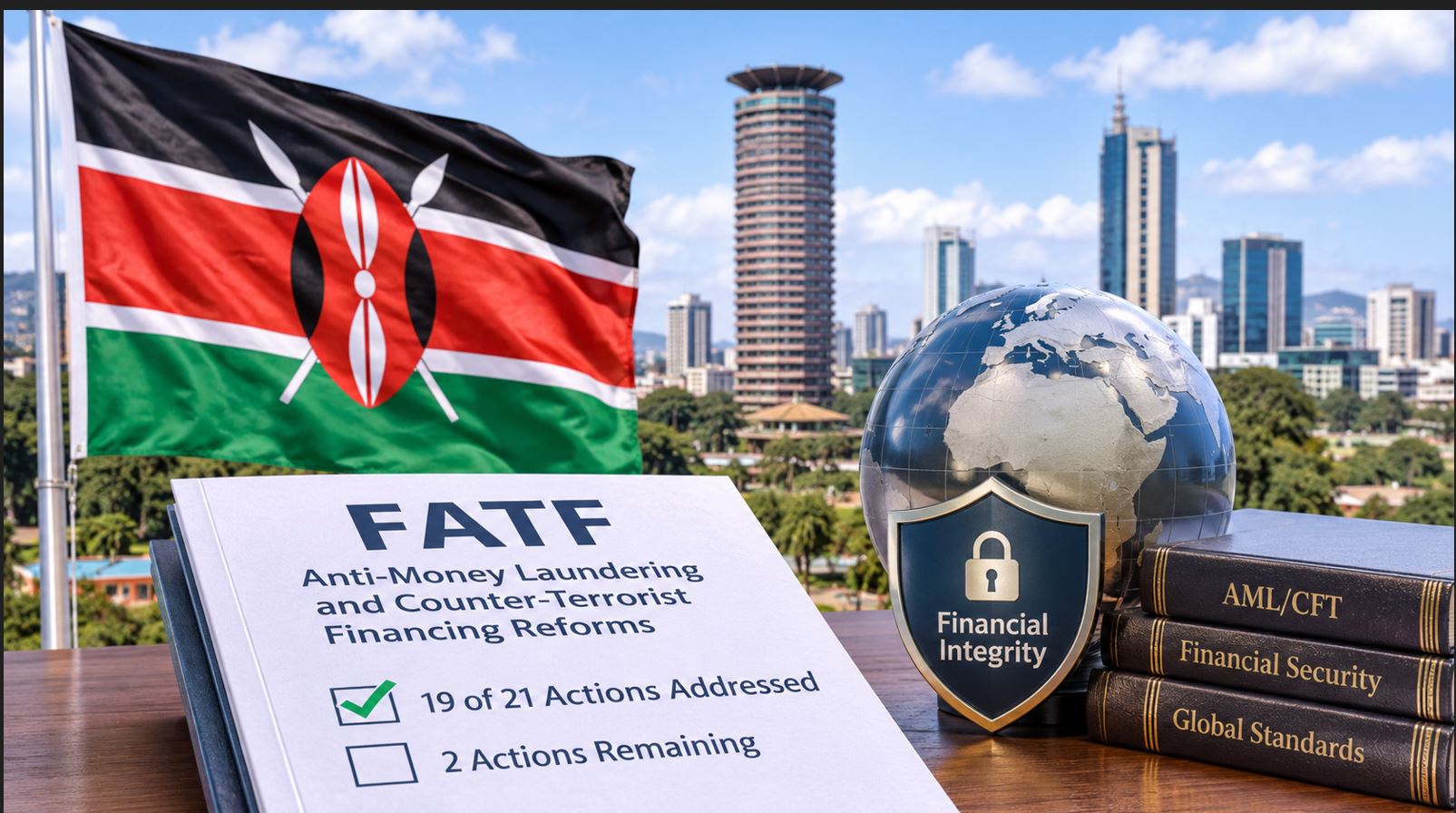
Kenya is edging closer to removal from the global financial crime watchlist after substantially addressing 19 of the 21 reform actions set by the Financial Action Task Force (FATF), strengthening prospects for restoring international confidence in the country’s financial system and reinforcing its position as a regional investment and commercial hub.
The progress, reported in October 2026, reflects an intensified national effort to close vulnerabilities in the systems used to detect, investigate and prosecute money laundering, terrorist financing and the financing of the proliferation of weapons of mass destruction. With two actions remaining, the focus is shifting towards completing the outstanding requirements and demonstrating that the reforms are firmly embedded in the country’s institutional and regulatory systems.
The development comes as Kenya seeks to strengthen its attractiveness to international investors, deepen financial partnerships and expand its role in regional and global commerce. Treasury Principal Secretary Chris Kiptoo has indicated that the government is targeting April 2027 for removal from the grey list, although Kenya must first complete the necessary assessments and verification processes before any formal decision can be made.
Kenya was placed under increased monitoring in February 2024 after committing to work with FATF and the Eastern and Southern Africa Anti-Money Laundering Group (ESAAMLG) to address strategic weaknesses in its financial integrity framework. The grey list identifies jurisdictions that have committed to correcting deficiencies in their systems for combating financial crime but remain subject to enhanced international monitoring.
Although grey-listing does not amount to a prohibition on international financial transactions, it places a country under greater scrutiny from global financial institutions and business partners. For Kenya, progress towards meeting the requirements is therefore important in protecting the credibility of its banking system, strengthening cross-border financial relationships and maintaining confidence in its broader economic environment.
The 21-point International Cooperation Review Group Action Plan provides a structured framework for addressing vulnerabilities that could allow criminal networks to exploit legitimate financial institutions, businesses and professional services. The reforms extend beyond introducing regulations to strengthening the ability of authorities to identify suspicious financial activity, follow illicit proceeds and ensure that those responsible face effective enforcement.
Among the measures already undertaken are stronger risk-based supervision of financial institutions and designated non-financial businesses and professions, improved suspicious transaction reporting, better collection of beneficial ownership information and enhanced use of financial intelligence. Kenya has also designated an authority to regulate trusts and aligned its targeted financial sanctions framework with FATF Recommendation 6.
These interventions are important because financial crime increasingly operates across institutional and national boundaries. Criminal networks can exploit opaque company ownership structures, weak reporting mechanisms and inadequate regulatory oversight to conceal proceeds, finance organized crime and move money across borders. Strengthening the ability to identify the individuals who ultimately own or control businesses makes it harder to disguise illicit financial activity behind legitimate corporate structures.
For ordinary businesses and financial institutions, stronger compliance systems can contribute to a more predictable operating environment. Banks that maintain effective controls are better positioned to identify suspicious transactions, protect customers and maintain relationships with international correspondent banking partners. Improved confidence in these relationships is particularly important for a trading economy such as Kenya, where businesses depend on reliable international payment systems to import goods, export products and receive investment capital.
Kenya’s ambitions to strengthen Nairobi as a regional financial centre also make the reforms economically significant. A credible regulatory environment can improve the country’s appeal to multinational companies, financial service providers and international investors seeking a stable base for regional operations. Stronger financial transparency can further support the development of legitimate investment channels and reinforce confidence in Kenya’s institutions.
However, removal from the grey list should not be presented as an automatic guarantee of increased investment or cheaper international transactions. Its value lies in removing an important reputational and regulatory concern while demonstrating that Kenya can meet internationally recognized standards. Actual economic benefits will depend on broader business conditions, institutional performance and sustained confidence among international partners.
The reforms also carry substantial national security implications. Effective counter-terrorism financing controls help authorities identify and disrupt the financial networks that enable extremist organizations to acquire equipment, move resources and sustain operations. Financial intelligence, suspicious transaction reporting and cooperation among regulators, investigators and security agencies are essential to identifying these networks before financial resources can be deployed for violent activities.
Equally important is the prevention of proliferation financing, which involves the movement of funds and financial resources that support the development or acquisition of weapons of mass destruction. By strengthening targeted financial sanctions and regulatory oversight, Kenya reinforces its international security obligations while protecting its financial institutions from exploitation by prohibited networks.
An important dimension of the reforms concerns the regulation of non-profit organizations, particularly those operating in humanitarian assistance, faith-based activities and community development. The government has adopted a risk-based supervisory approach intended to prevent terrorist financing abuse without imposing unnecessary restrictions on legitimate organizations.
An assessment of 260 faith-based organizations across nine counties found that 90 per cent were classified as either low or medium-low risk. Only five per cent fell within the medium-high and high-risk categories. The differentiated supervisory framework provides for enhanced scrutiny of higher-risk organizations while allowing routine monitoring of those assessed to present lower exposure.
This approach recognizes that effective financial regulation must protect national security without undermining financial inclusion or restricting legitimate development activities. Unnecessary de-risking, where banks withdraw services from entire categories of customers rather than assessing individual risks, can exclude credible organizations from formal financial channels and weaken the very transparency that regulators seek to promote.
The broader challenge for Kenya will be ensuring that the progress achieved translates into lasting institutional effectiveness. FATF compliance is not determined solely by the number of laws enacted, regulations introduced or administrative structures established. Authorities must demonstrate that financial intelligence is acted upon, suspicious transactions are investigated, beneficial ownership information is accessible and enforcement mechanisms deliver practical results.
Kenya must also complete the FATF verification process, including an on-site assessment to establish whether the reforms are operational and sustainable. A positive assessment would then be considered through the appropriate FATF plenary process before removal from increased monitoring can be confirmed. The progress on 19 of the 21 actions provides a strong foundation for completing this process. More importantly, it offers an opportunity to strengthen the foundations of a financial system that supports legitimate enterprise, protects national security and facilitates international economic engagement.
For a country seeking to attract investment, expand regional trade and reinforce Nairobi’s position as a financial gateway to Africa, financial integrity is not merely a regulatory obligation. It is an essential component of economic competitiveness. Sustaining the reforms beyond the grey-listing process will be critical to ensuring that international confidence is matched by a transparent, accountable and resilient financial system.