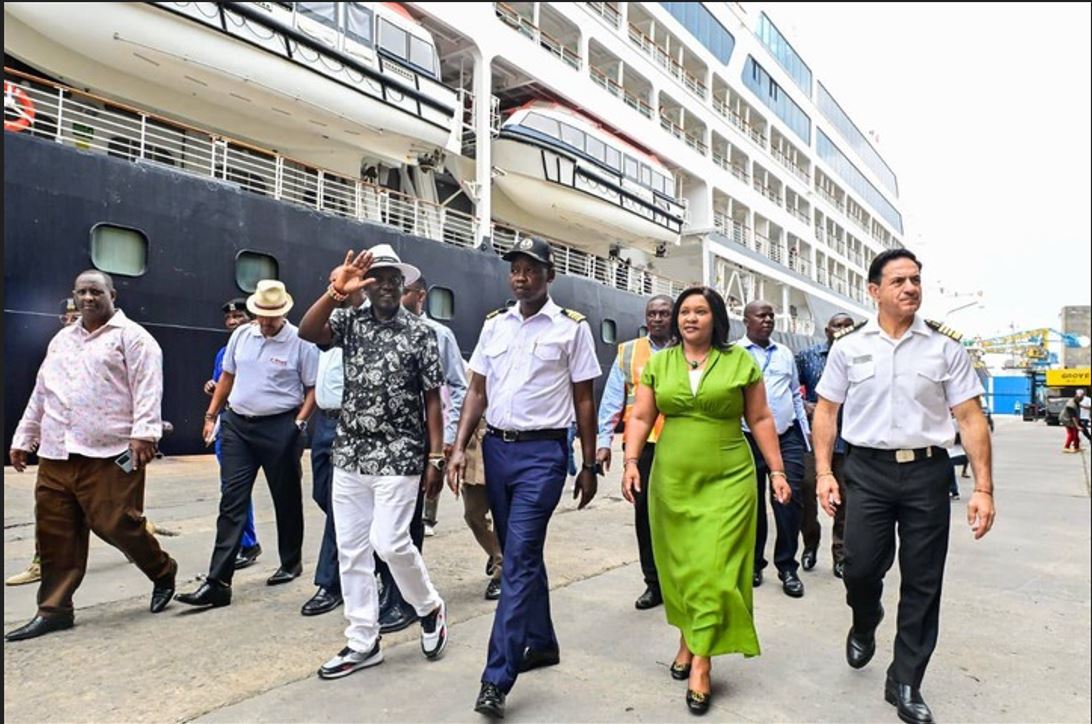
Kenya welcomed the Azamara Journey at the Port of Mombasa on Monday, reinforcing the country’s growing profile as a cruise tourism destination in the Western Indian Ocean. The arrival of the luxury vessel, carrying hundreds of high value visitors, underscored the impact of sustained government policy, port modernization and coordinated public private efforts to anchor cruise tourism as a strategic pillar of national economic growth.
Kenya’s reception of the Azamara Journey at the Port of Mombasa marks more than a ceremonial port call. It is a visible outcome of deliberate state policy, sustained investment and coordinated public and private action to reposition the country as a serious cruise tourism hub in the Western Indian Ocean.
The arrival of the vessel, carrying nearly seven hundred high value visitors, reflects a shift in Kenya’s tourism strategy away from overreliance on traditional safari circuits toward a diversified, maritime driven tourism economy. This direction is firmly anchored in President William Ruto’s Bottom Up Economic Transformation Agenda, Vision 2030 and the broader blue economy framework that treats ports, coastlines and ocean-based trade as engines of inclusive growth.
Cruise tourism fits squarely within this national development logic. Unlike mass tourism models that concentrate value in a few enclaves, cruise arrivals distribute spending rapidly and widely across port cities. Passengers inject foreign exchange into transport services, tour operations, heritage sites, restaurants, handicraft markets and small hospitality enterprises within a single day. For Mombasa and Lamu, this translates into immediate income for MSMEs, artisans, guides, logistics providers and informal traders whose livelihoods depend on predictable visitor flows.
Government action has been central to making Kenya cruise ready. Targeted upgrades by the Kenya Ports Authority have improved berthing capacity, passenger handling and port side logistics, ensuring that international cruise lines can dock efficiently and safely. Streamlined immigration processes and digital travel authorization systems have reduced friction for sea arrivals, aligning Kenya with global best practice in cruise facilitation. These reforms send a clear signal to cruise operators that Kenya understands the commercial realities of the industry.
Equally important has been destination readiness beyond the port gates. National and county governments, working alongside private tour operators and hospitality players, have invested in shore excursion planning, security coordination and visitor experience management. This ensures that cruise passengers encounter a seamless product that links heritage sites such as Old Town and Fort Jesus with cultural experiences, coastal cuisine and short safari extensions that lengthen stays and raise per visitor spending.
The economic multiplier effects are already evident. Each cruise call generates demand across supply chains ranging from fresh produce and fuel to waste management and port services. Employment creation spans both skilled and semi-skilled labor, from maritime services and tour guiding to creative industries and cultural performances. Over time, repeated cruise calls enhance international destination visibility, embedding Kenyan ports into regional itineraries that include the Indian Ocean islands and East African coastal cities.
Security and sustainability are emerging as decisive competitiveness factors. Kenya’s investments in maritime domain awareness, port security and inter agency coordination reassure cruise lines operating in a region sensitive to safety perceptions. At the same time, climate smart port infrastructure, coastal conservation initiatives and community-based tourism models are protecting fragile marine ecosystems while preserving cultural heritage. These measures are essential to ensuring that cruise tourism growth does not erode the very assets it depends on.
Looking ahead, sustained momentum will depend on deepening public private partnerships. Port expansion projects, skills training for cruise facing services, digital destination marketing and the development of diversified shore excursions will be critical. Integrating Mombasa and Lamu into structured regional cruise circuits can anchor Kenya as the primary gateway between mainland Africa and the island economies of the Indian Ocean, increasing cruise frequency and encouraging repeat calls.
The successful hosting of the Azamara Journey should therefore be understood as a policy benchmark rather than a one off achievement. It demonstrates how early investment, institutional coordination and market aware planning can translate national development strategies into tangible economic outcomes. As cruise tourism scales up, Kenya stands to reinforce tourism as a leading foreign exchange earner, stimulate inclusive coastal development and strengthen its position as a globally competitive Indian Ocean destination.
If sustained with discipline and foresight, cruise tourism can become a durable pillar of Kenya’s long term growth, proving that ports are not merely gateways for goods, but powerful platforms for jobs, enterprise and shared prosperity along the coast.

President William Ruto has placed Micro, Small and Medium Enterprises (MSMEs) at the center of Kenya’s economic transformation strategy, recognizing the sector as the backbone of job creation,...
Read moreDetails