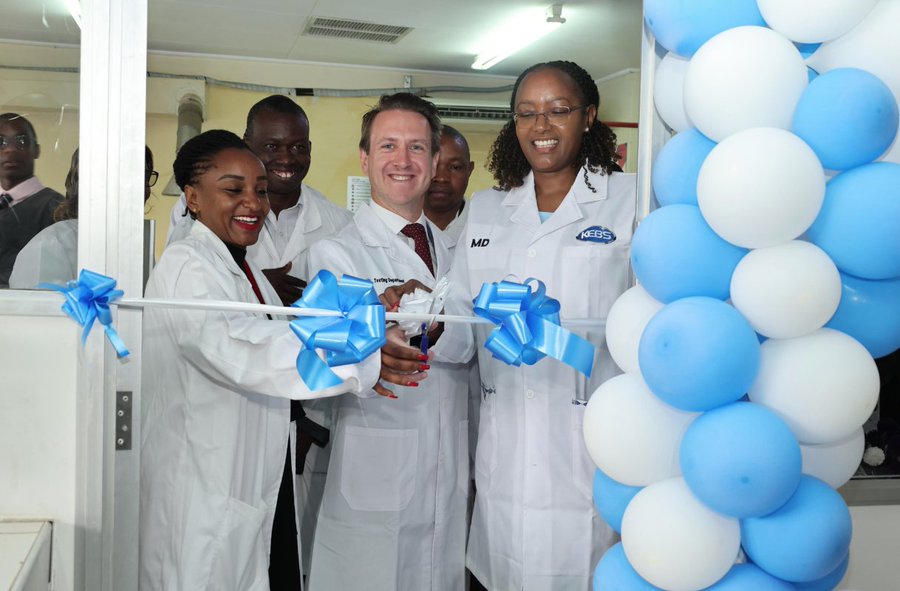
The Kenya Bureau of Standards (KEBS) has commissioned over Sh67 million in state-of-the-art laboratory equipment, a decisive modernization push that positions the agency at the centre of Kenya’s economic transformation and institutional strengthening agenda. The upgrade, procured with support from the British High Commission in Nairobi through TradeMark Africa, marks one of KEBS’ most significant technical overhauls in recent years, sharply boosting its ability to enforce quality standards, safeguard consumers, and accelerate the country’s march toward industrial resilience.
The new systems, including an Ultra-High Performance Liquid Chromatography (UPLC) platform, a Near-Infrared Spectrophotometer, and a Microwave Inductively Coupled Atmospheric Plasma Optical Emission Spectrometer (MICAP-OES), anchor a technological shift that aligns with national development reports highlighting the central role of quality infrastructure in driving economic growth. With Kenya targeting higher value manufacturing, deeper regional integration, and greater participation in global value chains, regulators increasingly depend on advanced analytical capability to keep pace with the demands of modern industry.
The equipment gives KEBS a level of precision and efficiency that elevates its regulatory credibility, expands the scope of risks it can detect, and reduces dependence on costly consumables. Notably, the MICAP-OES system eliminates the need for argon gas, cutting operational expenses by an estimated Sh1 million per week, which directly improves the sustainability and responsiveness of national quality assurance systems. Faster testing and certification now allow exporters to clear compliance hurdles in days rather than weeks, reducing non-tariff barriers that have long impeded Kenya’s trade performance.
This upgrade reflects the government’s broader commitment to strengthening institutions that underpin economic competitiveness. National industrial and trade assessments consistently underscore that adherence to standards, modern laboratory infrastructure, and predictable regulatory processes are critical drivers of investor confidence. With enhanced analytical capability, KEBS is better positioned to support industries such as horticulture, food processing, livestock feed, and manufacturing, sectors whose success relies on rigorous safety assurance, transparent conformity assessment, and predictable turnaround times.
KEBS Managing Director Esther Ngari affirmed the institution’s commitment to delivering safer products, faster certification, and improved market access, framing the upgrade as a strategic investment in national welfare and economic progress. Partners from the British High Commission and TradeMark Africa emphasized that strengthened laboratory capacity will reduce export rejections, especially in sensitive markets such as the UK and EU, while deepening Kenya’s reputation as a trusted supplier of high-quality goods.
The modernization of KEBS laboratories represents more than a technical enhancement; it is a policy milestone. It reinforces Kenya’s drive to build credible, future-ready institutions capable of supporting innovation, protecting consumers, and enabling businesses to compete globally. By combining advanced technology with skilled personnel and stronger operational oversight, KEBS has positioned itself as a cornerstone of Kenya’s development agenda and a critical enabler of nationally aligned economic ambitions.
As Kenya pushes forward with industrial diversification, food safety reforms, and export-led growth, the strengthened capacity of its standards authority sends a clear signal. Modern regulation is not a bureaucratic formality but a strategic asset. KEBS’ investment demonstrates that building a competitive economy requires institutions with the technical force, policy clarity, and analytical authority to translate national development goals into tangible gains for citizens and businesses alike.

Kenya’s Affordable Housing Programme (AHP), accessible through the Boma Yangu platform, stands as a flagship government initiative to deliver decent, safe, and affordable homes to low- and middle-income...
Read moreDetails