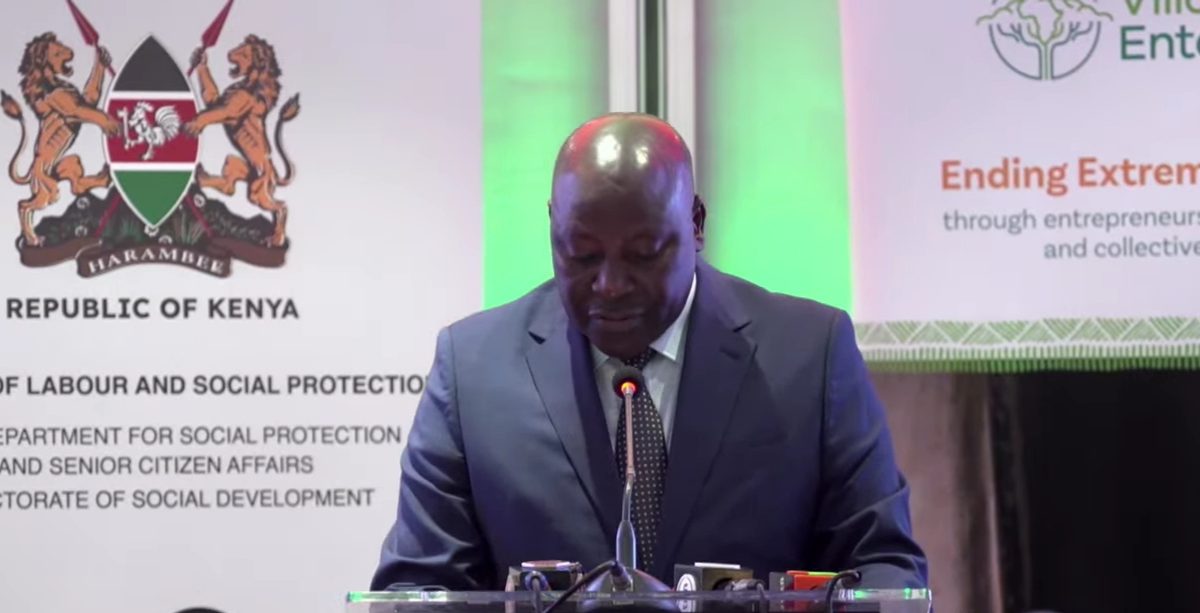
Kenya has officially unveiled a comprehensive Ultra-Poor Graduation Strategy, a landmark national initiative designed to lift the country’s most vulnerable households out of extreme poverty through a structured pathway to economic independence. Launched in Nairobi by the State Department for Social Protection, the strategy marks a major breakthrough in Kenya’s social protection and poverty reduction agenda, signalling a decisive shift toward long-term, evidence-based solutions that promote inclusive growth and economic resilience.
Principal Secretary for Social Protection and Senior Citizen Affairs Joseph Motari said the new framework aligns with President William Ruto’s bottom-up transformation agenda and reinforces Kenya’s commitment to equitable, community-centred development. He noted that with 39.8 percent of citizens living below the poverty line and 7.1 percent facing extreme deprivation, the strategy represents “a national commitment to unlock human potential, reduce chronic vulnerability, and empower families to build sustainable livelihoods.”
The strategy will be rolled out in phases between 2025 and 2030, beginning with targeted counties experiencing the highest levels of extreme poverty. Ultra-poor households will be identified through a coordinated system involving county governments, local administrators, community committees, and digital targeting tools to ensure transparency and accuracy.
Selected households will receive a sequenced package of support, including consumption assistance, livelihood assets, tailored skills training, access to microfinance, agricultural inputs, business development services, healthcare linkages, and mentorship. The strategy is designed to move households from basic stability to enterprise development and long-term economic inclusion.
The programme brings together the national government, county administrations, and local organizations to harmonize social protection initiatives that have previously operated independently. Counties are expected to play a central role in beneficiary identification, local capacity-building, community mobilization, and ensuring field-level implementation remains inclusive and accountable.
Several counties, including Makueni, Taita Taveta, and Turkana have piloted similar approaches with encouraging outcomes such as improved food security, increased savings, and rising small-enterprise activity.
The strategy was co-developed with partners including Village Enterprise and CHASM, who have contributed data, field experience, and tools for designing evidence-based interventions. Development agencies, civil society groups, and private sector partners will play roles in financing, technical support, digital integration, and scaling enterprise opportunities for programme participants.
Village Enterprise CEO Taddeo Muriuki highlighted that coordinated partnerships are “critical to delivering lasting change,” noting that more than 25,000 households are currently supported through business grants, training, and mentorship under similar models.
The strategy integrates economic, social, and environmental dimensions to address poverty’s underlying drivers. Key components include: Cash transfers and consumption support, Livelihood asset provision, Business skills training and financial literacy, Community savings groups and access to microfinance, Agricultural resources and climate-smart inputs, Linkages to healthcare, education, and social services, One-on-one mentorship and coaching, Gender-sensitive interventions benefiting women and youth, and Environmentally sustainable livelihood options
Community engagement will ensure local ownership, while mentorship structures help build confidence, enterprise skills, and long-term self-reliance.
A robust monitoring and evaluation system will track household progress, measure programme impact, and identify challenges early. Data from county and national dashboards will help guide decision-making and ensure resources reach the intended beneficiaries. Independent evaluations will assess long-term outcomes, including income changes, employment patterns, and resilience to shocks.
The strategy includes training for community development officers, social workers, enumerators, and county staff to strengthen institutional capacity. Local organizations will also be equipped to manage graduation programmes, expanding Kenya’s technical expertise in social protection.
Entrepreneurship sits at the centre of the initiative, with participants supported to establish micro-enterprises, adopt modern agricultural practices, join cooperative networks, and identify market linkages. The goal is to create conditions where ultra-poor households generate reliable income long after programme completion.
The government anticipates far-reaching benefits across Kenya, including:
• Higher household incomes and improved livelihoods
• Greater access to healthcare, education, and nutrition
• Increased job creation through micro-enterprises
• Stronger resilience to climate, economic, and health shocks
• Social cohesion through community-led initiatives
• Accelerated regional development and reduced marginalization
Motari emphasized that previous pilots demonstrated a 35 percent increase in savings, improved food security, and sustained income gains, proving that graduation from extreme poverty is achievable when support is well-sequenced and targeted.
The strategy aligns with Kenya’s long-term goals for industrialization, equitable growth, and economic diversification. By empowering vulnerable households to participate meaningfully in the economy, the programme strengthens labour productivity, expands local enterprise ecosystems, and contributes to national stability.
“This is a transformative step that places human dignity, opportunity, and shared prosperity at the heart of national development,” Motari said. “The Ultra-Poor Graduation Strategy ensures that Kenya’s growth is inclusive and that no household is left behind.”
Officials from county governments, development partners, and civil society organizations attended the launch, signalling broad national support for one of the most ambitious poverty reduction programs ever undertaken in Kenya.
President William Ruto has placed Micro, Small and Medium Enterprises (MSMEs) at the center of Kenya’s economic transformation strategy, recognizing the sector as the backbone of job creation,...
Read moreDetails