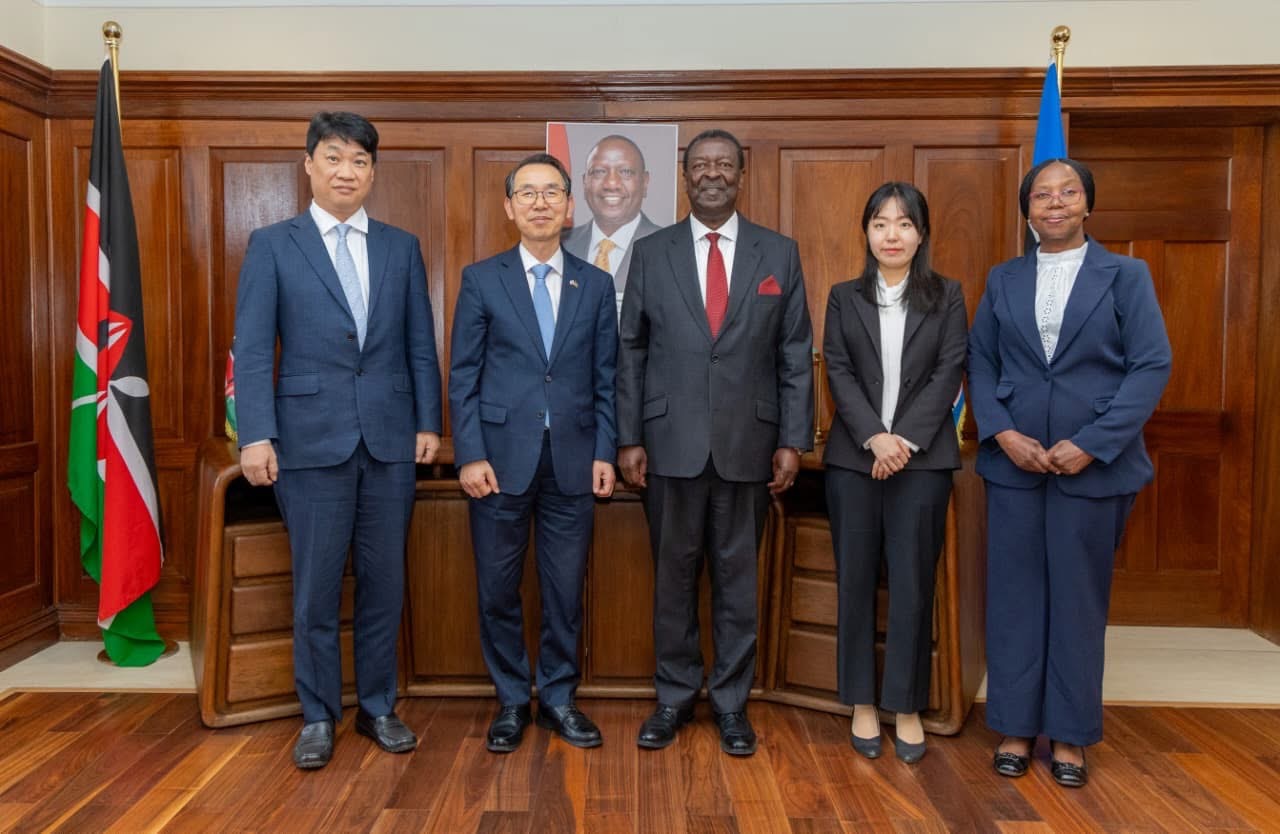
Kenya and the Republic of Korea are advancing their longstanding partnership with renewed focus on trade, innovation, and sustainable development following a high-level diplomatic engagement in Nairobi. Prime Cabinet Secretary and Cabinet Secretary for Foreign and Diaspora Affairs, Dr. Musalia Mudavadi, hosted Korean Ambassador H.E. Kang Hyung-Shik for discussions that reaffirmed more than six decades of warm relations between the two countries and set out a shared agenda for deeper cooperation.
Dr. Mudavadi praised Korea’s contributions to Kenya’s national development, noting significant progress in information and communication technology, agriculture, manufacturing, education, and socio-economic growth. He cited the flagship projects at Konza Technopolis as prime examples of the bilateral partnership’s impact. The Kenya Advanced Institute of Science and Technology (Kenya-AIST), scheduled for launch in September 2025, and the Konza Digital Media City are expected to transform Kenya into a hub for research, innovation, and digital enterprise.
The establishment of the International Vaccine Institute offices at Konza was also welcomed as a key milestone. This move strengthens collaboration in health and biotechnology, positioning Kenya to play a greater role in vaccine development and public health research for the continent.
Kenya’s priorities for the next phase of cooperation include enhancing trade, labour mobility, energy partnerships, maritime development, and joint climate change action. Dr. Mudavadi acknowledged Korea’s support through the Economic Development Promotion Facility, KOICA projects, the K-Rice agricultural programme, and the planned opening of Korea Exim Bank offices in Nairobi. The presence of the Exim Bank will improve project execution under the Economic Development Cooperation Fund, giving momentum to infrastructure and development projects.
Looking ahead, Kenya is eager to join Korea’s Global Green Growth Institute and to work together on green hydrogen projects. These initiatives are central to Kenya’s clean energy transition and its ambition to remain a continental leader in renewable energy. Both countries also intend to expand collaboration on blue economy projects, sustainable construction, and climate change adaptation.
The discussions took place ahead of the official visit of H.E. Woo Won-Shik, Speaker of the 22nd National Assembly of Korea, who will preside over the launch of Kenya-AIST. The institute is expected to become a hub of research and higher education in science and technology, serving Kenya and the wider East African region. Its creation is a symbol of the long-term commitment both governments have made to human capital development and industrial competitiveness.
This new phase of cooperation builds on recent milestones, including the inaugural Bio-Vaccine Research Conference co-hosted by KAIST and the International Vaccine Institute, which opened opportunities in biotechnology and public health. Korean scholarships for Kenyan students, and research collaboration in artificial intelligence, robotics, and smart infrastructure, further demonstrate the practical benefits of the partnership.
Korea’s role in Kenya’s health sector continues to grow, particularly through vaccine development and medical aid. In infrastructure and green growth, Korean expertise has supported projects in transport, renewable energy, and smart city planning, with Konza Technopolis serving as a flagship example. On trade, KOTRA and government-led forums are helping to encourage Korean investment in Kenyan manufacturing, ICT, and agriculture. These investments are creating jobs and advancing skills transfer while boosting Kenya’s industrial growth.
The two nations also share common ground on regional and international priorities. Korea has supported Kenya’s peacekeeping missions and broader efforts to promote stability in East Africa. This strengthens Kenya’s role as a regional leader and enhances its global diplomatic standing.
As these initiatives continue to expand, the Kenya–Korea partnership is emerging as a model of forward-looking and mutually beneficial cooperation. The relationship is rooted in innovation, sustainability, and shared prosperity. For Kenya, the benefits are already visible in improved infrastructure, stronger institutions, and opportunities for its youth. For Korea, the partnership opens a gateway to Africa’s fast-growing markets and provides a reliable ally on global issues.
Ultimately, the relationship is not only deepening bilateral ties but also aligning with global priorities that value inclusivity, green growth, and technological innovation. For Kenya, this means securing the tools and partnerships needed to accelerate economic transformation. For Korea, it confirms the value of a trusted partner in East Africa, one that is ready to collaborate in building a future of shared progress.
Kenya’s Affordable Housing Programme (AHP), accessible through the Boma Yangu platform, stands as a flagship government initiative to deliver decent, safe, and affordable homes to low- and middle-income...
Read moreDetails