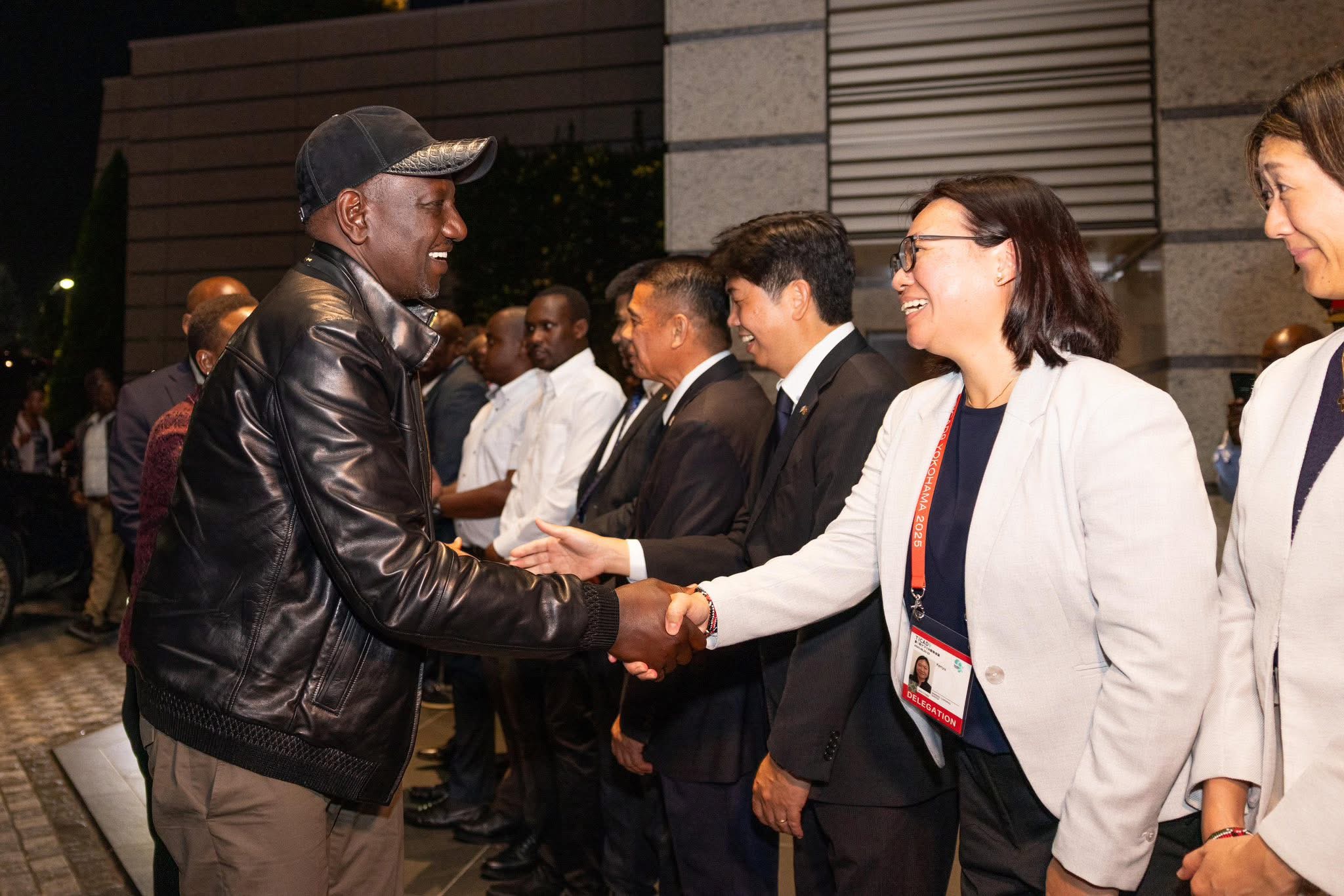
President William Ruto arrived in Yokohama, Japan, on Tuesday evening to attend the Ninth Tokyo International Conference on African Development (TICAD 9). He is accompanied by First Lady Rachel Ruto and Prime Cabinet Secretary and Foreign Affairs Cabinet Secretary Musalia Mudavadi. The President is expected to hold high-level talks with Japanese leaders, including Prime Minister Shigeru Ishiba, while also joining fellow African heads of state for the three-day summit that runs from August 20 to 22.
For Kenya, the visit carries significant weight. According to State House, Japan’s long-standing partnership with Kenya has grown to more than KSh600 billion in aid and investment, making Kenya the largest recipient of Japanese support in Africa. This deep reservoir of cooperation has already delivered transformative projects, and President Ruto’s presence in Yokohama signals Kenya’s intention to build on these successes by expanding opportunities in infrastructure, agriculture, education, and technology.
Central to the discussions are major infrastructure undertakings that hold the potential to reshape Kenya’s economic landscape. The expansion of Mombasa Port and the Mombasa Port Area Road Development will improve regional trade flows, positioning Kenya as the undisputed gateway to East and Central Africa. The Dongo Kundu Special Economic Zone, also a priority project, promises to attract investment and create jobs through industrial growth. These initiatives underscore Kenya’s strategy of leveraging strategic partnerships to expand its competitiveness in global markets.
Another critical area of focus is the Nairobi urban transport system. The capital city has struggled with traffic congestion and inadequate transit solutions, which affect productivity and reduce investor confidence. Japanese collaboration, with its advanced urban planning and transport expertise, offers an opportunity to transform Nairobi’s infrastructure. Efficient and modern transport will not only ease daily commutes but also contribute to the city’s ambition of becoming a regional hub for finance and innovation.
The discussions are not limited to infrastructure. Kenya and Japan are also strengthening ties in agriculture, forestry, and climate resilience. With food security under pressure from climate change, investments in irrigation rehabilitation, reforestation, and sustainable agricultural practices are vital. Japan’s commitment to forestry and environmental conservation complements Kenya’s own drive to restore landscapes and increase forest cover. Such collaboration ensures that economic development does not come at the expense of sustainability.
Education and human capital development feature prominently in the Kenya–Japan agenda. Japanese scholarships and technical training have already produced a cadre of skilled Kenyan professionals who are contributing to key sectors. Expanding these opportunities in science, technology, and innovation will help Kenya build the capacity needed for its digital and knowledge-based economy. By investing in people as much as in infrastructure, the partnership creates a foundation for long-term resilience.
Diplomatically, the visit enhances Kenya’s stature on the global stage. President Ruto’s bilateral meeting with Prime Minister Ishiba will focus on deepening trade and investment ties, while his reception at the Imperial Palace by Emperor Naruhito and Empress Masako reflects the strength of Kenya–Japan relations. These engagements underline mutual respect and a shared commitment to prosperity and stability.
At the continental level, President Ruto is using the platform to advance African integration. He will call for the removal of trade barriers and emphasize the African Continental Free Trade Area as the driver of inclusive growth. By anchoring Kenya as a voice for economic connectivity, he is not only pursuing national interests but also reinforcing the idea that a stronger, more unified Africa is in the best interest of global partners such as Japan.
TICAD itself continues to symbolize a partnership model rooted in respect and collaboration. Since its inception in 1993, Japan has sought to build relationships with Africa based on co-created solutions to development challenges. Kenya’s hosting of TICAD VI in Nairobi in 2016 remains a milestone in this history, and this year’s conference theme, “People, Planet and Prosperity in a Changing World: Co-creating Innovative Solutions with Africa,” resonates strongly with Kenya’s development agenda.
The dividends of this engagement are clear. Japanese financing and expertise will strengthen Kenya’s ports, roads, and urban transit systems. Agricultural collaboration will build resilience against climate pressures. Educational exchanges will continue to develop a generation of skilled professionals ready to compete in a global economy. Above all, the strategic partnership between Kenya and Japan stands as a model of how African and Asian nations can work together for shared prosperity.
President Ruto’s visit to Yokohama is more than a diplomatic formality. It is a deliberate move to attract cutting-edge investment, showcase Kenya’s economic potential, and strengthen alliances that will help drive Africa’s transformation. For Kenya, the commitment of over KSh600 billion in aid and investment reflects the confidence Japan has in its future. The challenge now is to translate this goodwill into tangible growth that benefits not only Kenya but also the broader region.
President William Ruto has placed Micro, Small and Medium Enterprises (MSMEs) at the center of Kenya’s economic transformation strategy, recognizing the sector as the backbone of job creation,...
Read moreDetails