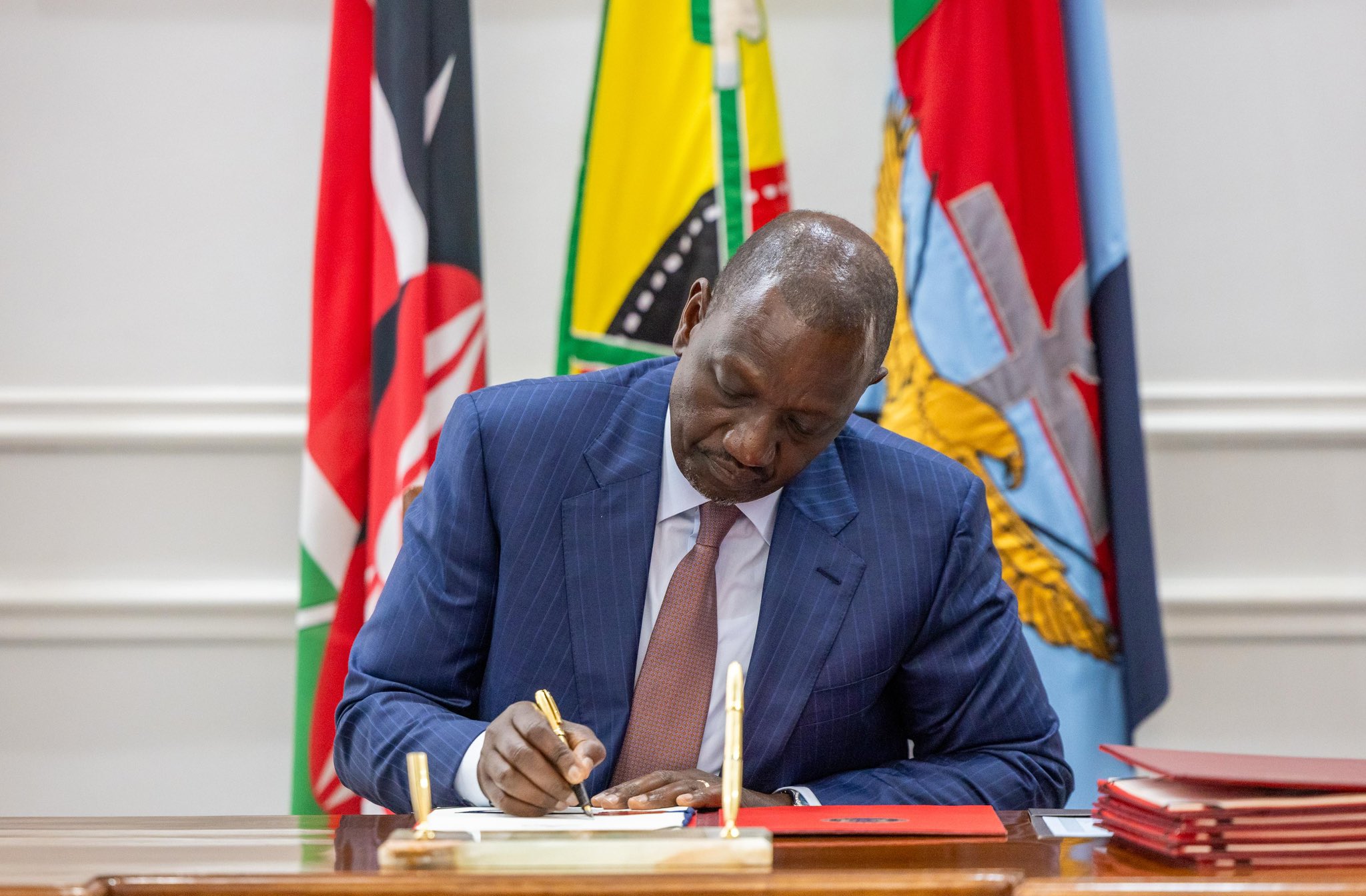
President William Ruto has officially signed the Conflict of Interest Bill into law, marking a significant milestone in Kenya’s fight against corruption and misuse of public office. The new law, which repeals the Public Officer Ethics Act, introduces a comprehensive framework for preventing the abuse of public positions for personal gain. This legislative move is part of broader reforms aimed at enhancing transparency, protecting public resources, and restoring public trust in state institutions.
The new Conflict of Interest Act creates a unified legal standard to manage conflicts of interest across all levels of government. It mandates public officers to operate with integrity and prohibits them from engaging in activities that may compromise their duties. The legislation also places strict restrictions on preferential treatment and external influence in public procurement, closing a long-standing gap that has enabled corruption through opaque contracting processes.
President Ruto described the law as a “consequential moment” for the country. He emphasized that it sets clear rules to ensure that public officers serve with accountability and that public funds are used for their intended purpose. Crucially, the law empowers ordinary Kenyans to demand transparency and hold officials accountable for the decisions they make while in office.
Oversight and enforcement of the law will fall under the Ethics and Anti-Corruption Commission (EACC), which now has expanded authority to manage wealth declarations and investigate conflict of interest violations across the Executive, Judiciary, and Legislature. This broad mandate ensures that no arm of government is exempt from scrutiny. By consolidating conflict of interest regulations into one framework, the law reduces ambiguity and strengthens enforcement capacity.
In addition to prohibiting self-dealing and contract interference, the law also addresses secondary employment. Public officers are barred from holding additional jobs that create a conflict with their primary duties, a move that seeks to eliminate divided loyalties and inappropriate commercial entanglements.
Complementing this legislation is the proposed Anti-Corruption Laws (Amendment) Bill 2025, which aims to introduce more aggressive deterrents against graft. One of the central provisions is a mandatory 10-year ban from public procurement for individuals and entities convicted of corruption. This would apply to all offenders, including companies that have previously used proxy firms or renamed entities to continue accessing government tenders.
Speaking at a public forum in Kericho, Principal State Counsel Claries Kariuki outlined the key aspects of the proposed amendments. She noted that corrupt actors have long exploited legal loopholes to remain embedded in public systems, but these reforms will help break that cycle. The bill also introduces a six-month statutory limit for resolving anti-corruption cases, a change intended to reduce trial delays, preserve critical evidence, and build public confidence in the judicial process.
The proposed reforms also enhance the powers of investigative bodies. Under the new measures, the EACC will have authority to inspect bank accounts, mobile money platforms, non-bank financial institutions, and money transfer accounts. It will also be allowed to seek court orders to freeze suspicious transactions for 30 days. This will significantly improve the Commission’s ability to track and recover illicit assets.
Additionally, the bill broadens the legal definition of “proceeds of corruption” to include indirectly obtained assets. Property that has been intermingled, laundered, reinvested, or transferred to third parties will still be subject to seizure. This is a powerful step toward dismantling complex financial schemes used to obscure the origins of stolen wealth.
In parallel, the government is advancing another critical reform through the Whistleblower Protection Bill 2025, which aims to foster a culture of ethical reporting. The bill guarantees confidentiality, shields whistleblowers from both civil and criminal liability, and protects them from employer retaliation. It compels both public and private institutions to set up secure, internal disclosure channels.
Claries Kariuki noted that the bill defines a whistleblower broadly to include anyone with credible information on misconduct, regardless of whether the information leads to prosecution. Those who support whistleblowers in uncovering wrongdoing are also protected under the legislation.
During the forum, Kericho residents expressed strong support for the bill, highlighting fear of reprisal as a major obstacle to reporting unethical behavior. Legal practitioners, youth representatives, civil society groups, and religious leaders welcomed the proposed legal protection, describing it as a transformative shift toward public empowerment in governance.
Together, these legislative efforts signal a paradigm shift in Kenya’s approach to corruption. They are not merely reactive but forward-looking. The emphasis is on creating institutions and laws that prevent corruption before it happens, while equipping enforcement agencies with real tools to act decisively when it does.
For Kenya, the significance of these reforms goes beyond legal compliance. They are crucial to improving public finance management, reducing wastage, and ensuring that government spending reflects national priorities. The new laws send a strong message that accountability is not optional, and that integrity must be the foundation of public service.
If successfully implemented, this legal architecture could redefine Kenya’s governance landscape. It offers a chance to restore public trust, ensure efficient use of national resources, and place Kenya on a firmer path toward inclusive development and institutional stability.

Kenya’s Internal Security Permanent Secretary Dr. Raymond Omollo has recently found himself at the center of growing media and political scrutiny, a development that observers link to his...
Read moreDetails