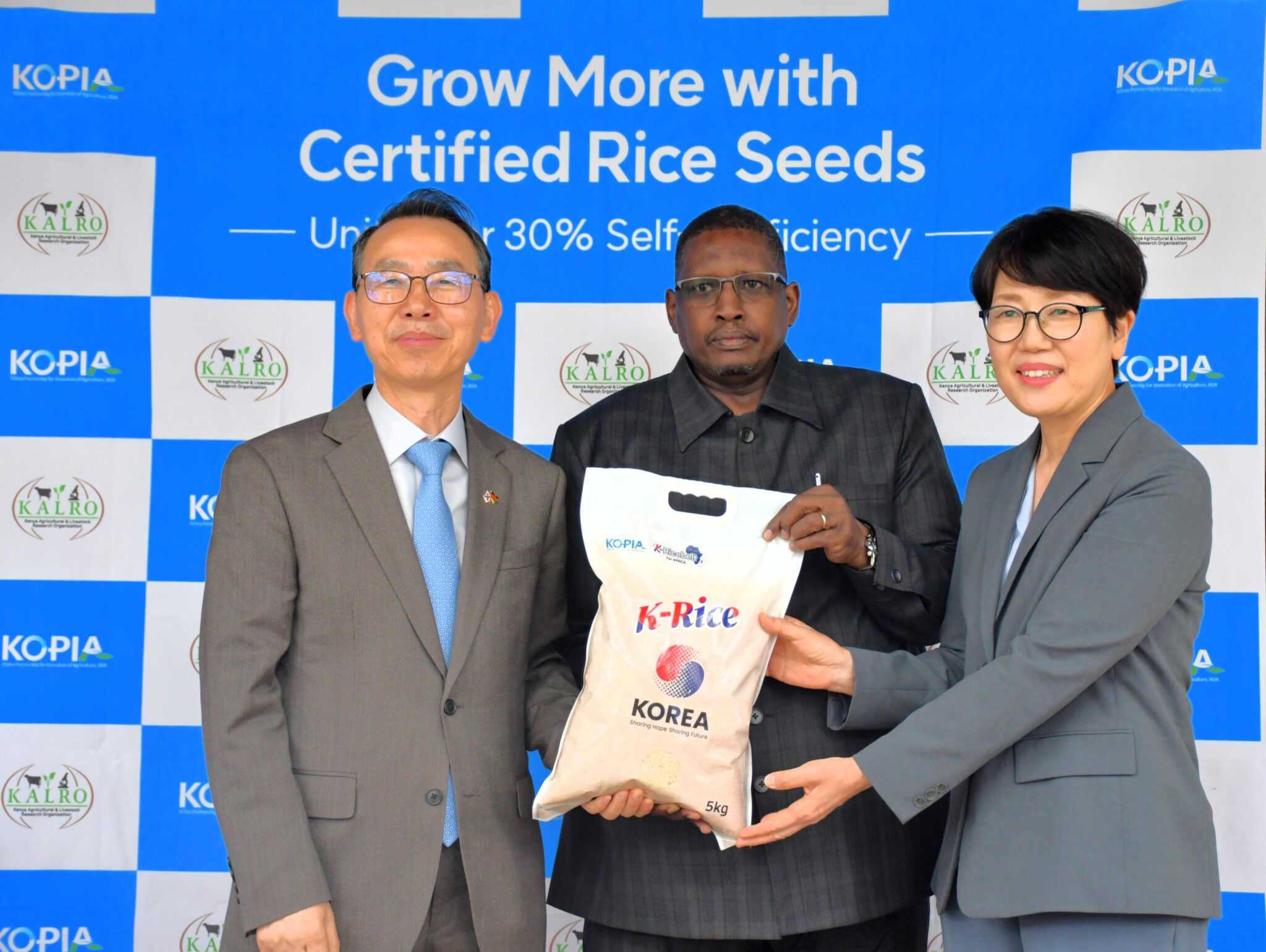
Kenya has unveiled a strategic partnership with the Republic of Korea to strengthen local rice seed production and reduce the country’s heavy reliance on imports. The Sh645 million project, launched through a five-year collaboration between the Kenya Agricultural and Livestock Research Organization (KALRO) and Korea Program on International Agriculture (KOPIA), is expected to scale up the availability of certified high-yielding rice seed and transform the nation’s rice-growing capacity.
The partnership comes at a time when Kenya imports more than 85 percent of its rice consumption, driven by rising demand, particularly among younger populations shifting away from traditional staples like ugali. Speaking during a rice symposium in Nairobi, KALRO Director General Dr. Eliud Kireger emphasized that the country must urgently expand local rice production to improve food security and economic stability.
“The consumption of rice in Kenya continues to rise rapidly. To reduce our dependence on imports, we must invest in the foundation of any crop sector, quality, certified seed,” Dr. Kireger stated. “This partnership allows us to test high-yielding Korean rice varieties and build the infrastructure needed to scale seed production across the country.”
At the heart of the initiative is a state-of-the-art rice seed production facility under construction at KALRO’s Mwea Centre in Kirinyaga County. The facility will not only serve Mwea; Kenya’s leading rice-growing region,but also supply certified seed to rice farmers in Nyanza, Ahero, and the Coast. The site includes 65 hectares of land at Kirogo Research Centre dedicated to paddy seed production. Once operational, it is expected to produce up to 10,000 metric tonnes of certified seed annually by 2027, compared to the current 100 to 200 tonnes.
According to Dr. Ruth Musila, Director of KALRO Mwea and the project’s principal investigator, the initiative is testing three Korean rice varieties; Ukafasi 39, ISRIZ 6, and ISRIZ 7 under Kenya’s National Performance Trials. “These varieties are showing promising adaptability and productivity,” Dr. Musila explained. “We aim to complete a second trial season by October and release them by early next year. Our goal is to ensure they are suitable for Kenya’s diverse ecological zones.”
Dr. Musila added that the improved seed could raise yields from the current national average of 2.5-3 tonnes per hectare to between 6 and 7.5 tonnes, significantly boosting production and farmer incomes.
The project is also focused on mechanization, training farmers in modern production techniques to lower costs and reduce post-harvest losses. These improvements are expected to make rice farming more efficient and attractive, especially for smallholder farmers who are the backbone of Kenya’s agricultural economy.
Korean Ambassador to Kenya, Kang Hyung-shik, emphasized the strategic nature of agricultural cooperation between the two countries. “Agriculture plays a critical role in Africa, contributing over 40 percent of employment and a significant share of GDP. Korea is committed to working with Kenya to address food shortages through initiatives like the K-Rice Belt,” he said.
He added that Korean companies are increasingly exploring investment opportunities in Kenya’s agricultural and food processing sectors, citing Kenya’s favorable investment climate.
Dr. Eunha Yoo, Director of the Division for KOPIA, highlighted the long-term vision of the partnership. “Our goal is to reduce rice imports by enhancing local production, thereby improving food security and livelihoods. We are here to ensure Kenyan farmers have access to affordable, certified seed and the knowledge needed to succeed,” she said.
The Korean government is supporting KALRO with infrastructure, equipment for seed processing, storage, and ongoing research. Through these efforts, Kenya will be positioned to gradually reduce rice importation, saving foreign exchange and investing more in domestic value chains.
Beyond the immediate economic and nutritional benefits, the project aligns with Kenya’s Agricultural Sector Transformation and Growth Strategy, which prioritizes food self-sufficiency and climate-resilient farming systems. As the seed system matures, the initiative will contribute to national resilience, allowing Kenya to better withstand global price shocks, trade disruptions, and supply chain risks.
Moreover, by positioning rice as a commercially viable crop, the partnership opens up new avenues for agro-processing and rural enterprise. This could lead to job creation, youth involvement in agriculture, and the growth of Kenya’s agri-food exports.
The Kenya-Korea partnership represents a forward-looking solution to one of Kenya’s most pressing food security challenges. Through strategic investment in seed systems, infrastructure, and innovation, the country is laying the groundwork for a more resilient and productive rice sector that can feed its population while empowering its farmers.
President William Ruto has placed Micro, Small and Medium Enterprises (MSMEs) at the center of Kenya’s economic transformation strategy, recognizing the sector as the backbone of job creation,...
Read moreDetails